
The value of culture and social innovation for freedom
Severino: 'Whenever culture retreats, democracy loses ground'

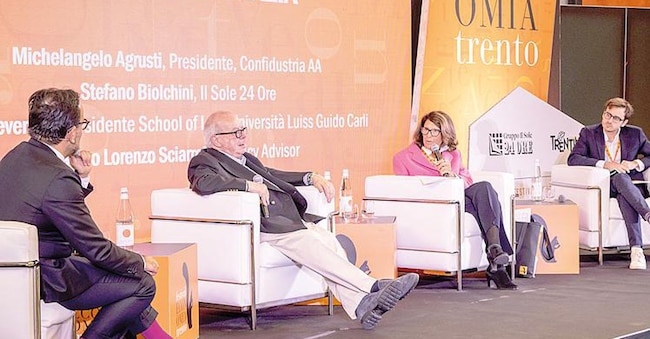
The Palazzo della Regione hosted the 'Books and Democracy' meeting, an important debate focused on the need to promote the conscious participation of citizens in public life and common debate. The event saw a direct confrontation between leading figures from the cultural, industrial, academic and policy advisory worlds, hosting Michelangelo Agrusti, President of Confindustria Alto Adriatico and President of Pordenonelegge, Paola Severino, President of the National School of Administration and President of the School of Law of the Luiss Guido Carli University, and Galileo Policy Advisor Lorenzo Sciarretta.
The relevant round table focused in particular on the participation of aware citizens in public debate and public life. "Democracy is based precisely on the conscious participation of citizens in public life," explained President Agrusti, drawing on his experience at Pordenonelegge, adding how "books help citizens, and this is because they help to form more aware citizens, they allow people to learn about history, politics, philosophy, science and the experiences of other peoples. Through reading, one learns to compare different ideas and develop a critical spirit, an essential element in a democratic society. It is no coincidence that in dictatorial regimes, books are often censored, banned, sometimes burned, because they are considered dangerous to power. Books represent a form of personal freedom, and through reading, everyone can escape from everyday life, discover new worlds, find comfort in difficult times. All the more so today, in the age of social networks and fast information, the value of books remains fundamental: reading requires time, attention, reflection, qualities that are increasingly important to avoid superficiality and manipulation'. Because, is his icastic conclusion in making an appointment for the Festival of authors and freedom (from 8 July in Milan, on the terrace of the Rinascente, a few steps from the Duomo, for the presentation of Pordenonelegge 2026), 'a society that reads is a freer, more critical and more democratic society'.
Professor Severino's speech, on the other hand, focused on two fundamental questions, namely what happens to a democracy when it stops nurturing culture? And what happens to culture when democracy recedes? In this regard, Severino explored 'the indissoluble link between democracy and culture through some of the 20th century's iconic masterpieces'. Following two main threads - the burning of books and reading/writing as acts of resistance - she then focused on the fact that 'whenever culture recedes, democracy loses ground; and vice versa. This is why cultivating reading among young people means educating them in the values of confrontation with the other, in a sense of justice and legality'. Regarding legality, in particular, the former Justice Minister of the Monti government focused on social redemption through books. "This is how it is," explained the president of the School of Law of the Luiss Guido Carli University, "also for those who are inmates in prison: books and artistic activities are not mere pastimes, but tools for personal and social growth. And again, looking at his experience, Severino explains, 'we have realised concretely, that culture, art, the ability to read and act represent an extraordinary spring for reintegration and to give the prisoner another chance in life. We have female prisoners who have rewritten Euripides' Trojan Women and are reciting it. They will do it on 1 December in the presence of the President of the Republic, at the opening of an exhibition on art and justice. They do it in universities, to establish contact with students as well. And speaking of students, stimulating young people to understand that prison is not the other, it is something we need to work on'.
Galileo Lorenzo Sciarretta, on the other hand, emphasises how 'reading is important for democratic stability as a phenomenon closely correlated with the economic and democratic development of a nation. A study some years ago showed that if the southern regions had had the same reading indexes as the northern regions in 1973, their GDP in the middle of the last decade would have been 20 percentage points higher. It is no coincidence that Gianni Rodari wrote: 'I would like everyone to read, not to become literati or poets, but so that no one is a slave any more''.
But, in the background, we cannot forget how much the health of democracies is related to the functioning of institutions or, as they say in technical English, their capacity for 'delivery'.

