
The value of music on stage in Cremona
The 22nd edition of Cremona Musica Expo & Festival, the international event featuring 450 exhibitors from 35 countries

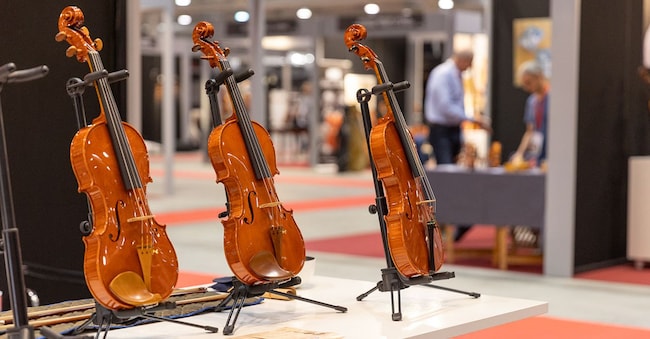
The 22nd edition of Cremona Musica Expo & Festival, the international music festival that brought the exhibition centre and the city’s historic centre to life for three days. There were over 450 exhibitors from 35 countries, 200 events including concerts, masterclasses, conferences and exhibitions, and a well-established presence of international visitors, showing a marked increase compared with previous editions. The art of stringed instrument making, a UNESCO Intangible Cultural Heritage of Humanity, engaged with buyers and enthusiasts from all five continents, whilst also making ample room for new artistic expressions and needs, ranging from synthesisers to remote piano concerts played using Yamaha’s Disklavier technology.
“On the international front,” said Massimo De Bellis, director of CremonaFiere, “the 2026 edition marked a significant leap in quality. Seventy international buyers and trade professionals were welcomed to the fair thanks to the collaboration with ICE-Agenzia, almost double the number compared to 2025. Cremona reaffirms its status as the city that makes Italia a benchmark for the tradition, history and future of music worldwide.”
Also significant was the delegation of distributors, importers, teachers, specialist journalists and qualified buyers from 30 key countries (including Australia, Brazil, Canada, China, South Korea, Japan, India, Indonesia, the United States and Thailand), who demonstrated the resilience of the Italian supply chain and the growth in musical instrument exports, which reached 148.8 million euros in 2025, with a trade surplus of 25.6 million. This situation was clearly illustrated by the Dismamusica 2026 Observatory in its recent report on the musical instrument market in Italia, presented in Rome at the Chamber of Deputies.
The musical instrument market
There are 1,091 musical instrument manufacturers operating in Italia, employing 2,118 people. On the distribution side, there are 744 retailers, employing over 1,500 people. The number of musical instrument repairers is growing, reaching 298 – almost double the 164 recorded in 2015. In 2025, sales in Italia by ‘sell-in’ businesses – manufacturers and wholesalers of musical instruments and sheet music – are estimated at around 230 million euros, down by 1.2 per cent. Exports, on the other hand, are expected to reach 134.6 million, up by 0.9 per cent. ‘Sell-out’ businesses are projected to generate sales of 278.7 million euros, down by 0.8 per cent. E-commerce, however, is growing, reaching €74.4 million – 4 per cent more than in 2024 and accounting for 26.7 per cent of total Sell-Out revenue.
The value of music in Italia
The total value of the market, as analysed by the Dismamusica Observatory, stands at 1.45 billion euros. The main components include €434.9 million from streaming and royalties, €413.5 million from the purchase of musical instruments, sound systems and DJ equipment, €277.2 million from music education and €188.5 million from exports. Added to these are €78.4 million generated by digital and physical music, €32.5 million from printed music and €25.7 million from the hire of instruments and equipment. Streaming continues to grow, reaching 340.6 million euros (+9.6 per cent), whilst royalties totalled 94.3 million (+7.5 per cent). Physical media is also regaining ground, reaching 74.6 million (+21.7%), driven mainly by vinyl, with revenues of 48.6 million. Digital downloads, on the other hand, fell to 3.8 million (-7.3%). Total exports for the sector reached €188.5 million, up 2.6 per cent on 2024.
Artificial intelligence
The use of Artificial Intelligence in the music industry is still limited: 21 per cent of businesses in the Sell-In and Sell-Out sectors report using AI tools in their business operations, primarily to create content for social media and websites (64.6 per cent) and for translations (58.5 per cent). Among consumers, the proportion of users drops to 13.7 per cent. Among those who use AI in music, 64.6 per cent use it to translate content, 53.1 per cent to create social media content and almost half to compose music or evaluate instruments and accessories to buy. It is precisely in this latter area that the first signs of AI’s potential commercial impact are emerging: amongst those who used it to help them choose instruments or accessories and subsequently made a purchase, 41.6 per cent stated that they had followed the recommendations provided by the AI.
In light of the findings of the Dismamusica 2026 Observatory, , Raffaele Volpe , president of DISMA (Distribution, Musical Instrument Industry and Crafts), stated: ‘The issues at hand are well known. As an industry, we are asking the legislator for three things: a financial incentive for the purchase of musical equipment, to support families with children enrolled in music high schools and conservatoires; a reduction in VAT on musical instruments by applying the same regime that applies to books; and the introduction of proper musical instrument courses in Italian schools.”

