
The Venice Biennale celebrates versatile and collaborative intelligence
The 19th International Architecture Exhibition in Venice opens its doors tomorrow 10 May - until November. There are more than 750 participants in the Ratti collective and 300 projects on display

4' min read
Key points
4' min read
We do not need individual genius, but the insight that comes from collaborative projects. Not of rigid solutions, but of flexible ecosystems. Faced with a changing world, architecture must adapt itself, pushing into hitherto unexplored territories. Thus begins the journey of Carlo Ratti, curator of the 19th Venice Architecture Biennale Exhibition, which has opened its doors and will remain open until 23 November. More than 750 are the protagonists of Ratti's collective and 300 are the projects on display.
The exhibition
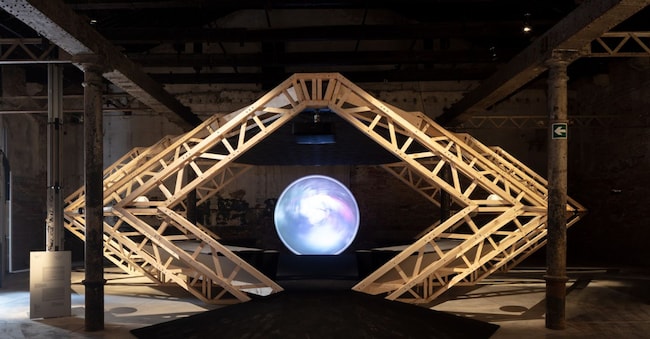
."Intelligens. Natural. Artificial. Collective" is the title of the Architecture Biennale 2025, and after the announcements the exhibition is a reality. A charged, rich exhibition, where art and technology, where matter and materials speak of possible and alternative scenarios. Where connections, immaterial but also infrastructural, are the red thread that binds ideas, people, places. Where Humanoids arrive for the first time, but where man wants to be the focus of the story.
Where climate and war urgently demand new imagery and projects that are in step with the times. "Through building we arrive at living, with intelligence. We have to build the world with intelligence, listening to the intelligence of the world,' said Pietrangelo Buttafuoco, president of the Fondazione la Biennale di Venezia, who emphasised Ratti's commitment - in listening to the murmur, the language, the signs of the world, but also in the ability to question the algorithms that envelop the construction of our living".
A synthesis of scientific and humanistic thinking, of interdisciplinary skills, architecture in Venice tells the trends of the near future. "Architecture is momentum," says Buttafuoco, "it grants space, it produces it, it arranges order and direction". The reference to the Laudato Si encyclical, which celebrates its first 10 years this year, is subtended in a proposal that is all about the collective commitment to taking care of the common home, with urgency in the face of climate crises and the phenomenon of "domicidium" that affects many countries, from Sudan to Ukraine to Gaza.
Suggestions
.The images are strong. Among others, that of a system of air conditioners that heats the first rooms of the Corderie or a system that transforms water from the lagoon into drinking water near the Gaggiandre. There are numerous installations that bring together energy, mobility, materials and water. There is the idea of libraries that in the future will not have to be built, but cultivated, thanks to botanical elements that will be genetically augmented to store the knowledge of architectural forms, which it will be possible to extract and use to counter polluting construction methods. There are images of floating ecosystems along Ecuador's trade routes for which models are being studied to protect the biodiversity and social rights of river communities. Other stories include that of a self-sustaining campus in Rwanda to train new agricultural leaders, embodying One Health principles in a replicable educational model.

Brand connect


Newsletter RealEstate+
La newsletter premium dedicata al mondo del mercato immobiliare con inchieste esclusive, notizie, analisi ed approfondimenti
Abbonati