
The Venice Music Biennale
Highlights of the programme include a performance by the Tallis Scholars in St Mark’s Basilica

He avoids the hustle and bustle of the Art Biennale, with the woman ringing the bell and the queues of spectators waiting to applaud her. And he also steers clear of the glamour of the cinema’s red carpets, because, although he is a celebrated star, Keiji Haino is not the Japanese winner of the Golden Lion at the Music Biennale: when he declares that he prefers the hurdy-gurdy to all other instruments, the students listening to him spellbound in the glittering Sala delle Colonne at Ca’ Giustinian find themselves wondering, somewhat doubtfully, whether ‘hurdy-gurdy’ might be a derivative of ‘ghiro’.
Ennio Morricone and the Tallis Scholars
And so the season curated by Cristina Barbieri – in her second and final year at the Festival – glides by, entertaining but lacklustre; it seems she thought of the title first and the content second, resulting in a rather meagre programme: ‘A child of sound’ – the ‘sound child’ or ‘child-like sound’ featured in the banner headline – boasts Ennio Morricone and the Tallis Scholars as its headliners: icons. Still capable of making an impact. But rather dated, here where we are seeking something new.
‘Musica per una fine’, a piece lasting just under ten minutes, was composed in 1988 by the creator of some of the most original film soundtracks of our time. The score for a four-part mixed choir and orchestra had remained unperformed in the archives of SZ Sugar until last year, despite featuring the gritty quality of Pier Paolo Pasolini’s recorded voice, rediscovered on a tape whilst he was reading one of his own accompanying texts: absolute, incisive, measured, and imbued with boundless bitterness. ‘Intelligence will never carry any weight, never, in the judgement of public opinion,’ reads the opening line, typed on the white margins of the staves. Already presented by ORT in a meticulous performance (available online), it has been chosen by Biennale Musica as the slender fulcrum of an evening at the Teatro Goldoni, paired with two well-known Bach pieces from the ‘St Matthew Passion’ and a Bach/Webern work. All well and good, given the Bachian roots of Psalm XVII, which Morricone has set to music. But it was performed superficially by the musicians of the PCME, the Parco della Musica Contemporanea Ensemble.
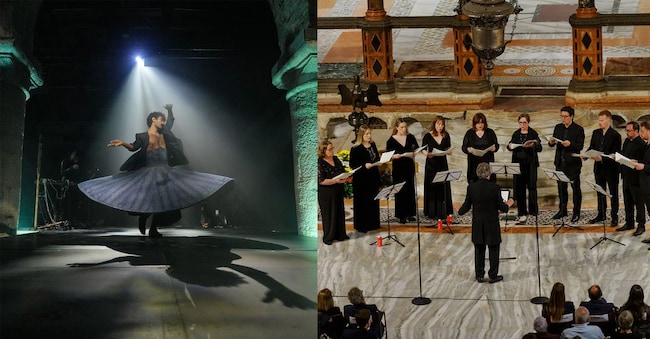
Immaculate clarity, virtuoso precision of intonation and millimetre-perfect adherence to the score are, by contrast, delivered by the Tallis Scholars in St Mark’s Basilica: they are the highlight of this Music Biennale, thanks to the venue, their skill, and a programme woven around a handful of motets composed by the medieval Hildegard and interwoven with the stark, contemporary polyphony of Arvo Pärt. Four angelic female voices blend into a golden unison. One of them, the highest-pitched, leaves no room for nostalgia for the unforgettable Deborah Roberts and soars through Allegri’s ‘Miserere’. The group is arranged in a quintet formation, but only here: Monteverdi was more daring in his day. The acoustics respond marvellously, thanks to the skill of Peter Philips: founder of the ensemble and one of the pioneers of the Renaissance revival in Oxford in the early 1970s; seen up close, he is exemplary in the simplicity of his gestures. The ensemble’s performance is a harmony of glances, of practice, of voices that are always listening. In Venice, it is a triumph.
It is but a short step from the gold of Byzantium to the patch of clear sky in the cloister of the Convertite – one need only cross the Giudecca Canal. Yet the emotional distance could not be more vast. In the courtyard of the Venetian women’s prison, which has been under the leadership of its new director, Maurizia Campobasso, for a year, a number of the inmates emerge; they have spent six months taking part in a musical programme with five young people selected from the Biennale College. Three hours on a Sunday afternoon, amid heavy silences, poems and new songs, hands and glances from above, through the bars. Even the most jaded hearts tremble. Whilst the rest of the Biennale is ‘ambient’ art that remains on the surface: Alif Hilal with fragments of vocal experiments, the repetitive Marta De Pascalis, Francesco Messina and minimalist album covers. Sarah Davachi’s 75-minute organ piece – winner of the Silver Lion – is not to be repeated, with its endless ‘clusters’ of unpleasant timbre and fixed harmonies lacking any structure. A dozing audience at the Teatro Piccolo Arsenale, and barely a minute’s applause. At the end of the month, we await the name of the new director of the Music section: rumour has it he’ll be sent from heaven. Fingers crossed.

