Games

Video gaming used to be the most resilient industry in the world: then someone pressed pause

In the book 'Tasto Pausa', author Luca Tremolada recounts the metamorphosis of one of the most creative markets on the planet, which now has to find the strength and courage to move up a level.

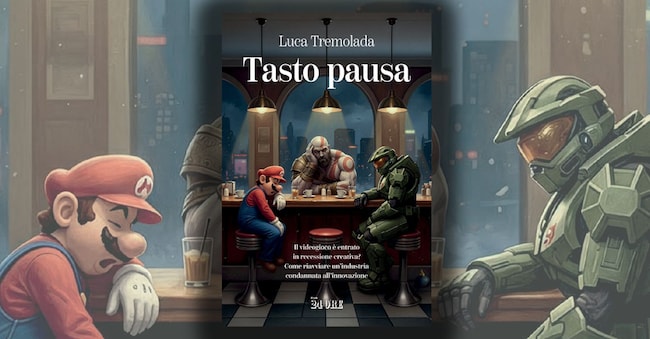
by Luca Tremolada

Il libro “Tasto Pausa” di Luca Tremolada

5' min read

Translated by AI
Versione italiana

5' min read

Translated by AI
Versione italiana

We publish an excerpt from the introduction of the book 'Tasto Pausa' (Sole 24 Ore) on newsstands for a month with Il Sole 24 Ore from Tuesday 16 December and in bookshops from 23 January.

Consider a video gamer: not a very young one, but not from the Pong era either. Not a youtuber who plays live video games for a living. But not even a pro player who makes a living playing games, i.e. a professional who perhaps has a sponsor, trains and participates in e-sports tournaments for a living. Consider, in short, a 'structured' one who has a job, who gets up every morning, goes shopping and pays the bills. A normal person, in short, who listens to music, reads books, sometimes plays sports, occasionally goes out in the evening and occasionally plays video games. Occasionally, because he doesn't have all the time. Here, consider those who, in spite of everything, lose a bit of their day to games when they can. And he's not the least bit ashamed to admit it. Even in front of strangers. If you recognise yourself in the description, know that you are not alone.

Loading...

From Generation X onwards, video games have entered by force into the media diet of those who live in that part of the bourgeois world where there is the internet, supplements and food diets. Those who are over forty grew up with the Atari VCS and the VIC-20, they played Pac-Man for the first time in the bar next door, when there was still no ban on smoking in public places. In the living room at home, he placed his PlayStation under the television set. On his desk he plugged a joystick into his PC. And when smartphones arrived, he continued to play with apps.

In return, as a sign of gratitude for the trust granted, digital games, in less than sixty years, have spread everywhere: in the latest generation TV sets, mobile phones, virtual reality helmets, work notebooks, tablets and inside every screen we have at home. They are a piece of our collective imagination, they have influenced cinema and TV, contaminated media arts, and finally turned into language. Those who practice them know this, they are a second language, a social code, something we sometimes feel the need for.

To video games we owe many of the innovations that have become part of our lives: such as the development of touch displays, the ones we have on our smartphones, three-dimensional graphics in cinema and the success of the GPU (Graphics Processing Unit), which is what made artificial intelligence the planetary revolution it is today.

Video games are then a nine-figure economy. Fifteen years ago, the gaming industry overtook cinema and TV, overtook Hollywood and book publishing in terms of revenue. Today, after the Covid-19 boom that forced half the world to go home, the gaming business has reached 179.7 billion dollars in revenues (against 41 billion for the cinema) and is poised to cross the psychological threshold of 300 billion dollars already next year. The US spends this amount on guns. Three hundred billion is what the fast food industry and the global smartphone market are worth.

They are worth so much because they offer hourly entertainment at bargain prices. Compared to other products, such as the book you are reading, or live events, or streaming TV, video game entertainment wins out in terms of cost-benefit.

In this last decade where everything has happened, electronic toys have become an economic indicator of well-being and, at the same time, a measure of inequality. They have survived international tensions, wars, inflation, the energy crisis, the demographic crisis and the semiconductor crisis. They have never stopped growing and spreading. They have anticipated and partly governed every new technological paradigm. And even today, from minute one, they have become the natural training ground for generative artificial intelligence, the greatest transformative technology of this century. They are as resistant as cockroaches. No amount of atomic radiation can keep them down. Nothing can kill them. At least, that is what we have always thought.

The trade wars triggered by Donald Trump, the subsequent end of globalisation, the wars in Ukraine and Gaza, and the new world order are not helping any trade economy. But something deeper has happened since the pandemic years. The video game seems to have, all of a sudden, run out of life. Video game biodiversity has never been so endangered. The US big tech giants like Amazon, Google and Apple and the Japanese-Chinese giants like Tencent and Nintendo started to play a confusing game. An unprecedented consolidation phase has begun. Mergers, acquisitions and waves of redundancies. New types of interactive experiences are emerging with new and innovative business models. Video games are not what they used to be. From nowhere, after having been a driving force for progress, they have become the most fragile and innovative thing in the entertainment industry.

The thesis of this book is that someone or something is pushing towards the normalisation of a sector that, for years, has been creative and innovative like few in the world. In order to discover 'the' or 'the culprits', it will be necessary to put in order the notes accumulated over years of video game chronicling, to give a name to things, to study again who the protagonists are, who puts up the money and who the ideas. Analysing the stories of those who know how to combine different ingredients, mix substances, generate triggers capable of keeping many gamers glued. As for the economy of digital platforms, the video game must be analysed in a broader context that is not only technological. To measure the fundamentals of this new ecosystem, we need new tools, new data, new indicators. We need the journalist's belly, some rudiments of economics and the right anxiety for the new generations.

This book was created to tell economists about the economics of electronic games, to study the impacts of artificial intelligence, but also to reassure parents who have gamer children. Spoiler: have no fear, it could have been worse.

P.S. In the book on video games, there is a kind of mini-game. Nothing too articulate. After the peak of growth between 2020 and 2021, boosted by lockdowns, the global market has shown signs of slowing down. You have to find out who or what has pressed the pause button on this extraordinary creative economy that is now 53 years old and, despite the many innovations it has introduced, now more than ever risks becoming a market like any other. Imagine them as video game bosses, monsters to be defeated. Help us understand what it takes for this industry to move up a level. You don't win anything, but you learn a lot. Like in real video games.

Copyright reserved ©
  • Luca Tremolada

    Luca TremoladaGiornalista

    Luogo: Milano via Monte Rosa 91

    Lingue parlate: Inglese, Francese

    Argomenti: Tecnologia, scienza, finanza, startup, dati

    Premi: Premio Gabriele Lanfredini sull’informazione; Premio giornalistico State Street, categoria "Innovation"; DStars 2019, categoria journalism

Loading...

Brand connect

Loading...

Newsletter

Notizie e approfondimenti sugli avvenimenti politici, economici e finanziari.

Iscriviti