
The voice that will keep you nailed to your chair
The film built on the real voice of a Palestinian girl asking to be rescued from the Israeli army was the most divisive film in Venice. For some it is blackmailing, instead, it does what art should do: it shocks

4' min read
4' min read
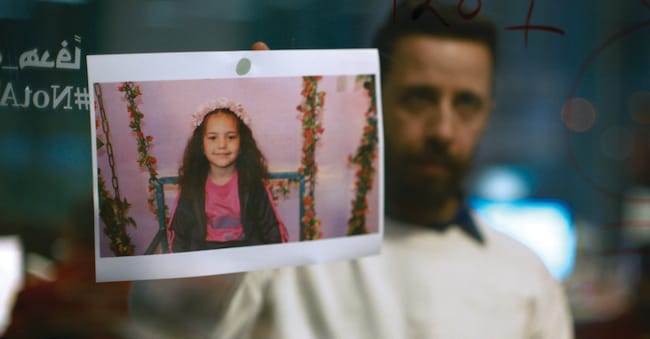
Supporting the strength of The Voice of Hind Rajab does not mean forgetting the 1,200 victims and 250 people kidnapped in the insane Hamas massacre on 7 October. A film should be made about each of those unjust deaths, the prisoners, the raped women. Kaouther Ben Hania's film is built on the true voice, recorded by the Red Crescent, of a six-year-old Palestinian girl, Hind Rajab, pleading with rescuers to save her from an Israeli army attack. It is 29 January 2024, Hind is in the car with her uncles and cousins as they try to flee Gaza. The car is hit and she is the only survivor. An uncle from Germany puts her in touch with the rescuers.
The Voice of Hind Rajab is a 'technically' simple film, by the director's own admission. Shot and edited in one year, it is set in an open space where the operational heart of the Red Crescent is reconstructed. A few documentary scenes are added at the end. It is mainly made up of close-ups to get at the emotionality of the rescuers: the team leader (Saja Kilani), the operator who first received the call (Motaz Malhees), the coordinator (Amer Hlehel) and a psychologist (Clara Khoury). To write the script, the director heard each of the real operators and, at times, superimposed the actors' voices over the real ones. Radically real, however, are the 70 minutes of Hind's voice. In all, the film lasts 90 minutes that keep the viewer nailed to the seat, despite the didactic moments, such as those explaining the Kafkaesque protocol the rescuers have to undergo to reach the car that is eight minutes away from the nearest ambulance as the crow flies. "This is what the occupation is all about," the director pointed out. "Having impossible rules, which, even if followed, do not lead to any results. The Voice of Hind Rajab is a film as tense as a spy story and the funny and tragic thing is that the viewer hopes for a happy ending even though he already knows how it ends. It asks cinema, that is, to perform a miracle, changing history, bringing it out of that sleepy, entertainment role to which films sometimes condemn themselves. He attributes to it the noblest of art's functions, that of saving people.
Many at the Venice Film Festival, where it was screened in competition, turned up their noses, saying that The Voice of Hind Rajab is not cinema. It may not be the masterpiece of the century, but not even Nomadland, Golden Lion in 2020, changed history. Was All the Beauty and the Pain, Laura Poitras' documentary on Nan Goldin and the opioid epidemic in the US, cinema-cinema? It rightly won the Golden Lion and no one made controversy. Ben Hania's film is one of those films that shocks and interrogates, that is, it does what art should do. The jury wanted for this compelling film, distributed by I Wonder Pictures, the second place, the Silver Lion Grand Jury Prize. The Festival, which has a duty to shake up and shake up, by putting it in competition proved that it lived up to its name. Not so Alexander Payne's jury and, perhaps, if true, neither did the Cannes Film Festival which rejected it: the director did not confirm, but neither did she deny the exclusion. It has also been said that The Voice of Hind Rajab is a blackmailing film, but blackmail is triggered when the viewer is forced to 'suffer' a feeling that might affect him. Fortunately, none of us are in the condition, and I hope we never will be, of the little Palestinian girl. Many said they would have expected to cry and, instead, this did not happen. The film is, in fact, liberating: it gives the opportunity to contribute to the perpetuation of the memory of an innocent, as Hind's mother wished, by authorising the use of the recording. The vision, the word-of-mouth to help the film contributes to giving voice to the impotence of thousands of citizens who demand to stop the genocide, like those who took to the streets last Monday.
The director herself is aware that cinema cannot stop war, but can stem its dehumanisation. Kaouther ben Hania, Moroccan, 48 years old, studied cinema in Tunis, then graduated from the Sorbonne. She uses documentary as a weapon of fiction and vice versa: her first film, Le Challat de Tunis, is a fake documentary satirizing the condition of women in Tunisia. L'uomo che vendette la sua pelle (The Man Who Sold His Skin) of 2020, starring Monica Bellucci, was about a Syrian man who, in order to obtain expatriation documents, agrees to tattoo a Schengen visa on his skin and be exhibited as a work of contemporary art in a museum. It was the first Tunisian film to be nominated for an Oscar for Best International Film. Tunisia has already announced that Hind's story will also compete for the statuettes and hopefully well, since Pitt, Phoenix, Cuarón, Mara and Glazer are executive producers and supporters. Give it a go at the box office, even to distance yourself from it. Finally, cinema is back in the news.


