
Supply chain: the warehouse as a strategic hub in logistics – the Modulblok experience
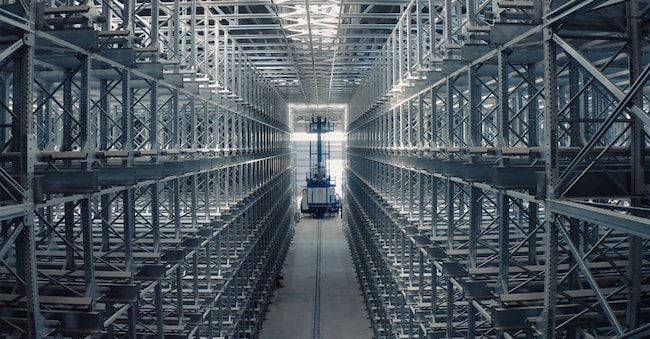
A paradigm shift is underway in industrial logistics, and it concerns the very role of the warehouse. No longer a passive terminal in the supply chain, but an active hub that manages the flow of goods, people, data and operational continuity. This is the premise upon which companies such as Modulblok have built their operational model: the warehouse not merely as infrastructure, but as a complex engineering system, requiring integrated design, specialist expertise and the ability to evolve over time.
The driving force behind innovation
An innovation-led approach that has now become a true model to follow, as demonstrated by data from the Politecnico Contract Logistics “Gino Marchet” Observatory at the School of Management of the Politecnico di Milano regarding the adoption of AI-driven solutions aimed at optimising space, movements and stock. To date, over half of companies commissioning logistics services (53%) are involved in AI projects. In particular, almost a third of commissioning companies (30%) apply this technology to logistics processes. Looking ahead, the adoption rate of AI in the sector is set to rise to 44 per cent over the next three years. The activities most affected by this revolution are, above all, order management (14 per cent), demand forecasting and material reordering (14 per cent).
Beyond just-in-time: resilience as the new logistics paradigm
For years, just-in-time dominated logistics: zero stock, on-time deliveries, maximum linear efficiency. The 2020 pandemic shattered this model when Asian factories ground to a halt and containers were left stranded in ports. This led to a structural rethink, with the warehouse taking on a new strategic role, called upon to respond more efficiently and flexibly to potential peaks in demand, shorter product lifecycles and increasing regulatory standards. Modulblok anticipated this trajectory before it became the market standard. Founded in the North-East as a specialist shelving manufacturer, the company has progressively transformed its model to become a technical-industrial partner capable of integrating structure, automation and regulatory compliance into a single design solution. Almost fifty years of history that reflect, step by step, the transformations of the sector: from the static, manual warehouses of the 1970s and 1980s, through the growing complexity of the 2000s, to the current model of the intelligent, interconnected supply chain node.
A four-pronged strategy for growth
Modulblok’s “engineering-driven” approach is the result of a structured growth strategy, which in recent years has been consolidated along four specific lines. On an industrial and technological level, the company has invested in new production capacity and plant automation, with the aim of ensuring quality and scalability for the most complex orders (now over 4,000 a year, with more than 18,000 installations worldwide and 340,000 active product codes, across 25,000 m² of production and operational space). On the corporate front, however, the integration with Logaut — specialising in modular automated solutions and software such as high-density satellite systems, multi-depth systems and stacker cranes — has made it possible to design truly scalable systems, where physical structure and automation interact right from the design phase. The third pillar of development underpins the organisational plan: the company has in fact strengthened its in-house engineering expertise, with a team of 140 staff capable of managing the growing complexity of intralogistics systems, from structural variables (loads, seismic constraints) to operational ones (demand peaks, regulations). The entry of the Equinox III fund, with the acquisition of 60% of the capital, has supported this process with more structured governance and a long-term vision for managerial growth. Finally, in terms of sustainability, Modulblok has adopted a measurable and progressive approach: certifications, organisational carbon footprint for 2023–2024, ESG assessment of the supply chain, expansion of photovoltaic capacity to approximately 900 MWh/year (approximately 60% of electricity requirements) and measures to reduce energy-intensive consumption in the paint shop thanks to new high-efficiency robotic booths. A set of initiatives that not only responds to reputational considerations but is also integrated into the company’s value proposition: designing warehouses that are efficient, safe and sustainable over time.
International growth and a systemic vision
In terms of markets, overseas operations account for around 20% of turnover, with a predominantly European presence that is growing steadily. This figure reflects the strength of the domestic base and the complexity of the international market, which is increasingly influenced by geopolitical dynamics. Modulblok’s trajectory follows two complementary paths: the technological evolution of the product and the organisational growth of people and processes. An ambition consistent with the philosophy that guides the company: the warehouse is no longer just infrastructure. It is an engineering system that governs the flow of goods, people, data and operational continuity. And those who design it must be able to conceive of it as such, as demonstrated by the examples of NaturaSì, Italia’s leading distributor and retailer of organic and biodynamic products, and Danieli Officine Meccaniche, a world leader in the construction of steelworks. Different needs, tailor-made solutions. In the case of NaturaSì, with over 65,000 items to manage across dry, fresh and temperature-controlled products, the company required a warehouse capable of integrating different flows, ensuring direct accessibility and controlled environmental conditions. Modulblok optimised the internal space within a 14,000 m² area with a clear height of 10 metres, creating a seismic-resistant structure compliant with regulations and safety standards. The project also involved ongoing consultancy, extended to include support and maintenance, to ensure operational continuity and scalability over time.
For Danieli Officine Meccaniche, however, the challenge was not one of quantity but of the quality of the flow: managing approximately 4,700 steel coils, each weighing 3 tonnes, at a rate of 60 coils per hour for 48 consecutive hours, within a space of 6,150 m² and 14 m in height. Modulblok developed an automated warehouse with stacker cranes and multi-depth satellite shuttles, introducing an original technical solution that ensured precision of movement and dynamic stability without increasing structural costs: maximum storage density, full operational continuity and high safety in one of the most critical industrial environments.
www.modulblok.com.

