
The Western entrepreneur who had never set foot in a factory and ended up on Wall Street

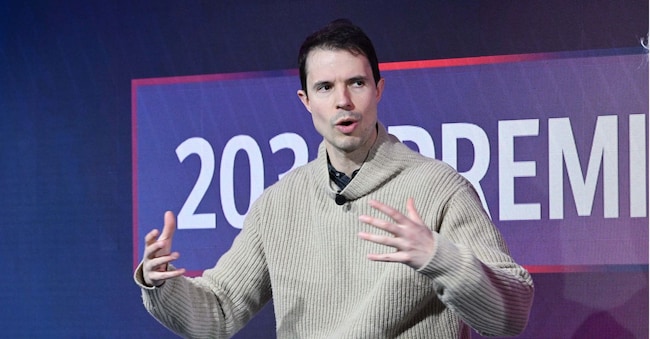
‘We lived in Settimo, a hamlet of Pescantina. It had a population of 900 and was situated near Valpolicella, in the province of Verona, not far from the Amarone region. Two of the most common occupations in Pescantina were farming and lorry driving. My mum, Cinzia, and my dad, Roberto, ran a ladies’ hairdressing salon. She was the only one in the family to have a school-leaving certificate. I don’t think anyone in the family had ever gone beyond Year 5 or Year 9 before. She loved maths. When I was six, on holiday on the beach at Bibione, she taught me how to solve equations.”
Luca Ferrari is the founder of Bending Spoons, the software, platform, app and digital services company that was listed on the Nasdaq on 1 July, with a market capitalisation that reached 25 billion dollars. Three days ago, Warren Buffett’s Berkshire Hathaway fund bought further shares, increasing its stake to 4 per cent of the share capital. Bending Spoons is a huge magnet: ‘In 2025, we received 800,000 applications. We selected 300 people. Today, our core team consists of 3,000 specialists, mainly based in Italia, the United Kingdom and the United States,” says Ferrari.
It’s lunchtime. We’re in a meeting room where the table is laden with sandwiches and salads, mineral water and fruit juices, fruit and cakes. We’re in Milan, between Corso Como and Porta Garibaldi railway station. Luca, aged 41, is married to Cristina, a chemist who now works in the perfumes and cosmetics division at Dolce & Gabbana. Celeste joined their family a year ago. ‘Look how lovely she is,’ he says, showing me a photo on his mobile, his eyes brimming with the boundless tenderness of any father overwhelmed by the birth of a daughter.
Luca Ferrari’s story is remarkable for two reasons. The first is the relationship between reality and representation. The second concerns the enigma of the entrepreneur. *Bending Spoons* shatters the sick and artificial spell cast by a portrayal of Italian high-tech that is at odds with reality. In Italia, the latest generation of high-tech generates industrial quantities of hot air at conferences and appearances by unlikely start-up founders (often going through andropause) in newspapers, on TV and on social media. The reality, however, consists of meagre balance sheets, real money that has never been earned, and underlying techno-industrial structures that are inversely proportional to media and advertising budgets. The reality and the image of Bending Spoons, however, are one and the same. The second reason concerns the issue of the entrepreneur. In an Italia characterised by the transformation of the children and grandchildren of industrialists into managers (at best) of money made by others (grandparents, fathers, uncles), Ferrari built a complex company from scratch, positioned at the cutting edge of technology and operating on a substantial financial scale: something which, in this context, is lacking in Italia and is not even common in Europe.
Luca starts eating his salmon and vegetables. I, on the other hand, tuck into my cheeseburger, which is still warm. Ferrari appears out of nowhere and recounts it with the composure of someone with a hyper-scientific background and the serenity of someone who, as is often the case in the hard-working and pragmatic North-East, embraces culture without any trace of narcissism. He reads a great deal (‘about fifty books a year’), but he does not flaunt either his technical and quantitative background or his reading of non-fiction and literature. He does not impose his working-class origins on others. He is devoid of the mellifluous arrogance of those who, as a prerequisite for their ability to create jobs and accumulate wealth, feel the need to construct a gallery of supposed ancestors within Italian humanistic civilisation and of great masters of philosophical thought. Ferrari is a straightforward and uncomplicated exponent of Italian and European technical and scientific culture: he holds a three-year degree in information engineering from Padua, followed by a specialisation in electronic engineering, first at Padua and then at the Technical University of Denmark.


