
The women who made archaeology and photography
At the American Academy an exhibition with photos taken in the early 1900s by scholars who immortalised ancient buildings and the society of those times

3' min read
3' min read
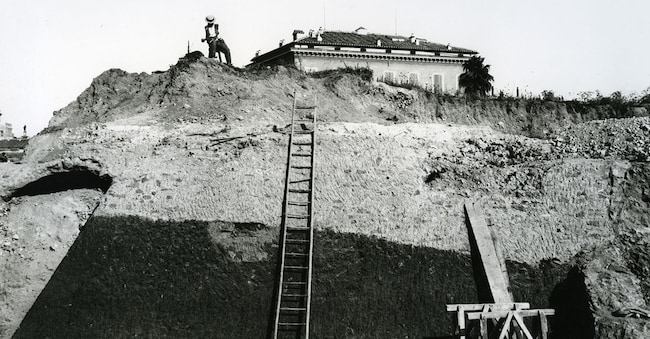
Gaze and consciousness, detail and elegance. The photograph, dated 1914, that Esther B. Van Deman took at the Little Theatre of Pompeii to immortalise the opus reticulatum best represents the photographic exhibition Women and Ruins: Archaeology, Photography, and Landscape, currently being held at the American Academy in Rome. That image, a vintage print, preserved in the Academy itself, testifies to the courage and acumen of some women who, at the beginning of the 20th century, arrive in Italy, are thunderstruck by the ruins and become chroniclers and scholars. They realise they are in the right place at the right time to write history. Van Deman portrays the construction technique with a perfect, geometric photo, almost an abstract painting, and demonstrates her consciousness as an archaeologist by lowering with elegant softness - only a woman could choose this way - a metre to understand the dimensions of the work: the glance, the detail become science.
Alongside Esther Van Deman, the exhibition passionately reconstructs the journeys and research of Marion Elizabeth Blake (1892-1961), sisters Agnes (1856-1940) and Dora (1864-1948) Bulwer, Gertrude Bell (1868-1926) and Maria Pasolini Ponti (1856-1938). They are American, British and Italian, they are three scholars at the Academy in Rome, the famous explorer Bell and the historian Pasolini Ponti, above all "they are modern women who travel through Italy, who know how to overcome prejudices in the name of archaeology and realise that they are witnessing a radical transformation of Italy", explains Lexi Eberspacher, one of the curators and Programs Associate for the Arts at the Academy. Rome became the capital in 1871, the city was a building site and the eyes of the travelling scholars are now our eyes. They arrive in Rome attracted by the antiquity and the international atmosphere of the city, which saw the birth of many international institutions in the second half of the 19th century. Thus, the protagonists of the exhibition, with the exception of Gertrud Bell who only stayed in Rome in 1910, spent long periods in the city and stopped the rethinking in progress with their cameras. Dora and Agnes Bulwer, who frequented the director of the British School, Thomas Ashby, and the archaeologist Rodolfo Lanciani, chose the Plutei Traiani in the Roman Forum or the remains of the Tomb of the Claudii in Piazza Venezia, Esther Van Deman the statue of a Vestal in the Atrium Vestae or a section of the Servian Walls. They are - and this is also one of the chapters of the exhibition - "talking ruins", as Piranesi had already defined them: they speak of a luminous past that must be documented before it disappears. And so Gertrude Bell shows her interest by portraying capitals and columns in the foreground as if they were faces seeking dialogue after two thousand years. Marion Blake, who travels with Van Deman and also records site visits in their notebooks, is in the ancient city of Peltuinum, along the Via Claudia Nova, north of Rome, and documents the construction in opus reticulatum of the theatre steps or Monte Velino from Alba Fucens (Massa d'Albe) as if it were a ruin-monument.
Women immortalise and are immortalised, this too is an awareness of their role: "In many photos," argues Caroline Goodson, curator and Andrew W. Mellon Humanities Professor, "solitary female figures appear immersed in the ruins, they are fused with the landscape and seem to tell history that they are history's landscape. It is an exhibition of great awareness, including that of having respect for the men and women who are portrayed among the columns and temples: the female archaeologists belonged to a social and intellectual elite that had little to do with the poor people, the peasants. Yet these female eyes have a human approach: the Bulwer sisters photograph thatched huts, near Gabii, and the camera is a discreet way of entering these worlds.
Again large spaces and buildings in the section "The Shape of a Wall": Esther Van Deman studies construction techniques, perhaps with a manual in mind. There is a wall of the Temple of Fortune in Palestrina and the Aurelian Walls: archaeology enters our eyes to make itself contemporary and eternalise the courage of these women who gave strength to each other. Cameras evolve - those on display are two jewels -, and technological possibilities increase, but what makes the difference is the heart of the women and their ability to wonder because, as Gertrud Bell wrote to Van Deman "this is a dream of beauty".
Women and Ruins: Archaeology, Photography, and Landscape.


