
The world? Risks water bankruptcy
This is the alarm raised by the report of the Swiss management company Swisscanto. The German case and the Italian virtues

Key points
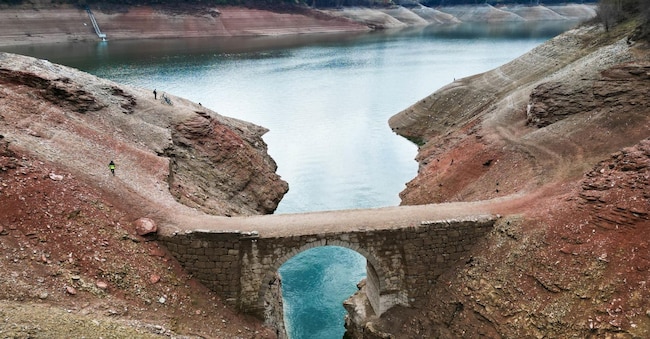
Global freshwater reserves 'are structurally under pressure', more water is 'withdrawn from rivers, lakes and aquifers than can be replenished through rainfall and snowmelt'. In short, the world is entering an era of true 'water bankruptcy'. This is the picture taken by the management company Swisscanto on the occasion of World Water Day (22 March): the report by Holger Frey, lead portfolio manager for Zkb-Swisscanto's Sustainable Water strategy, is not the most reassuring.
The United Nations warning
They cite the United Nations, which had long since issued a warning to the public. They point out that half of the world's major lakes have lost water since 1990. Globally, glaciers have shrunk by almost a third since 1970. About 75 per cent of the world's population lives in countries with unsafe water supplies. According to these predictions, global water resources are at risk of going into deficit.
"In our opinion," Swisscanto points out, "there are indeed solutions that can be mobilised to counter water scarcity.
The case of Germany: an entire Lake Constance has evaporated
The surprise concerns Germany: contrary to what one might think, it is among the countries with the largest groundwater losses globally. In this regard, the environmental organisation Naturschutzbund Deutschland (Nabu) and the consulting firm Boston Consulting Group (Bcg) completed a study on Germany published in early 2026.
According to this study, as reported by Swisscanto, 'every drop counts'. Germany's natural water resources have in fact 'already diminished by some 60 billion cubic metres over the past two decades, a volume equal to that of Lake Constance. Paradoxically, the greatest danger lurks in the smallest details. The weakening of local water cycles, due to rare or extreme precipitation, depleted soils and surface runoff, is considered particularly critical'. According to the study, 'these cycles are critical to keeping landscapes cool, wet and in balance'.

