The interview

The Zen Circus: the society of the show is 'Evil'

The Pisan band returns with an album that is a child of the historical moment. Inspired by counterculture magazines but also by Guy Debord: 'Beyond there is only the right to oblivion'

by Francesco Prisco

The Zen Circus tornano con l’album «Il Male»

7' min read

7' min read

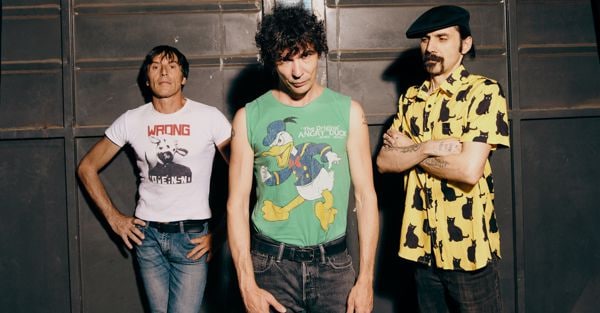
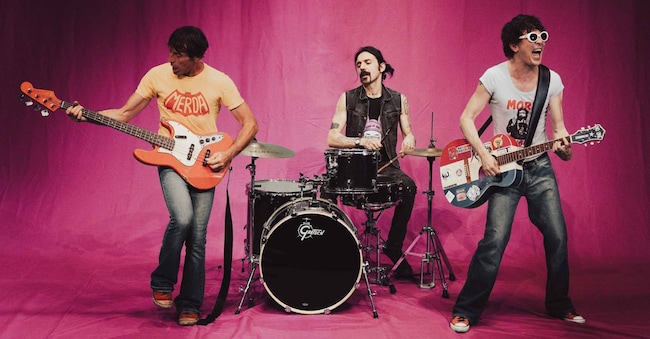
It may be that there is plenty of 'material' available at this particular moment in history: Trump returning to the White House nastier than in previous episodes, red carpets rolled out under Putin's amphibians, the Gaza massacre and the fear and desire to use the term genocide. It may be that everyone turns the other way and then, in good conscience, you feel it is time to call a spade a spade. Maybe it is because when everyone knows they are right, people like them just can't help being on the wrong side. It must be for this and much more that on Friday 26 September The Zen Circus return with an album with a simple but anything but banal title: Il Male. Eleven songs that, taken together, represent a return to the rock roughness of their origins, a manifesto of constructive pessimism and the most political album by the Pisan band, at least since Andate tutti affanculo. A debordante (in the sense of sound) and debordiano (in the sense of Guy Debord) record. With only a handful of days to go before its release, we listened to a preview and discussed it with those directly involved. Namely Andrea Appino, Massimiliano "Ufo" Schiavelli and Karim Qqru.

"Evil" has "always been our best talent", Andrea sings in the title track that opens this deeply pessimistic album, undoubtedly a child of the historical moment. Can it be said or not that it is a political album?
Andrea: 'To exist is political. From this point of view it can be. We start from a perspective that is not necessarily pessimistic. We are convinced that evil is the great collective repressed of this era, removed from the artistic, intellectual narrative. The fact that it has been obliterated, from our point of view, has contributed to the creation of real Evil. We try to do a somewhat simple job: we watercolour the real while trying not to sweeten it. We are those of Live you die, which you can read as a statement (Live you die) but also as an exhortation (Live, you die). With great disenchantment we sing Evil, but perhaps only to return to enchantment'.

Loading...

Esistere è politica. Da questo punto di vista, «Il Male» può essere considerato un disco politico. Proviamo a fare un lavoro semplice: acquerelliamo il reale cercando di non edulcorarlo

Andrea Appino (The Zen Circus)

Ufo: "Then let's say it's politics! The truth is that there are many evils. In the record we also tried to sing evil as the absence of evil, which is the speciality of this era'.

Karim: 'An era in which the ice is breaking under our feet. In 1945 we were resting on a pretty thick layer. For about eighty years things seemed to be going well, despite a few episodes like the financial crash of 2008. Then there was Covid and, after Covid, we certainly didn't come out any better. Now we find ourselves in an era of post-truth, and the record tries to tell the tale'.

Ufo: "I mean: you must have realised that, as a band, we think a lot..."
La copertina de «Il Male», nuovo album di The Zen Circus

Evil is definitely an album in which Zen Circus' old rock soul prevails over their songwriting soul. On a stylistic level, what kind of reasoning is behind it?
Andrea: "The only thing we said to each other before working on it was: why don't we make a record the old-fashioned way, sit in the rehearsal room for two years and then record? And so we did. A practice that should be the norm, then years happen when you make more produced records.... This time we felt it was right for everything to be as simplified as possible: the three of us in the recording studio I have here at home, in Livorno, and that's it. A played record, without intoning anything'.

Karim: 'If you like, it was a bit of a reaction to our immediately previous albums. The way of making music has changed over the years, and even our last few works started from something different from the concept of three people locked in a small room, as it used to be. A concept that in Male we wanted to recover.

Ufo: 'Because we are a band. We wanted to make it more obvious. And so our live soul came out'.

You say Il Male and you think of the legendary alternative magazine founded in 1978 by Pino Zac and Vincino. You open the vinyl and find there an illustration by Enzo Sferra, who was an author. What did that adventurous season in the history of Italian publishing represent for you?
Andrea: "On an anagraphic level we are a bit younger than the protagonists of that era, but we breathed that air there: we grew up at the Macchia Nera social centre, I remember the Stampa Alternativa Mille Lire books when I entered the homes of those older than me..."

Ufo: 'I learned to read with Linus. I remember Frigidaire, Cuore, Comix... very well. It went that ex post, after the record was finished, we asked ourselves: what do we Zen Circus do? Politics? Culture? Counter-culture? Satire? Do we make people laugh? Do we piss people off? Then let us take as a point of reference someone who did all these things at once. And did them very well: Evil, meaning the magazine, that was.

Karim: 'Al Male were the first in the history of Italian publishing to bring together the sacred and the profane, with a certain taste for paradox. Just as, in their own small way, Zen try to do'.

In It's only a moment the theme of existential balance returns. And a concept that is dear to you returns: 'You are your mother, you are your father: there is no escape'. Almost as if there were a destiny, above our heads, from which we cannot free ourselves. "It is only a moment". But exactly how long does this moment last?
Andrea: 'That is a song dedicated to those who at least once in their lives have had to say to themselves "It's only a moment". Like all our things, it sounds defeatist, but it is also a warning to be able to embrace ourselves, realise what is happening to us and react. It is not necessarily the existential assessment of a 47-year-old person, but an invitation to take care of oneself'.

Karim: 'On It's only a moment I can say that rarely has one of our pieces had such a strong empathetic reaction from the audience. It must be that we had been stationary for a few years'.

Ufo: 'Or it will be that those who listen to us have said that thing to themselves.

The Zen Circus, fuori "Miao", il nuovo singolo (e video)

"I dreamt this song, like McCartney Yesterday," reads the lyrics of Better Than Nothing. Did it really happen like that?
Andrea: 'I confirm. And precisely I dreamt that we were playing it in a TV studio. Then my cat woke me up, I was falling out of bed but I managed in time to grab the guitar and throw it down. The funny thing was that we were playing it for the first time right in a TV studio. I had dreamt of music several times but, before this one, I had never been able to stare at it. Then, being a Zen piece, we put some self-mockery into it: compared to Yesterday "of course it's not the same thing but the subconscious doesn't lie, it's no fun knowing that everything is gone forever".

You basically dreamt up a song about the need to come to terms with one's dreams...
Andrea: 'Actually yes... very interesting perspective.

Novecento and Vecchie troie instead express the point of view of Generation X, your generation. Does pride or shame prevail?  
Andrea: "Well... I would say shame (laughs, ed.). In the two songs, the generational connotation is both there and not there. We have a diverse audience, in many cases younger. We ourselves are an intergenerational group: between Ufo and Karim, ten years pass between us. There is a bit of us in the pieces, but it's not just us.

Ufo: 'The two songs carry a claim that is full of frustration. An unpleasant idea that people of my generation have is for example to see the 20th century return'.

La nostra è la prima generazione che ha trasformato in business la nostalgia. Questa cosa si vede persino scorrendo i video di TikTok. Il paradosso sta nel fatto che siamo finiti ad aver nostalgia di un periodo in cui, alla fine, neanche stavamo bene

Karim Qqru (The Zen Circus)

Karim: 'Consider that ours was the first generation that codified and turned nostalgia into a business. You can see this overbearingly in the videos of TikTok, the social network that has been moving the most money lately. And it is feeding precisely on nostalgia. The paradox lies in the fact that we Generation X are now nostalgic for a time when, in the end, we weren't even well off.

The Zen Circus: da sinistra Ufo, Andrea Appino e Karim Qqru (photo by Ilaria Magliocchetti Lombi)

And then there is Viral: 'At the parade the celebrities/ celebrate exclusivity together/ but the explosive is much more inclusive/ and will make them shine in the sky'. Is this more a condemnation of the society of show business or of society in general?
Andrea: "It's nice that you pick up on the reference to Guy Debord who was a staple in the writing of this song.

Karim: 'But Debord killed himself'.

Andrea: 'And I don't, tié. It is clear that in our pieces we are not always the ones to speak. As in De André's Bombarolo, another reference in the song, we sometimes feel the need to make this Evil speak. Which can be envious, resentful and animated by deep hatred towards a certain kind of post-truth'.

Karim: 'Really strange, when you think about it, the story of Viral. It wasn't even supposed to be on the record, yet it ended up being the track that represents the record the most, perhaps because it better represents what we are going through'.

Ufo: 'Because it is a song that subtends a revolt'.

«Virale» è un brano che sottende una rivolta. Nella società dello spettacolo dell’Italia contemporanea tutto è format

Massimiliano Ufo Schiavelli (The Zen Circus)

What kind of revolt?
Andrea: 'We don't know and we don't say, but we are part of it too.

The judgement on contemporary entertainment society here in Italy, what is it anyway?
Karim: 'Merciless'.

UFO: 'Everything is format'.

Andrea: 'An artist should do things as long as he has something to say. Beyond that there is only the right to oblivion. Not everyone in our world is at peace with the idea. And that is a problem'.

Copyright reserved ©
Loading...

Brand connect

Loading...

Newsletter

Notizie e approfondimenti sugli avvenimenti politici, economici e finanziari.

Iscriviti