On Nature

NASA finds traces of life on Mars, the discovery in a rock

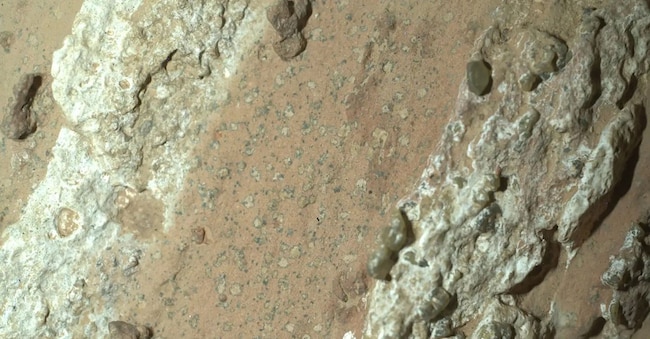
Found and observed by NASA's Rover, Perseverance, on this microbe rock would have left a clear mark, formed by minerals that would not otherwise be readily present

by Leopoldo Benacchio

La roccia su cui sono stati trovati segni COMPATIBILI con tracce di vita passata.

3' min read

3' min read

Signs of life on Mars, billions of years ago? Again, perhaps, but the answer to this question, which is posed with every Martian mission, is getting closer and closer.

Nasa, in a very long and detailed press conference, released a scientific paper published today in the important journal Nature, which reports the results of a year-long research on a Martian rock.

Loading...

Found and observed by Nasa's excellent rover, Perseverance, it was immediately described as very interesting. On this rock microbes would have left a clear mark, formed by minerals that would not otherwise be readily present. However, we are talking about marks left billions of years ago when water flowed on Mars, and this is now quite certain.

So not microbes, i.e. established life forms according to our biology, but signs of their past existence. Perseverance, Nasa's robotic rover, discovered in the Jezero crater, which it has been studying for some time, these minerals on a rock above a hardened mound of mud, in the bed of a river from the past. The location, therefore, is suggestive of microbes, but it must be said at once that, despite the excitement and the concrete certainty of the research team, there is also the need for further confirmation because, as the press conference honestly stated, in principle the small concretions found, called leopard spots, could also be due to inorganic natural phenomena, albeit with greater difficulty.
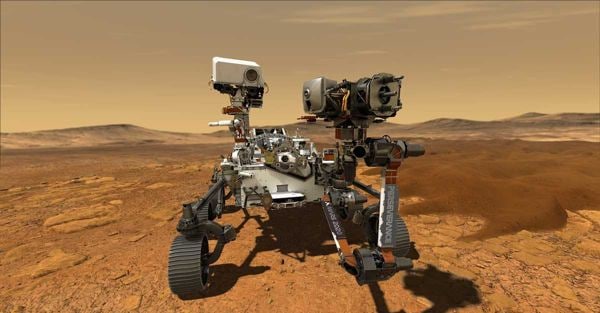
Rover perseverance

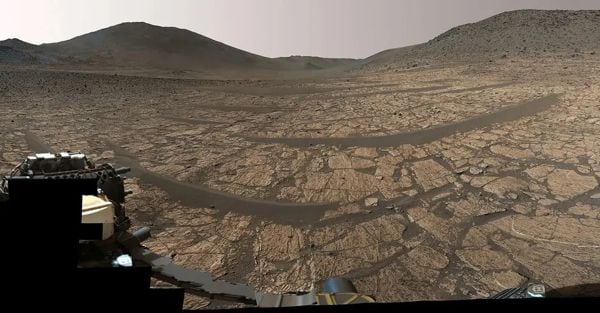
Persevarance landed in the Jezero crater in February 2021, which was certainly once a rather important lake, from which a river flowed down the crater. The area, in short, a few billion years ago, was warm and humid, a perfect place to house, and thus find today, microbes and their traces.
This is according to NASA scientists who were initially disappointed, in years past, not to find the traces of organic life that they expected and that a lake and river should leave behind.

The discovery of the rock in question rewards decades of research work, and the Nature article describes in much more detail the mineralogy of the rock and the surrounding terrain that scientists have named Cheyava Falls.

In addition to the leopard spots, which are formed by a dark part and a light inner part, the rock also contains tiny concretions, less than a millimetre in size, which scientists called poppy seeds, and which contain vivianite, an iron phosphate mineral.

On our planet, and here's the kicker, this mineral, and others found on Martian rock, often form in freshwater lakes, river estuaries and marshes in sediment deposits.

"These would be examples of microbe-influenced environments, where microbes consume organic matter and produce these minerals as a by-product," said Joel Hurowitz of Stony Brook University in New York, head of the group that authored the important scientific work.

Cratere Jezero a 360 gradi

In short, the strong suggestion is there but, as scientist Carl Sagan stated years ago, 'Extraordinary claims require extraordinary evidence', and the evidence in the rock found by Perseverance is certainly very intriguing, but not conclusive.

Perseverance, with its robotic arm, drilled into the clay and now has a sample in a container along with the 27 other soil samples taken over the years since February 2021 when it arrived on Mars.

All these samples were originally supposed to return to Earth thanks to a very daring and complex mission, Mars Sample Return, which was supposed to bring a shuttle to Mars that would take the samples from Perseverance and fire them back to Earth. The examinations and studies that can be carried out in an Earth laboratory are of another level of depth and completeness of course and could prove decisive in this case, but the mission was practically cancelled by the cuts wanted by the Trump administration, because the cost estimates soared to eleven billion dollars.

Searching for life, some form of life, outside the Earth is important because it might make us realise that we are not, for the umpteenth time, privileged, but just one of many planets, among billions and billions of others, where it has developed.

Copyright reserved ©
Loading...

Brand connect

Loading...

Newsletter

Notizie e approfondimenti sugli avvenimenti politici, economici e finanziari.

Iscriviti