The anniversary

USA '94, Roberto Baggio and that cursed penalty: thirty years since the Italy-Brazil final

A bitter memory: the 1994 Italy-Brazil final, marked by penalties and Baggio's failure

by Dario Ceccarelli

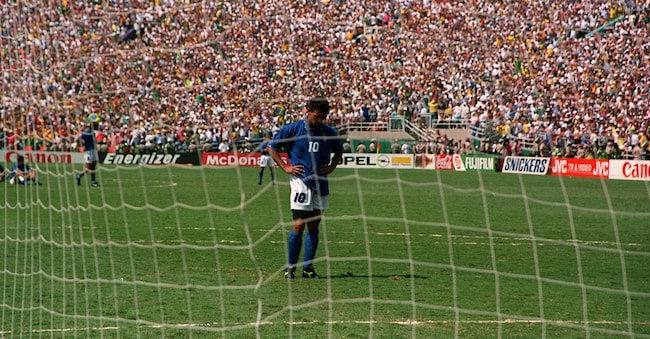
Roberto Baggio dopo aver battuto il rigore che decretò la vittoria del Brasile al mondiale 1994. (Reuters)

6' min read

6' min read

It was very hot that 17 July 1994 at the Rose Bowl stadium in Pasadena. A suffocating heat with a humidity index like a tropical jungle, hardly fit to put one's nose out of the house let alone play the World Cup final between Italy and Brazil at 12.30 pm.

Back then, 30 years ago, there was still no talk of global warming, as there is now, but that 17 July in California, with the sun hammering down, would certainly have served the environmentalists well to reiterate that the world had already started to go to hell.

Loading...

The choice of time for the final

Someone will rightly say: but was such an important final, facing two national teams that had already won three world titles each, really necessary to have it played at that time? When the asphalt begins to sizzle and those who go out onto the pitch are already drenched in sweat before they start?

It is a question for pure souls. The answer, taken to the extreme, is the usual: this is show business, baby! The lords of football, in tune with the television networks, had thought of scheduling the matches at delirious hours in America to allow European viewers to enjoy the games in the evening, thus ensuring maximum viewership.

Money is money.

An obviously absurd choice, which would have penalised not only the final but the whole world championship characterised by a heavy series of injuries and slowed rhythms by bachelors and grooms.

It is not a pleasant memory, that final, although time has smoothed out the less pleasant corners. For a start it ended badly with Brazil winning (3-2) on penalties after a tense but ugly nil-nil, conditioned by fatigue and fear of being scored upon. And not only on the part of Italy, also led by Arrigo Sacchi, the prophet of pressing and intensity. But also on the part of the cariocas, usually testimonials of wonder football, who were less Brazilian than usual.

Good players, of course, but not a team of talent like the one that had thrashed us (4-1) in Mexico in 1970. In place of Pelé and his comrades, the Greenoro, in Pasadena, presented honest football workers like Taffarel, Aldair, Branco and Dunga with two spearheads like Bebeto and Romario. Almost all of them, curiously enough, passed and discarded by our league. Football always offers these last-ditch rematches. Think of a coach like Vincenzo Montella, dumped by Italian football, and who has become one of the most appreciated coaches in the last European Championships.

The Decisive Penalties

.

Going back to that 17 July, the first thing that comes to mind is the 'lottery' of penalties, with our specialists, as cooked as the Brazilians, approaching the penalty spot with funeral faces that presaged the worst. A firing squad. The first penalty is kicked by Franco Baresi, who has returned 24 days after meniscus surgery. He shot it to the stars, or rather the sun, confirming that it was going badly. Afterwards, however, Pagliuca immediately put a patch on it by neutralising the first Carioca execution. But the worst is yet to come.

While the Brazilians no longer failed, Daniele Massaro, not quite Van Basten, had his own saved. At this point, an as-yet-unelaborated Shakespearean drama unfolds: that of Roberto Baggio's penalty, the Divin Codino, the imaginative star who, with his goals (unforgettable the one in extremis against Nigeria), had allowed Arrigo Sacchi's national team to reach the final.

Arrigo, strong in his principles on the prevalence of the collective, had no great passion for that extraordinary talent in intermittent mode because of all his aches and pains. Even in that final Roberto had risked the bench due to a muscle complaint. But, in the end, Sacchi, out of a sense of gratitude, let him play anyway, even if Baggio's contribution, held back by the fear of a new injury, was poor, as was that of many Azzurri.

But we are at the showdown. Baggio has to shoot. He knows that even if he scores, the chances are minimal because Brazil still has match point in their hands. Even he, usually surgical at the penalty spot, has the defeated look of someone who knows he will not arrive at his best at the most important appointment of his life.

'That match,' Roberto recounted, 'I had imagined it many times when I was a child. I was three years old but I couldn't forget the defeat against the Brazilians of Italy. I wanted to avenge Gigi Riva and the others. It was my dream. When it ended like that, the world collapsed on me.

Here is Baggio shooting. Crushed by bad thoughts, he does exactly what he should not do. He shifts his weight back too far, kicking the penalty over the crossbar. End of drama. Brazil, after 24 years of fasting, wins the World Cup for the fourth time in a final for the first time decided by penalty kicks. But it does not matter, what matters is that the people of Rio, together with the Selecao, go crazy with joy for the conquest of a world championship that will later be dedicated to Ayrton Senna, the legendary Formula 1 driver who died in Imola just over two months earlier.

The Azzurri were so tired that they almost didn't realise it was over. The most distraught was Baresi who, consoled by Sacchi, cried like a child.

Envoy Gianni Mura writes: 'Italy comes out on the last day as it did on the first, defeated. With Eire with its head down, with Brazil instead with its head held high. In between there is so much fatigue, so much suffering. The obstinacy to prolong a dream as long as possible has come within 11 metres of happiness. Thank you all the same'.

The one who will carry the stigmata of that final, of that malignant sliding door, is still Roberto Baggio, the Divin Codino, the one who, with his goals, after a disastrous start (defeated by Ireland, Italy had only managed to qualify for the round of 16 thanks to a repechage among the best third-placed teams) had managed to tow the Azzurri to the final after having overcome Nigeria, Spain and Bulgaria.

'Coming out of that nightmare was hard,' Roberto would say years later.

"If I could erase one image from my sporting life, I would erase that one. The strange thing is that I have never shot a penalty over the crossbar. Of course, by failing the last penalty, I became the sacrificial ring erasing those missed by my teammates. Without me, though, we would never have made it to that final.

Craft football in the 1990s

.

Looking back, that final was truly one of the last world cup challenges of the 20th century, with that football still naive and artisanal, despite the pressure of television networks. Arrigo Sacchi's Azzurri had arrived in Pasadena after playing their previous matches on the East Coast, up and down between New York, Washington and Boston, to gather the affection of the Italian emigrants who had rebuilt their lives there.

Arrigo Sacchi, let's face it, did not gather much approval as coach. After Alfredo Bearzot and Azeglio Vicini he was the first Italian coach not to come from the Federation. Wealthy, charismatic and divisive, he came from AC Milan, the Milan of Silvio Berlusconi's invincibles, and this bond will always stick to him like a trademark. Then he had those ideas of his, of total football, of the primacy of the team over the individual, which did not arouse the sympathy of Italians, especially those who had grown up with the equally ideological ideas of Gianni Brera and other more or less illustrious commentators.

Almost anthropological theories that privileged defence over attack, arriving at the admirable synthesis that first of all it is better not to take them. Which in the end, due to impending fatigue and many injuries, Sacchi also did to his indelible dismay.

The hot summer of Berlusconi's first Italy

.

In conclusion, it must be remembered that the summer of 1994 was also 'hot' in Italy. And not only for the weather. Silvio Berlusconi, leader of 'Forza Italia', and for about two months the new premier, hosted the G7 in Naples in July. In front of the world's greats, Silvio had never been so rampant. Charged also by the extraordinary victory (4-0) of his AC Milan team in the Champions League final against Barcelona.

In the wake of his success, Berlusconi also attempted to stifle the Tangentopoli push by entrusting Minister Alfredo Biondi with a package of restrictive measures on justice (toh, what a novelty...) later called the 'save corrupt' decree. "A decree that will prevent us from dealing with the crimes we have investigated so far," replied Antonio Di Pietro and the entire 'Mani Pulite' pool, submitting their resignations.

The country, as always, was divided: one side supporting Berlusconi, the other going against him head-on.

To the point of taking even Sacchi's Italy in dislike, considered a dangerous weapon of mass distraction, daughter of Berlusconism. And so everything got mixed up, football, justice and politics, in the usual tragicomic summer fuss. The decree later deemed unconstitutional was rejected by the Chamber of Deputies. And that evening, that 17 July, those two Italies, very confused and very unhappy, found themselves speechless before the tears of Baggio, the man with the fairy foot who, but only that once, sent his penalty kick into the sky.

Copyright reserved ©
Loading...

Brand connect

Loading...

Newsletter

Notizie e approfondimenti sugli avvenimenti politici, economici e finanziari.

Iscriviti

Tutto mercato WEB