

I tentativi estremi di rianimare i negoziati tra Usa e Iran
dal nostro corrispondente Marco Masciaga

4' min read
4' min read
Few objects lead us straight into the dilemmas of design in times of polycrisis as much as private swimming pools. The torrid global warming summers and the post-pandemic search for livable private outdoor spaces have increased desire and demand. In Italy the turnover, according to a Deloitte research for Assopiscine, has grown by 12 per cent compared to pre-Covid and is around one billion euro. The water crises and droughts of recent years, however, raise new questions: can a private swimming pool be sustainable in the face of chronic water shortages? In Tuscany, last year, the Fiora aqueduct banned filling them during the summer because there were more urgent needs to which the water could be allocated. This will not remain an isolated case: from Nevada to Catalonia, private swimming pools often end up under indictment in times of drought. As with any contemporary design object, we are in a phase of constant technological development: smart models, remote controls, integration with entertainment systems. But for the future of this sector, there is no development as important as the search for solutions that are compatible with ecological demands and, at the same time, with the new climatic context of ever higher average temperatures. In this sense, swimming pools are almost a laboratory of future consumption.
"From being a dream for the few, today the market has widened, become more varied and adaptable even to small spaces or terraces," explains Massimo Semola, landscape architect, who has long grappled with the dilemma of the sustainability of private pools. The basic level of change lies in the choice of materials: resources of choice are PVC and recycled concrete or reconstituted wood, made from waste elements. Relying on the circular economy for infrastructure, however, is not enough. 'Research is opening up frontiers of complexity and new challenges,' explains Semola. There is the issue of reducing water and energy consumption, a primary objective, but also the reduction of chemical pollution, with research into alternatives to chlorine purification.
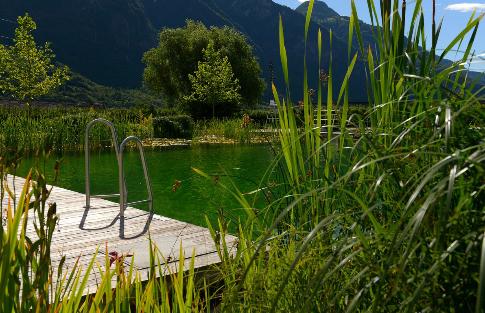
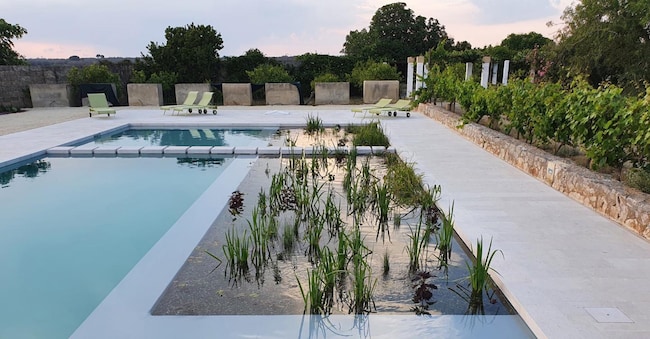
One answer that combines the solution to water, energy and chemical problems are bio-pools. These are facilities that simulate natural water purification and recycling systems. In the experience of those who install and use them, they are more like natural ponds, even though they may take the form of traditional swimming pools. The water is treated by a natural filtration system located in a pool adjacent to the main pool, where aquatic plants, algae or volcanic lapilli can be used to naturally purify and retain bacteria in the water. According to Semola, 'the effect is slightly less clear than in a chlorine-treated pool. It gives the exact sensation of swimming in a natural environment and, precisely for this reason, in Italy, we still encounter what I would call cultural resistance'. It is no coincidence that bio-pools are much more popular in countries such as Holland, Germany or Austria, where swimming in lakes and rivers is a widespread habit. An example of a public bio-pool in Italy is in South Tyrol, in the municipality of Gargazzone.
"When I have to motivate clients to make this choice, I explain that the difference between a chlorinated pool and a natural pool is like the difference between owning a motorboat and a sailing boat: they are different experiences, with a different level of commitment, and they give access to different forms of pleasure," explains Filippo Piva, landscape designer and pool designer for Pampa Studio. Biopools allow you to use less water, they do not need to be covered in winter (no problem if they freeze), they consume less energy, as well as fewer chemicals, and they are more economical to install. A single photovoltaic panel is enough to power them. On the other hand, these new solutions closer to nature have slower purification times, need more constant maintenance and a higher level of commitment. "There is another issue that is divisive and may or may not be liked. Biopools attract biodiversity, so birds, dragonflies, water snails, frogs, newts. This is often a reason for mistrust'. In Italy we tend to see it as a defect, a sign of contamination, almost a symptom of a lack of care and cleanliness, when it is exactly the opposite.
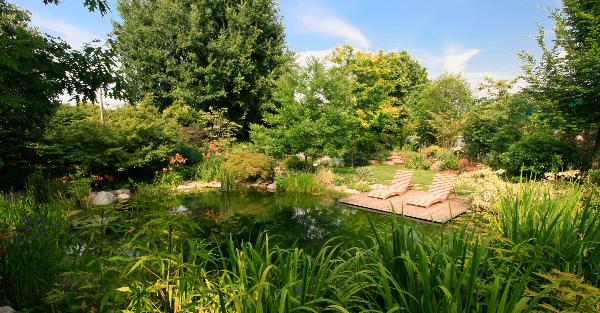
For Adriano Grechi, the question of sustainability is also semantic. That is why he has chosen to call them commercially biolaghi. His Grechi Giardini was one of the first companies to bring this way of rethinking the relationship with water to Italy twenty years ago. It was the beginning of the 2000s and, after a year of study by the masters of the sector, the Dutch, he actually created a market that did not exist before. "We chose to stop using the word pool, because it was confusing in terms of expectations. Our plants are real living systems, which stand for biology much more than engineering. They are similar to large aquariums with plants, in which you can also swim". Grechi designs bio-ponds for hotels and agritourisms, but also for private residences. The dimensions can also be very small, three metres by two, and even fit on a terrace. Prices depend on the context, but are roughly equivalent to those of a high-end swimming pool. The bio-lake, or bio-pool, is a small private ecosystem, 'almost more a place of rest than recreation,' says Grechi. It does not necessarily require more maintenance, just a different kind of attention, "more like that which we would give to a garden than to a swimming pool". Choosing this solution also represents a rewriting of one's mental codes, starting with the details: "A swimming pool with leaves on it looks dirty and neglected, a bio-lake with those same leaves is instead a living space".

