Art

Thomas Schütte and Tatiana Trouvè in Venice

The Pinault Collection's spring in the lagoon revolves around the human figure: in presentia at Punta della Dogana; in absentia at Palazzo Grassi
by Silva Menetto

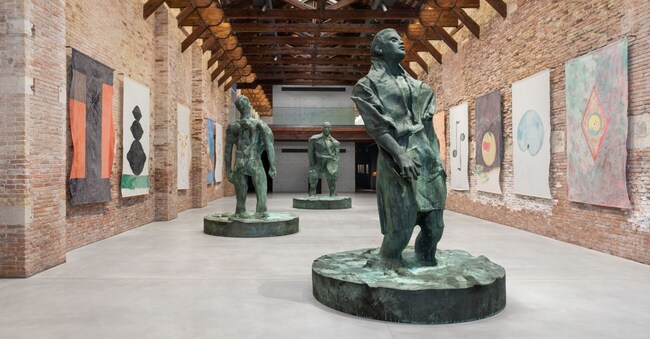
Thomas Schutte, Mann im Wind, 2018

4' min read

4' min read

Entitled 'Genealogies', the first major retrospective dedicated in Italy to the German artist Thomas Schütte: staged by the Pinault Collection at Punta della Dogana, Venice, the exhibition is a triumph of the depiction of the human body, in a melting pot of techniques and genres.

On the other side of the Grand Canal, in the immense spaces of Palazzo Grassi, on the other hand, the intimate work of Tatiana Trouvé (a Franco-Italian artist born in Cosenza in 1968) stands out due to the total absence of the human figure, which hovers everywhere without ever manifesting itself.

Loading...

Thomas Schütte e Tatiana Trouvè in mostra a Venezia

Photogallery14 foto

The Giants and Schütte's Drawings

It is difficult to place Thomas Schütte within predefined patterns; he is a multifaceted artist, able to move with absolute ease from one material to another, from one form to another, from the monumental three-dimensionality of sculpture to the more intimate, two-dimensional line of drawings. The Venetian exhibition is a clear demonstration of this, in the rooms of Punta della Dogana where works on paper dialogue seamlessly with gigantic sculptures, outsized heads and busts in glass (created in Murano in collaboration with Berengo Studio), bronze, ceramic; sketched or caricatured figures, grotesque, ironic, lyrical or symbolic subjects.

From the 1970s to the present day, the entire catalogue of Schütte's production (Golden Lion at the Biennale in 2005) has been brought together in the exhibition curated by Camille Morineau and Jean-Marie Gallais, following a thematic, rather than chronological, course.

From the large 'Men in the Wind', but with their feet trapped in the earth, to the 'Spirits', the fountains of 'Weeping Women', and the disquieting 'Efficiency Men', Schütte never ceases to exert his critical, questioning and corrosive force on humanity, starting from the absolute freedom to reproduce it. As in the case of the two gigantic bronzes that ideally open and close the exhibition: Mutter Erde (Mother Earth) and Vater Staat (Father State). She, a proud matriarchal figure, stands at the entrance to Punta della Dogana shrouded in an aura of mystery, her eyes lighting up at night; he, exhibited in the turret, looks like a giant emptied of meaning and imprisoned in his role.

Bringing a touch of levity is the repertoire of graphic works, in a change of scale from the infinitely large to the infinitely small, drawings, watercolours, lacquers, many of which had never left the artist's studio. They are the most intimate part of Schütte's work, the most playful and imaginative, at times almost childlike, as if in drawing the artist managed to carve out a private space for himself, detached from the world.

The Strange Things of Trouvé

The universe of Tatiana Trouvé, invited to animate the spaces of Palazzo Grassi with her works, tells the story of the artist 'in absence'. The human figure is the great absentee and at the same time the absolute protagonist of the exhibition 'The Strange Things in Life'. Trouvé has transformed the grandiose interior of Palazzo Grassi into her very personal microcosm, an ecosystem (as she herself defines it) made up of objects collected in the cities where she has lived, memories, dreamlike images, real or merely imagined spaces in which she invites the public to wander, to move, between earth and sky, navigating in the great "Atlas of Disorientation". Our certainties are immediately shaken by the site-specific work that covers the floor of the hallway of Palazzo Grassi: a carpet of asphalt studded with stars made of manhole covers, metal plates, casts, and pipe covers recovered from Paris, London, Venice, Rome and New York: testimonies of everyday urban life that, seen from above, create a cosmic map.

Always hovering between the lived past and the imagined future, Tatiana Trouvé moves around creating large three-dimensional still lifes, artist's studios crammed with objects, necklaces resembling large rosaries that pelt small relics collected in the cities where the artist has lived, and again walls, gates, doors, in a continuous rite of passage that has taken shape at the artist's behest in close collaboration with curators Caroline Bourgeois and James Lingwood.

There is the Guardians series, the most poetic: empty chairs or benches on which various personal objects have been abandoned, a pair of shoes, clothes, a cushion, a bag, a blanket, books... all made of marble, onyx, or cast in bronze, brass, impervious to life and yet completely human.

There are inaccessible rooms that can only be seen through small glass doors. There is the series of newspaper front pages from around the world collected 'From March to May, 2020' and used by the artist as the basis for his drawings during the lockdown. And there are the series of large drawings, which create new, disorienting spaces. In all the rooms of the exhibition, the human element is totally absent but always powerfully implied, like an invariable constant: the essence of the artist.


Thomas Schütte, Genealogies - Venice, Punta della Dogana, until 23 November 2025

Tatiana Trouvé, The Strange Life of Things - Venice, Palazzo Grassi, until 4 January 2026

Copyright reserved ©
Loading...

Brand connect

Loading...

Newsletter

Notizie e approfondimenti sugli avvenimenti politici, economici e finanziari.

Iscriviti