
Thomas Schütte's trip to Italy celebrated by MoMA and Pinault
The German artist returns to Italy with 50 sculptures and 150 new drawings from the artist's studio at Punta della Dogana. The Tucci Russo gallery and its market

5' min read
Key points
5' min read
According to data recently shared by the Apollo Group at the meeting of Italics member galleries at the Fondazione Donnaregina - Museo Madre in Naples, the Italian art market does not make up the numbers, accounting for only 0.5% globally and 2% in Europe. But when one goes to analyse the career of an artist like the German Thomas Schütte (Oldenburg, Federal Republic of Germany, 1954) - a counter-current, free and provocative artist, yet celebrated by the major international institutions, both public and private -, the role of the Italian art system, and Italy in general, takes on a whole other impact.
"We got to know Schütte through the gallery owner Konrad Fischer from Düsseldorf, and after a short time we found him in Turin, first at the 'Overture' exhibition opening at the Castello di Rivoli in 1984, and then in the exhibition 'Rheingold' at the Palazzo della Società Promotrice delle Belle Arti a few months later," recalls Lisa Tucci Russo, of the gallery of the same name in Turin - a member of Italics. Hence the invitation to hold his first exhibition in Italy, in 1986: the first of seven and perhaps the most intransigent. On show was a unique installation that occupied the entire exhibition space, a square room 15 metres on a side. "We respected its imagery, it was a difficult language and unfortunately a Canadian collector bought it, but by the second exhibition Italian collectors such as Giuseppe Panza di Biumo came along," adds the gallery owner. Since then, the collaboration has never waned, and Lisa Tucci Russo has followed the artist in her latest major international consecrations.
The exhibition in Venice
.Only a few months have passed since the German artist's major retrospective at the MoMA in New York, and now his works land in the lagoon, in the prestigious spaces of Punta della Dogana, the second Venetian venue - besides Palazzo Grassi - of the Pinault Collection, restored with surgical dedication by the Japanese architect Tadao Ando and opened in 2009. At MoMA, the route was chronological and embraced horizontally the various souls of the artist's practice - drawing, sculpture and architecture - through a repertoire that ranged from the modelling of the very first works created under the aegis of Gerhard Richter at the Düsseldorf Academy of Fine Arts in the 1970s up to a monumental sculptural production that from the 1990s onwards explodes the themes of an ironic and at times grotesque humanity, victim and paradox of a society governed by uncertainty.
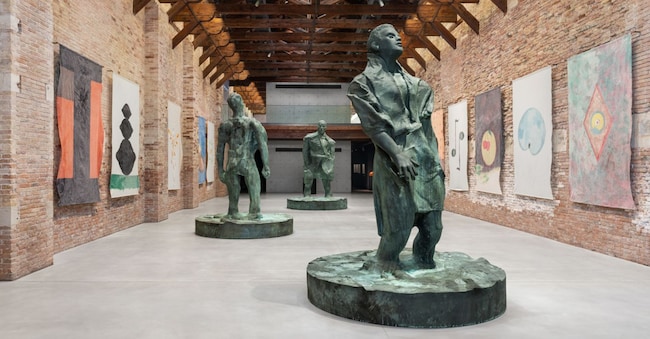
In Venice with the exhibition "Genealogies", which opened on 6 April and can be visited until 23 November in conjunction with the 19th. Architecture Biennale, curatorsJean-Marie Gallais and Camille Morineau focused on the important body of works, 50 sculptures, acquired by luxury entrepreneur François Pinault since the 2000s. The works from the collection were placed in dialogue with 150 drawings, many watercolours and almost all previously unpublished works from the artist's studio, who also decided to show for the first time to the public a series of sketches made during a three-month stay in a psychiatric hospital in 2022, a sombre and revealing moment. This production on paper acts as an intimate counterpoint to a more explicitly plastic narrative, from bronze to ceramics but also glass, a material that Schütte became acquainted with in 2011 with Studio Berengo in Murano, since then his collaborator in Venice.
After all, the artist's relationship with Italy has become much stronger over the years since that solo exhibition at Tucci Russo's in 1986. In 1992, in fact, Schütte was invited to be in residence at the German Academy of Villa Massimo in Rome, and it was then that the belpaese also entered into the themes and content of the artist's works, both in a present dimension and through the lens of history. This is the year in which the Tangentopoli phenomenon broke out under the impetus of Mani Pulite, to date the largest and most ramified investigation into political corruption in Italy. "Schütte felt infected by that climate of conspiracy, he studied the conspiracies of Ancient Rome and became interested in the murder of Pierpaolo Pasolini, for which he also imagined a memorial in a fort in Ostia, the drawings of which are on display in the exhibition," explains Jean-Marie Gallais, curator of the Pinault collection. After this experience, his sculptural production touches new chords, becomes monumental but still fragile, symptomatic of a society as criminal and rolled in on itself as its inhabitants.

