
The 'time without form' of Rosi, Marcello and Sorrentino at the New York Film Festival
Selected at the NYFF, they share a concern with what historian Charles Maier calls 'architectures of memory'.

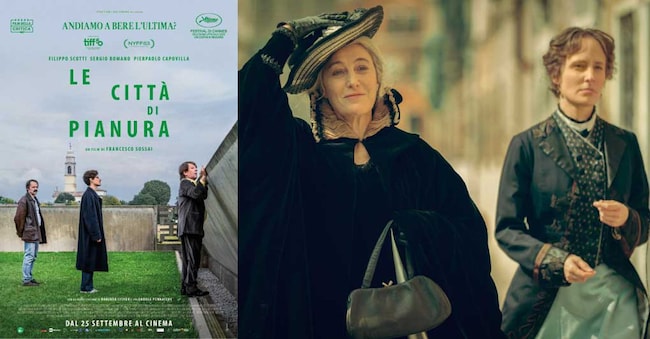
How much time do we have left? There are four Italian films at the New York Film Festival that try to give a rounded answer:Gianfranco Rosi's Under the Clouds, Pietro Marcello's Duse, Paolo Sorrentino's La Grazia, and Francesco Sossai's The Cities of the Plains all seem to emerge from a particular systematic age that touches as much on mortality as on the relationship between past and present, in a climate where many films at the festival (26 September - 13 October) already have commercial releases and october galas on their calendar. These days, Lincoln Center is a hive of arthouse and restoration buffs; the "Revivals" section is full of titles, including Erich von Stroheim's Queen Kelly, 1929, between the splendour and decadence of an imaginary Central European world.
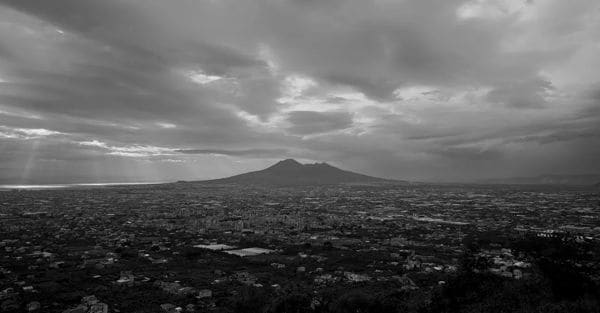
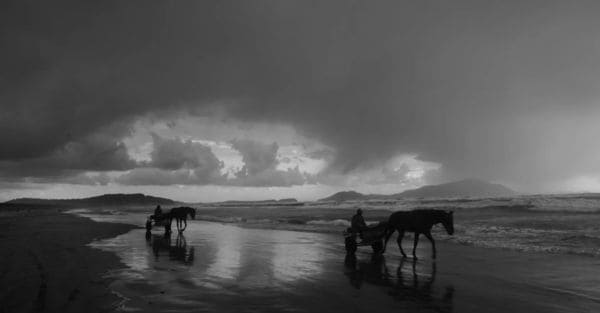
Rosi, Marcello, Sorrentino and Sossai, selected at the NYFF, share a preoccupation with what historian Charles Maier calls 'surplus memory' or, more overtly, 'memory architectures' - the social and technological frameworks through which cultural memory is preserved and transmitted. They pursue the same constellation of George Kubler's 'primary objects', each with a load of resolutions to the problem of giving substance to time.Under the Clouds by Gianfranco Rosi is perhaps the most literal thought of historical understanding; the work positions itself as an excavation, following tomb raiders through the underground tunnels of Naples, and figuratively unearthing layers of historical sediment in contemporary Neapolitan life. Rosi's choice to shoot in black and white transforms today's Naples into what he calls an authentic 'archaeological site'. In the heart of the mosaic-like nature of Naples, Rosi sets his human lantern. He shows us a teacher running an after-school centre, emergency workers responding to calls about domestic violence and natural disasters, detectives tracking antiquities thieves, and sailors unloading Ukrainian grain while their homeland is being bombed. Each narrative thread occupies a different temporal register - the cyclical time of educational routine, the crisis time of emergency response, the deep time of archaeological preservation, the compressed time of geopolitical crisis. A 'plural present' that finds its double in the title taken from Cocteau's observation: 'Vesuvius makes all the clouds in the world'. A Naples suspended in time and covered in the ash of a perpetual catastrophe.
Duse
Kubler theorised that the classic focus of 'art history on the lives of individual artists', while necessary, often obscures the 'continuous nature of artistic traditions'. Pietro Marcello's Duse elegantly navigates this tension by focusing on the last years (1917-1923) of actress Eleonora Duse, a struggling figure within the 'formal sequence' of theatrical expression. A biographical analysis that becomes even more revealing when it examines the relationships of the artists with 'what preceded them and what will follow them'. A sharp, time-conscious Duse in the theatrical tradition - we see her neither early nor mid-career, but in a late position where formal mastery is combined with an awareness of mortality. The fact that there are no recordings of her voice, only a few photographs, places the project in a framework of adventurous reconstruction. Just as art historians work on sculptures using solvents for cleaning, resins and epoxy adhesives for settling, plaster and vinyl putty or rabbit glue to reconstruct broken parts, so the alchemist Marcello must rebuild his Duse from limited material traces.
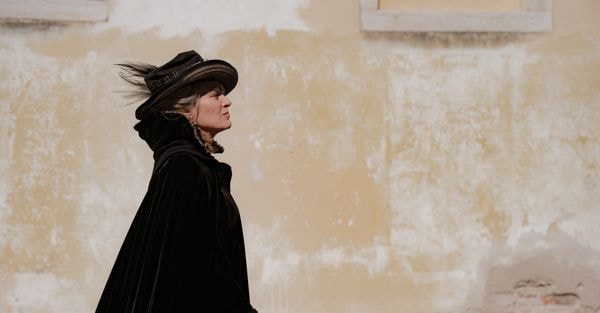
The integration of archive footage creates a constant movement of Duse between cities and countries. An artwork that brings formal innovations from one geographical context to another, Duse functions as a relay that transmits theatrical techniques and survival across national borders. 'He never stayed more than forty days in one place,' Marcello recalls. His Duse becomes omnipresent/always present, as are the Rondò Veneziani, Gian Francesco Malipiero and Gian Piero Reverberi.
The Grace
And what would political time and its latent morality be if we were not also confronted with Paolo Sorrentino's La Grazia, an interweaving of individual psychology and institutional time. The film's protagonist, the (fictional) president Mariano De Santis, occupies multiple time positions simultaneously: the cyclical time of political office, the linear time of biological ageing, the suspended time of moral deliberation, and the compressed time of term limits that impose artificial deadlines on complex ethical issues. Sorrentino's choice to focus on an imaginary president grappling with euthanasia and clemency places the film within a great need for answers and resistance to easy solutions. The president's moral dilemmas - a cocktail of law and ethics, institution and conscience - pass through carrels of palatial spaces and tableaux of official ceremonies interrupted by interventions of the absurd. Everything becomes an object of vulnerability, from official structures to forces in action beyond official control. And vulnerable are Le città di pianura by Francesco Sossai with, at the centre, two middle-aged men whose nightcap is simultaneously 'the last' and prelude to the next. A paradox that reflects broader questions about how individuals navigate the gap between subjective consciousness and objective progression. The protagonists Carlobianchi and Doriano exist in a time of 'routine' (the repetitive temporal structure that provides stability but threatens creative development, progress). The attention to architectural details - from rural farmhouses to shopping centres - maps different temporal layers within a single geographical space. Environments and 'markers of duration' clash with the friendship between Carlobianchi and Doriano: theirs is a 'lived time', and together with Rosi, Marcello and Sorrentino they forge a 'time without form', fused in genres: drama, documentary, archive. Investigations into the fervent, often dispersed energies of an epochal archipelago. So how much time do we really have left? How much time have we lived under the clouds of cinema?

