
Tinariwen: their cry is my voice
The Tuareg group releases 'Hoggar', its tenth album, recorded in Algeria with a new generation of musicians and full of political claims
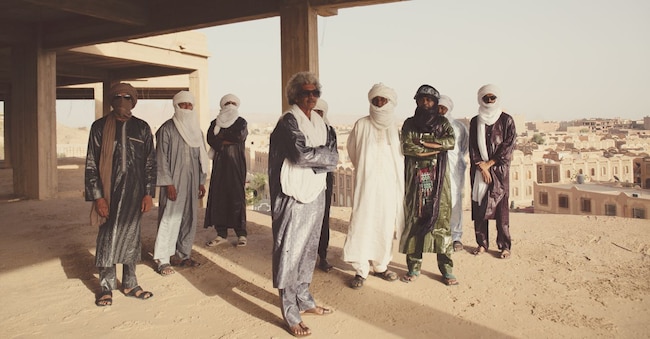
"This is the starting point," says Carlos Santana on stage at the Montreux Jazz Festival in 2006, pointing to three Berber musicians. "When I listen to them, I hear the beginning of the music of Mississippi, the music of Stevie Ray or Jeff Beck or Mighty White or B.B. King, Little Walter, Otis Rush, Buddy Guy," the guitarist continues: "This is where it all comes from." These words had been a recognition that the Tinariwen had something older and more irreducible than any American blues. Their story is one that the music world knows by heart but can never really contain: Ibrahim Ag Alhabib, the founder, had witnessed at the age of four the execution of his father at the hands of the Malian army during the 1963 rebellion. Growing up as an exile, he made his first guitar out of objects picked up on the street: a tin can - or, depending on memory, a plastic bin - a wooden handle and a bicycle brake wire.
Back to Tamanrasset
'Hoggar' is the mountainous massif of the Algerian Sahara, the historical refuge of the Tuareg. It is the title chosen for the group's tenth studio album, released on their own label, Wedge. A clear choice compared to the previous 'Amatssou' (2023), made with Daniel Lanois - the Canadian who has worked with names such as U2, Bob Dylan and Peter Gabriel - and which incorporated banjo and pedal steel in a hybrid of American country and Saharan sounds. This time the historical members Ibrahim Ag Alhabib, Abdallah Ag Alhousseyni and Touhami Ag Alhassane returned to Tamanrasset, the town in southern Algeria where the group took its first steps, to work with a younger generation of Tuareg musicians: Iyad Moussa Ben Abderrahmane of Imarhan, Hicham Bouhasse, Haiballah Akhamouk. Daily sessions for a month took place in the studio, not in the usual open space of the desert. The political context is not the background: when the Russian mercenaries of the Wagner group began to settle in the Malian Sahel in 2022, France completed the withdrawal of its troops in August of the same year, upsetting the balance of power in a conflict that the Tinariwen have always sung in the Tamasheq language.
Radges emerging from the desert sand
In 1989, Ibrahim and a companion named Japonais are in Al Kufrah, on the border between Sudan and Libya, when they hear a local musician playing a melody they have never heard, 'Sagherat Assani', a traditional song that circulates between Sudan and the Sahara. Japonais learns it, but unfortunately passes away in 2021. Five years later, the song holds the architecture of 'Hoggar': the same number of tracks precede and follow it, five. "Sagherat Assani" is sung by Sulafa Elyas, a Sudanese voice and player of the oud - a Middle Eastern chordophone - now in exile in Paris, and is the album's liveliest track. The opener, 'Amidinim Ehaf Solan' has a syncopated rhythm, choruses, hand claps and darbuka, with lyrics about a thirsty, aching land that will turn green again. The female voices of Wonou Walet Sidati and Nounou Kaola run through several tracks, a novelty in the group's discography. In 'Imidiwan Takyadam' José González adds a few verses in Spanish, while the album flows between the dark 'Erghad Afewo' and the brooding 'Tad Adounya'. The album closes on the notes of 'Aba Malik', a track written and sung by Abdallah Ag Alhousseyni who rails against Wagner's mercenaries. The Tinariwen come to terms with their age, some of them in their seventies, but they do not question the concerts: they want to continue to make their land known and sing until peace descends on it.

