Munich Salon

Tindaya debuts, how Cupra imagines the car of the future

The Spanish manufacturer, part of the Volkswagen Group, previewed the Tindaya showcar at the Munich Motor Show, a vehicle with original shapes and materials

by Federico Cociancich

4' min read

4' min read

Cupra is one of the few car manufacturers that has always had the courage to come up with original styling choices, at least as far as the design of its cars is concerned: large logos prominently displayed in the centre of the bonnet and brightly lit at the rear, shark-nosed front ends so as not to go unnoticed, matt colours mixed with copper colour are just some of the brand's distinctive and immediately recognisable elements.

At the end of March, CEO Wayne Griffiths, left the company after five successful years, but he took with him the courage to dare and the desire to astonish. Cupra reaffirmed this today at the Munich Motor Show with the Tindaya showcar, which highlights decidedly unusual shapes, innovative new materials and a futuristic-looking interior.

Loading...
Cupra Tindaya: la nuova showcar mostrata in anteprima al Salone di Monaco

She looks alive

.

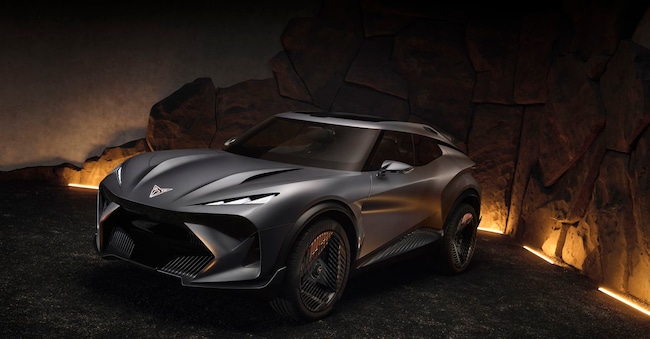
The car seems to come to life with the illumination of the Cupra logo prominently displayed on the front and the activation of the underlying black mask, which is actually a digital display, showing a constantly moving image. The lighting effect then expands laterally, displaying three digital triangles that form the eyes of the car, ending with the switching on of three progressive triangular lights that reveal the new lighting signature of this showcar. Once the 'wow effect' is over, one appreciates the front end with a pronounced shark-like nose, flanked by aerodynamic keels that guide the airflow towards the side intakes. The bonnet is characterised by two pronounced elevations and sharp lines that connect with the roof, where an aluminium element draws a large ypsilon supporting two removable glass panels.

The exterior mirrors seen from the front are characterised by aerodynamic elements, while from the driver's point of view they are edgeless and look very 'light'.

With a length of 4.72 m, large 23-inch wheels and a high ground clearance, the Tindaya displays robust proportions further emphasised by the progressive wheel arch cladding and lower door panel. The sloping roof (fastback type) leads the view towards an equally original rear end. A prominent double spoiler extends from the roof, while triangular taillights frame a digital display that echoes the one at the front and displays a perpetually moving image. In the centre, the Cupra logo is prominent and illuminated in bright red to symbolise the beating heart of this concept car.

The rear bumper, like the front one, features two side keels connected by air channels that help convey the idea of great performance. Finally, the large rear diffuser represents a design element with a strong impact.

Cupra Tindaya: le foto della showcar che prende vita

Photogallery18 foto

The Interior

.

Upon opening the doors, which are symmetrical, one is immediately struck by the four seats that seem to be suspended and the central tunnel that runs the length of the car to beyond the rear seats. The steering wheel recalls the shape of an aeroplane's cloche (or the gaming ones) and is full of buttons, while the shape of the cockpit is not as distinctive as one would expect. Attention is in fact drawn to the centre of the tunnel where 'The Jewel' is located, a transparent pyramidal element that allows you to vary the driving modes and the environment: you go from an immersive mode, designed for everyday driving, to a 'driver' mode, which enhances the performance and adrenalin aspect of driving, to a more 'social' mode, which shows elements of intelligent and connected mobility, proposing advice derived from artificial intelligence.

Each mode is associated with an environment that activates different data and colours, and in the case of connected mode also shows information on a thin band projected just below the windscreen along its entire length.

Material and colour research

.

This Tindaya is not only characterised by an original design but also shows interesting research into new materials. The large Y on the roof is made of 3D-printed aluminium, and the rear of the body incorporates 'Bcomp' flax fibre, which, according to the company, guarantees high performance and greater environmental friendliness than carbon fibre. Also interesting are the semi-transparent plastic parts that are integrated laterally into the bodywork, just behind the front wheels.

Inside, the floating seats and centre console are upholstered in bio-based vegan leather, there is extensive use of bronze-coloured waxed microfibre, while the structural elements are also made of 3D-printed aluminium, like the exterior.

The matt colour of the Tindaya's bodywork changes shade gradually from front to rear, going from an intense metallic grey with a hint of blue to a soft beige to recall the characteristic tones of volcanic earth. Finally, the glass parts are illuminated by a coppery light to recall the brand's characteristic colour.

Cupra calls the new Tindaya a showcar, something very close to a concept, but at least from what we've had a chance to see, it's not that far from actually being produced and marketed. Cupra has rarely left a project in the drawer and we would be very curious to see the Tindaya on the streets of our cities.

Copyright reserved ©
Loading...

Brand connect

Loading...

Newsletter

Notizie e approfondimenti sugli avvenimenti politici, economici e finanziari.

Iscriviti