Evidence

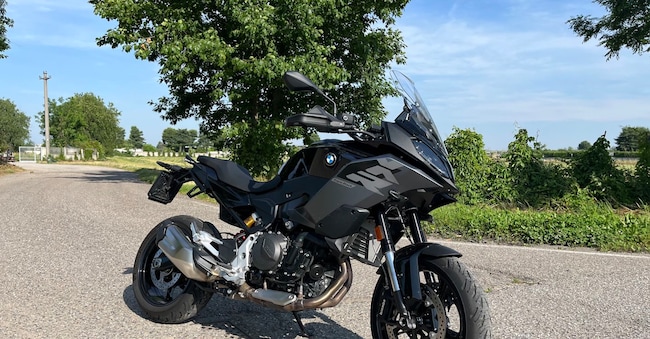
Bmw F 900 Xr, how the medium-sized German crossover goes between sport and touring

With the my2025 comes the fully adjustable fork and many standard features
by Gianluigi Guiotto

4' min read

4' min read

They call them crossovers, with a term borrowed from the world of cars: they are those motorbikes that combine a vaguely enduro set-up (comfortable seat with upright back and legs bent at right angles, or almost) with a sporty and aggressive ride, thanks to an engine and chassis designed in this way. In BMW's 'medium' segment, there is the F 900 Xr (prices from 12,250 euro), recently renewed but unchanged in its vocation, which we could summarise as follows: touring with (a lot of) spice.


Loading...

New products for my2025

.

The new F 900 Xr has revised some details to improve wind protection: the wind deflector has been redesigned, but the possibility of raising and lowering it to two positions with one hand remains, even on the move. And hand guards are now standard - very useful, especially in winter, in combination with the heated grips, also now standard. While the engine remains unchanged - the in-line 895 cc twin-cylinder with 105 hp and 92 Nm, now Euro5+ - the new "Dynamic" riding mode (in addition to Road and Rain), which makes the response of the twin-cylinder to the throttle grip even more prompt, becomes standard. Also now standard are the ABS in the Pro version, which adapts its intervention also considering the lean angle, the dynamic traction control (DTC), to ensure safety during acceleration, and the engine torque control, to prevent the rear wheel from slipping when downshifting. On the safety front, of particular note is the Headlight Pro system, which includes daytime running lights and adaptive headlights ("follow" the curve, illuminating the inside of it), and rear direction indicators that integrate the brakes and rear lights. On the chassis front, the my2025 gains a 43 mm upside-down fork with adjustable rebound, compression and preload, and two new 17-inch rims that are 1.8 kg lighter: this contributes to making the bike quicker in changes of direction. Overall, the weight loss compared to the previous model is 3 kg, thanks also to the battery, which has lost almost a kilogram.


How's the Bmw F 900 Xr

The seat is 820 mm above the ground, but, as always at BMW, a lower (at 775 mm) and higher (comfort seat at 845 m
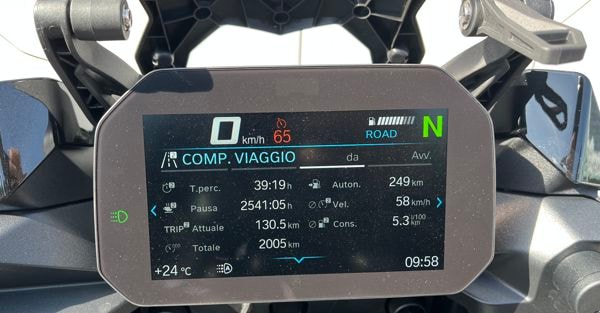
m); in fact, the standard seat is rather rigid: it is fine for sporty use, a little less so for touring. The ergonomics are clearly travel-inspired: the torso is upright, the arms relaxed, the legs with a natural bend angle; the position is comfortable even after a few hours of riding, thanks also to the fairing which protects even the tallest riders well from the air and, being quite wide, also shelters the shoulders well. In front of the rider the command bridge is unchanged, with the 6.5" screen used on many BMW models that I dare say is perfect for readability (even in the sun), layout and font size; everything is adjusted with the joystick on the left knob (where there is also the cruise control), while the right houses the riding mode button. Also on the left is the Esa suspension adjustment button, which allows you to choose between two mappings for the monoshock - Dynamic or Road - and also to change the load: rider, without and with passenger and luggage. On the fork head there are now two butterflies that allow rebound and compression adjustment without tools. On the move the F 900 Xr, despite weighing 216 kg with a full tank of petrol (15.5 litres), is very agile and quick and gives confidence from the first metres. On fast mixed roads, the progress made on the chassis front is very much appreciated: even without touching the fork settings, the set-up seemed more balanced, with less tendency for the front end to sink in on hard braking (a bit of pitching is always there, however: it is still a bike born to travel and dedicated to comfort). In changes of direction and on corner entry, the F 900 Xr benefits from the lighter wheels and proves more dynamic and responsive, without however surprising with abrupt responses. One also appreciates the quicker response of the engine in Dynamic at the first twist of the throttle: the BMW crossover has gained a little more character, which never hurts, also because there is always the Road map when you want to ride relaxed. Also pleasing is the elasticity of the German twin-cylinder that picks up in sixth gear up to almost 2,000 rpm and, at 130 km/h indicated, revs around 5,000 rpm without annoying vibrations. The brakes are powerful, especially the front, a little less so the rear, which is penalised by a pedal with a long free travel and an attack point too low. The quickshifter struggles a bit to engage the gear under torque, but pulling the gears is lightning fast. A final note on consumption: at the end of our test (carried out with no regard for economy) it was 5.3 litres per 100 km (almost 19 km to the gallon).

Copyright reserved ©
Loading...

Brand connect

Loading...

Newsletter

Notizie e approfondimenti sugli avvenimenti politici, economici e finanziari.

Iscriviti