
Tivoli focuses on cultural tourism with a Literary Park
In 2023, the museum system in the area recorded almost 38% more visitors and is aiming for one million with the new project dedicated to Marguerite Yourcenar, Ludovico Ariosto and Ignatius of Loyola

3' min read
3' min read
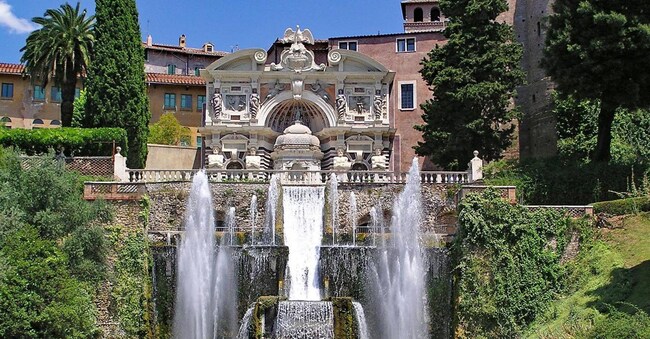
The 'free and wild' ruins of Emperor Hadrian's palace that Marguerite Yourcenar first visited exactly a century ago and that would inspire her 1951 masterpiece novel. The phantasmagorical gardens of Cardinal Ippolito II d'Este's villa, inspired by the flights of Ludovico Ariosto's Orlando, the storyteller of the success and splendour of the Ferrara dynasty. The severe vaults of the complex where the Sanctuary of Hercules the Victorious stood and where Ignatius of Loyola, who precisely during his stay in the city in 1539 received the approval of his order from Pope Paul III, founded the first Jesuit school in Italy. Three sites, two of which are Unesco heritage sites, united not only by their belonging to the territory of Tivoli, but also by the project of the new Literary Park named after these characters who lived there in many ways.
Launched last June, strongly desired by the director of the Villae museum system, which includes the Tiburtine residences, Andrea Bruciati, the Literary Park thus enriches the network of the same name, created in 2010 as a new formula to valorise territories and destinations linked to writers, a network that today counts 33 parks in almost all of Italy (in addition to the one in Tivoli, another, dedicated to Percy B. Shelley, was inaugurated in Lerici in the past few weeks) and others in Norway, Florida and Cuba. Shelley) and others in Norway, Florida, and Cuba, while one is being studied in Greece, Canada and Switzerland. These are all places where the passion for literature fuels a more aware and sustainable tourism, with virtuous spin-offs on the territory, which is also the object of study of the Centre for Literary Tourism (Tule), the first of its kind in Europe, founded in 2021 within the University for Foreigners of Perugia precisely to investigate the economic spin-offs of the phenomenon as well.
In the age of overtourism, Literary Parks stand out for their sustainability: not only can itineraries and routes be experienced all year round, but they are also often found in areas that are not traditionally touristy. Two examples: the village of Galtellì, in the province of Nuoro, has just 2,400 residents, but is visited each year by around 25,000 people who come to it for the Literary Park dedicated to Grazia Deledda; Aliano, in the province of Matera, is the village of Carlo Levi's confinement, has a population of 800 people and thanks to the Literary Park hosts around 30,000 visitors a year.
The case of Tivoli in this sense is different, since the town has a population of 55,000 inhabitants and is the heart of one of the most economically lively areas in the province of Rome. This is also thanks to cultural tourism: last year the Villae sites recorded 748,656 presences, a 37.74% increase in accesses compared to 2022, a figure that marks a record number of guests in the last 16 years and places the system among the top 10 most visited Italian state sites last year. The positive effects on the territory are also the result of the "Villae con voi" protocol, a partnership between the UNESCO sites and other local entities (such as the historic Acque Albule spa complex) signed in 2020 to foster the effects of tourism on the territory's induced activities. The next step, looking at the now possible quota of one million visitors, could be the birth of a broader and more complex 'Community Villae'.


