
Entering the Land of Fools and looking after them
World Mental Health Day. There is a growing number of books featuring stories from mental asylums

Key points
- The Land of Fools
- Inside the Volterra mental hospital
- It’s been a hundred days since I last came back
- The Night of San Servolo
- The WHO report
- Stigma and prison
- Mario Tobino
‘Mad people weren’t just called “mad” and nothing more. They had names that you could learn and remember.’ As is often the case, a child’s discoveries can leave a deeper impression than dozens of figures. So, on the eve of World Mental Health Day, 10 October, alongside the alarming figures from the WHO – one billion people worldwide with mental health conditions, rising costs to the global economy, particularly in terms of lost productivity, and funding that has remained stagnant for the past ten years, averaging 2 per cent of healthcare budgets – it is the power of literature that throws open the doors to a subject as difficult as it is increasingly crucial. Indeed, there is a growing number of books – novels and more besides – capable of offering a glimpse into the unsettling world of ‘madness’. A world that has been shunned and repressed for years, hidden from view and from public consciousness; locked away behind the walls of mental asylums.
The Land of Fools
One was in Colorno, transformed into the ‘Palace of a Hundred Windows’ in the imaginative world of Gianna, the protagonist of “Il Paese dei Matti” (Bompiani, 208 pages, 16 euros) by Federica Iacobelli. Through the eyes of a little girl from 1944, who actually lived in the lower Emilia region, and her friendship with the ‘prince’ Mario, we are drawn into the depths of the war-mad, confined within the grand palace from which coffins emerge, unaccompanied by anyone. Except for Gianna and her cat, named Gatto. And one cannot help but reflect on these consequences of war – of all wars, throughout history. With the magic of an almost fairy-tale-like language, characteristic of someone whose profession is to write from a child’s perspective, Iacobelli unveils the unspeakable nature of that palace, and with it the abyss of all prison-hospitals, such as the one in Volterra.
Inside the Volterra mental hospital
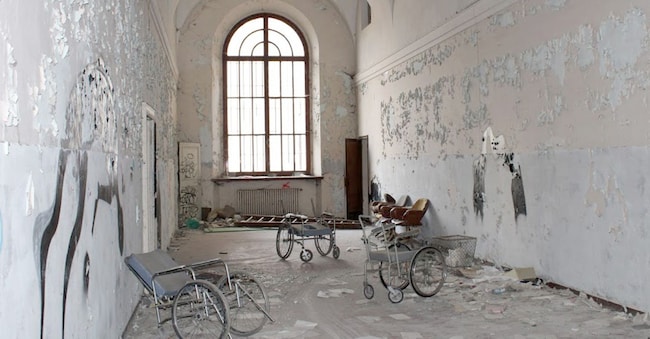
‘We’re living in the same era, and this gigantic building contains everything,’ says Ferruccio, the nurse, in Luisa Pessina’s book , *Perché gli ulivi nascono storti* (Minimum Fax, 147 pages, 17 euros): ‘the mentally ill, criminals, orphans, tuberculosis sufferers, prostitutes, the poor’. Along with a few women who cause a stir. Or who are paying the price for a nasty road accident, a surgical operation that never took place, and ailments hastily confined behind impenetrable walls.
It’s been a hundred days since I last came back
This is the story of Rosa, the protagonist of *Cento giorni che non torno/ Storie di pazzia, di ribellione e di libertà* (A Hundred Days Without Returning: Stories of Madness, Rebellion and Freedom), the gripping journey by Valentina Furlanetto (Laterza, 288 pages, 20 euros), a journalist at Radio24, through the parallel lives of her maternal grandmother and Franco Basaglia, a contemporary and fellow regional native, to whom we owe the closure of the mental asylums in 1978. With the style of an investigative report and the rhythm of a novel, the reader is taken on a journey into the conditions within psychiatric hospitals. And, at the same time, into the widespread denial surrounding the issue of mental illness.
The Night of San Servolo
Daniela Stefanutto also passes through those gates in her own way, with her family-centred, ensemble-style story – *E prese fra le dita la notte* (Lindau, 272 pages, €18.50), centred on the San Servolo mental hospital in the Venetian lagoon and the prejudices surrounding psychiatric disorders. These issues continue to be inadequately addressed in terms of both financial and cultural investment.


