Beyond China. Korea's potential
International galleries in Seoul for the third edition of Frieze to meet sophisticated local collectors, but also interesting new artists

6' min read
6' min read
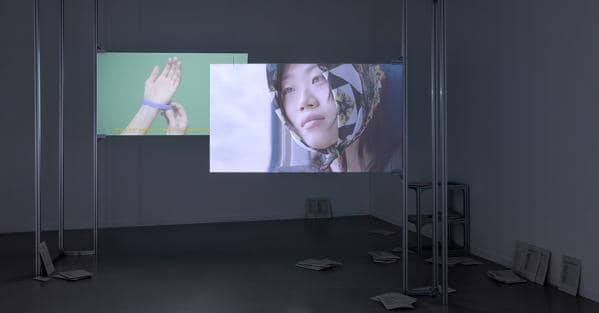
There has long been talk of rewriting the history of female art, and now Asia too is rediscovering its female artists. These days in Seoul, at the height of Frieze Week, the MMCA museum opened the exhibition "Connecting Bodies. Asian Women Artists", which investigates the experience of the body in the art of 130 women from 11 Asian countries from the 1960s to the present, while a book "Korean Feminist Artists: Confront and Deconstruct" about Korean feminists, edited by the former director of Seoul's SeMA, Hong-hee Kim, is being released by Phaidon. It includes both young artists who are growing internationally such as Mire Lee, whom we will see at the Tate Modern's Turbine Hall in October, and Ayoung Kim, who last year won the Golden Nica of the Prix Ars Electronica, the most important award for media art, and this year the ACC Future Prize of the National Asian Cultural Centre in Korea, as well as artists who paved the way for Korean feminist art, such as Na Hye-Sok (1896-1948) and Chun Kyung-Ja (1924-2015), of whom a retrospective is currently being held at the SeMA.
Feminist art
.The rediscovery stems from the need to give visibility to the many female artists of the post-war generation who gave up their careers for their families. Their plight is well represented by the painter Jinju Lee (1980), who takes up ancient Korean techniques in terms of the abundance of detail and the use of pigments and brushes, but shows an iconography far removed from tradition, in which it is the man who paints male figures, hieratic, staring at the spectator. The women in his paintings cover their faces, suffering, often pregnant. Over the past five years, her fame has grown in Korea and now also abroad: in October she will be at the Yuz Museum in Shanghai, and important international galleries such as Esther Schipper and White Cube have already included her in group exhibitions. At Arario Gallery in Seoul, prices are still under $20,000.
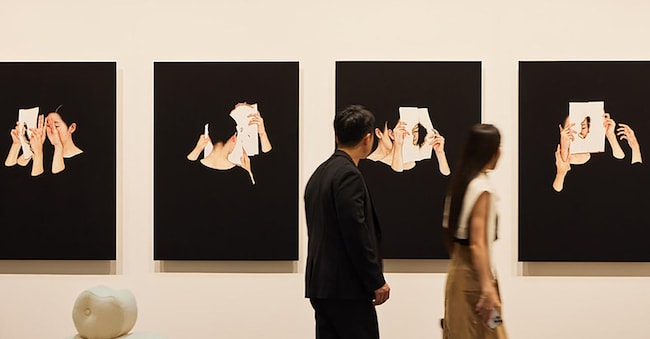
The same gallery represents another Korean woman undergoing a revaluation: Park Youngsook (1941), a pioneer of feminism and photography, a medium that does not have a long history in Korea, as it does in Japan, so she has remained unnoticed. The women in her shots oppose Asian beauty standards and show bodies marked by time, while the faces - again - are covered by large irons. In October we will see her at Frieze in London (prices under $15,000).
The Korean market
.But the Koreans are ready to embrace new art. The tradition of collecting has been rooted here since the mid-1980s and now there is a new generation that is very attentive. Frieze Seoul, the third edition of which takes place from 4 to 7 September, has given international momentum and, despite China's slowdown and global political-economic instability, wars are perceived as far away. Even the report 'Korea Art Market 2023' predicted relatively more conservative transactions with more rational prices for 2024, but the rich will not stop buying. On the contrary, it is seen as an opportunity.
"Quality works continue to sell well," said Patrick Lee, director of Frieze Seoul. "It is true that there is no sense of urgency to buy, but it is a global trend. For decades Koreans have been among the most important art buyers for the whole of Asia, but until a few years ago they sourced their art from local galleries, which imported international art, so they went unnoticed in the West. With travel and generational change, there has been an opening. There is great potential and as a fair we have worked a lot with the government and local institutions to strengthen the network and infrastructure'.