Artificial Intelligence

'Ai, train the man or productivity will not increase'

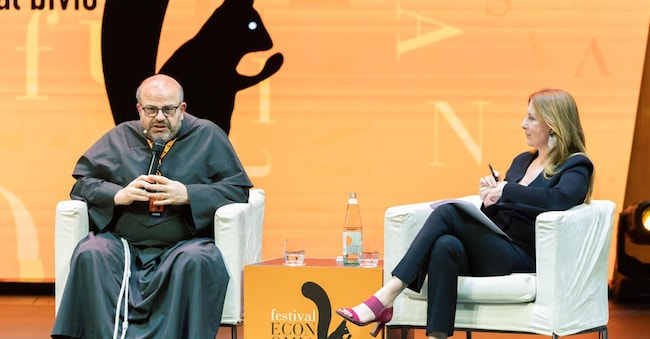
Father Paolo Benanti at the Trento Festival of Economics in the panel "Artificial intelligence and mankind", together with Milan Polytechnic pro-rector Giuliano Noci and economist Massimo Lapucci, moderated by Barbara Carfagna

by Andrea Biondi

L’intelligenza artificiale e l’uomo

Nella foto: Paolo Benanti, Barbara Carfagna

4' min read

4' min read

It was not just a discussion between experts: it was a mirror looking into the future; an attempt to understand whether we can really still call ourselves masters of our destiny in the age of algorithms. At the Trento Festival of Economics, the panel 'Artificial Intelligence and Man' was not about chips and CPUs, but about consciousness, power and, above all, responsibility.

'We are not talking about a Galileo-style debate, whether the telescope is good or bad, but we are in a situation analogous to the industrial revolution. The question is: how much is too much?", began from the stage of the Social Theatre Father Paolo Benanti, chairman of the Artificial Intelligence Committee of the Department for Information and Publishing of the Presidency of the Council of Ministers.

Loading...

'It must be recognised,' he added, 'that the only real enabling platform for technological innovation in artificial intelligence is the human being. If man is not educated and trained, productivity does not increase and social tension and imbalance are generated'. Certainly, Benanti points out, we are 'in a fantastic time, we can question each other', returning 'to questions that we thought we had left to a previous season'.

It is, after all, a modern paradox, in a game of mirrors as old as philosophy: the more intelligent machines seem (are), the more they force us to question what this really means for man. It is not just a technical question, nor is it just an ethical one. It is an 'epochal juncture', in the words of a Father Benanti (introduced by moderator Barbara Carfagna) who recalled how the debate today is no longer whether machines 'know how to reason', but whether they will be able to reach a level of intelligence equal to - or greater than - human intelligence.

'Regarding the so-called general artificial intelligence, there are those who say that it is nonsense and that there will never be a time when machines will be able to perform all the tasks that human beings do. However,' the RAI journalist concludes, 'there are scientific tests that show us the opposite'.

However, when an investment in Ai costs up to one trillion, it is no longer just a question of ethics but also of industrial, political and cultural choices. And it is no coincidence that Giuliano Noci, pro-rector of the Milan Polytechnic, has called for overcoming the false dilemma between man and machine: 'There is no real dichotomy. Artificial intelligence must be a co-pilot at the service of man'. Mr. Noci spoke of the 'digital transition' as a phenomenon that can undermine Western cultural identity to the extent that it is a transition that, in other regions of the world, is approached with less resistance: 'In Asia, for example, a cultural model prevails that exalts connection and does not put the individual at the centre, but his social projection'.

So what can happen and with what risks? Massimo Lapucci, co-author with Stefano Lucchini of the book 'Rediscovering the Human', approached the topic from the perspective of finance, where the use of artificial intelligence is already widespread. He put it bluntly: 'We cannot have blind faith in algorithms. Ai must be guided and monitored'. And if 'in areas such as credit scoring or portfolio management AI has become central, the models must be understandable and monitorable. You cannot delegate everything to the machine without knowing how it works'.

The logical thread thus leads the economist to draw attention to governance and the risk of systemic bias: 'Artificial intelligence is a tool that can discriminate if not properly designed. It is crucial to have rules, such as those proposed by the European Ai Act'. However, this emphasis is also accompanied by a proposal: to place curators alongside Ai evaluators, figures capable of ensuring that the machines are truly at the service of man.

The latter remains at the centre and must be aware, Father Benanti points out, of a risk that cannot now be dismissed: 'In the Middle Ages illiteracy was not knowing how to read manuscripts,' he says. 'Today it is not knowing how to interpret digital information. The new generations risk information illiteracy if they are not educated to distinguish the value and credibility of sources. It is an educational problem, even before the technological one'.

Ultimately, however, Noci concludes, 'there is no need to focus on the theme in terms of the antinomy between man and machine. The theme is to find a Hegelian synthesis between man and machine. Technology can indeed become a form of order if properly designed and governed'. And who knows to what extent the Ai Act will be able to do the latter, about which the Vice-Chancellor of the Milan Polytechnic, however, is not soft: 'The Ai Act defined by Europe is a form of regulation in which those who regulate do not control the playing field. So European companies enter crippled. Elsewhere in the world, they enter the field with doping'.

Copyright reserved ©
Loading...

Brand connect

Loading...

Newsletter

Notizie e approfondimenti sugli avvenimenti politici, economici e finanziari.

Iscriviti