
"To women I say: believe more in yourselves, in your value and step up".
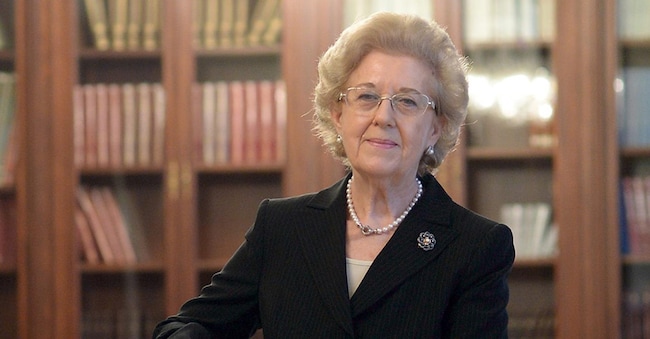
Anna Maria Tarantola. Forty-two years at the Bank of Italy, former president of RAI and, until recently, at the head of the Centesimus Annus Foundation, she fights for gender equality
6' min read
6' min read
"When I was deputy director general at the Bank of Italy, there was a queue of people coming to introduce themselves and apply for a position. All men. I picked up the phone and called an executive involved in equal opportunities to find out why there was not a single woman there': Anna Maria Tarantola is inflamed recalling the episode, she who has made many advances in her long career, in some cases as a true pioneer. Born in 1945, until a few weeks ago president of the Centesimus Annus foundation, she is committed to the emancipation of women ("which does not mean homologation to the male model", she points out) and the right of women to work and be mothers, without ("unacceptable") renunciations.
Her story speaks for itself, ever since her childhood in Zorlesco, a handful of inhabitants near Casalpusterlengo (Lodi). An only child, a lover of study, born into a family all substance and no frills (her father Emilio was a clerk at Snam, her mother Lucia a housewife but ready to work when she had to due to her husband's injury), she grew up in an Italy where a sense of duty and an iron will were the preconditions for building a future. She has always obtained merit-based scholarships ('in middle school and accountancy from Snam, then from the university, then from the Bank of Italy', she summarises) which has allowed her to chart her own path and make choices otherwise precluded. Her degree in Business Economics (with 110 cum laude) from the Cattolica University in Milan in '69 brought back memories of the student protests. Luigi Frey, his professor, was on the students' side so much so that he later left the university to move to Trento. "I was his volunteer assistant, I did the tutorials and took five lire per exam. I followed him, but not the barricades, I didn't do them. I remember the tents outside, with some lecturers together with the students. I held classes at my house, in Metanopoli, the students came there and my mother offered apples and coffee... a bit of a borderline situation,' she smiles. It was Frey himself who had sent her to England for her thesis ('I had studied English, but once I was there it was really hard... I had a hard time, I could read and understand the text, but speaking and understanding the interlocutors was something else altogether'): a prelude to the master's course at the London School of Economics, where she was 'the only woman out of about eighty students'. The Einaudi scholarship was not enough to cover her expenses, 'looking at the notice boards I saw that they were looking for an economics professor in a technological high school and, after one exam, they hired me... I got up at five in the morning, took the train to Victoria Station, in the early afternoon I went back to the university, and in this way I was able to pay for the plane to go home at least at Christmas and Easter, and to buy a few more books'.
Such a focused and comprehensive training in business administration earned her a call to the Bank of Italy in 1971, where she would remain for 42 years.
He started in Milan, and so he was able to go on teaching at the Cattolica: 'I still keep the little letter in which Guido Carli authorised teaching, explaining that the Bank was proud to have young people who could also make a contribution at an academic level because this would be an enrichment for the Bank itself. I did this outside office hours,' he points out. At Via Nazionale, the environment was dominated by men, 'in the management career there were less than ten women', recalls Tarantola who then moved from Milan to manage the branches in Varese, Brescia and Bologna, then moved to Rome where she became Accountant General (2006) before moving to the Supervisory Department the following year and, from 2009 to 2012, holding the position of Deputy Director General (over the years she also held positions in international bodies such as the Banking Supervision Committee, which enabled her to understand the strengths and weaknesses of the Italian system).
How difficult was it to make your way in such a male-dominated sector, also considering that in the meantime Cristina and Paola had been born from her marriage to accountant Carlo Ronchi? It took three things: constant commitment, to the maximum, you can't afford not to be prepared because a man is allowed to be superficial, a woman is not; great organisational ability, having chosen to build a family and therefore, in fact, to take on a double job; excellent health, because as soon as you're not well, the reaction is always the same: 'there are these women...'. She pauses for a moment, pondering, and then adds a fourth element: 'Of course help is needed, and that is why I tried to fight for the others. My husband didn't share the caring work but psychologically he was very close to me, he supported my career progress even when it involved transfers. My parents gave me a big hand and they can't all count on that, so you have to support women through a network of structures that put them in a position where they don't have to choose'.


