
Lidia Ravera to women: forget eternal youth and fight against inequality
Fifty years after 'Pigs with Wings', a bestseller with over 3 million copies, the writer recounts that hot phase of the 1970s and takes stock of the condition of women today

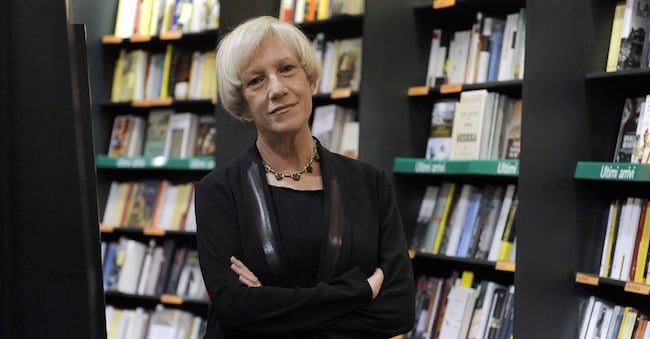
With short hair, gym leggings, and a jaunty air, Lidia Ravera welcomes me into her bright (and of course book-filled) home on the Lungotevere in Rome with the look of someone who, at 75, feels pressed by the passing of time, by forces that are no longer the same, but remains animated by an unchanged desire to be there and try to change a society that is out of step with the times. The same desire as fifty years ago, when Ravera was overwhelmed by the success (unimaginable, even more so in those proportions) of Porci con le ali, written with Marco Lombardo Radice (who died prematurely in 1989) and published by Savelli. Over 3 million copies, translations everywhere, still sold today, republished by Bompiani who cyclically makes new editions.
A shelf in the room is dedicated solely to that debut (which was followed by more than 30 novels): it was inevitable to start from there, from the overwhelming response to a book that was a provocation, a stone thrown into the pond of an Italia in which sexual freedom, despite '68, was far from coming. The secret of such success for Lidia Ravera 'has to do with the sincerity of those pages. In recounting the damage of sexual repression, we talked about much more without knowing it: the suffering of adolescence, betrayal, the desire to experiment, the idea of an open couple. We were groping for an evolution of human relations, in our opinion brutalised by capitalism, which has won out by making only the capacity for interested exchange count. And if you don't have that capacity, you're out. Here, Porces with Wings has thrown down some cornerstones'. Which ones, we can also understand from the personal history of the author, who was born in the Turin 'factory-city, monocultural, and therefore oppressive: there was Fiat, there was Fiat, there was Fiat.... My father was an engineer at Philips and to me it already seemed like aristocracy'. Mum 'was a housewife in spite of herself, at the time you couldn't choose, she used to say of my piano teacher that she was a failed woman because she had no children'. An ingrained male chauvinist culture, a cage in which one had to somehow fit in, 'I grew up aspiring to be the opposite of my mother, accompanied by reading, which literally saved me from loneliness and closure'. It is not surprising, then, that already at the Gioberti high school ('busy: it was politics') Ravera, a journalist even before being a writer, debuted with her first article entitled 'Against the family'. After high school, her goal was to leave Turin to escape the cage to which she was destined. The choice of Oriental Languages in Venice convinced her parents, but it did not last long, 'I did not attend even one of the Russian and Chinese lessons, I spent my nights going up and down alleys with notebook in hand', sniffing society and looking for stories to tell.
A move to Milan opened the doors of 'real' journalism for her, with a collaboration contract at Panorama, directed by Lamberto Sechi. She was 20 years old. And with the recklessness and restlessness of that age, she left the weekly to try her hand at Abc, a sex and politics magazine, but found herself fired for a cover story in memory of a murdered comrade, with a daring title even for that newspaper: 'Polizia assassina! And yet it was a providential misfortune, because Ravera decided to move to Rome and to do so in the manner typical of her environment and her time: 'In Milan, the humanist wing of Lotta continua had expressed a "sub-association" called Circoli Ottobre, a sort of extremist Arci... If you said "I want to go to Rome for a week to clarify my ideas" they would put you in touch with a comrade or companion who lived there, who could put you up. It was normal, it was a network (other than the web!), you could be poor in a cheerful way. And then being poor was a value. They gave me an address, via Claudia 23, and a dishevelled giant with his shirt off his trousers came to open the door: Marco Lombardo Radice. He told me 'there's a green sofa there, it's free for now'. It all started like that, in a casual way'.
Lidia starts work at Muzak, a magazine of pop, jazz, rock and politics, 'I had the role of being sober and slothful, like all women'. And soon she is doing an investigation into sex education, distributed in Roman schools: this is the root of Porci con le ali. A striking title that in itself intrigues and attracts attention ('Giaime Pintor, Luigi's son, did it, taking the idea from David Cooper's The Death of the Family, 1971'), it is written in the form of a diary 'so that it would be less boring: it was addressed to our younger brothers who were already getting fed up with politics, the disengagement of the 1980s was coming. Mine is the voice of the girl, Antonia, that of Lombardo Radice (a medical graduate, ndr) of the boy, Rocco. We recount a series of sexual situations - masturbation, making love the first time, jealousy, homosexuality - with a figure that, if we are here talking about it fifty years later, was literary, capable of reaching the heart. But then Marco 'ran away' and left me alone to manage it, this enterprise. He went with Médecins sans Frontières to Lebanon, he didn't attend the round tables, he didn't get hit by a thick pitch of tomatoes'. Put like that, it sounds like a flop, but instead... 'It was a resounding success, but also scandalous. At the age of 25, I found myself withstanding the protest of my reference groups, i.e. the extra-parliamentary left, and the heinous courtship of the 'compradora' bourgeoisie. Carlo Ponti phoned me but I wanted them to call me Luigi Manconi or Goffredo Fofi'. Instead, Fofi wrote a violent letter to Ravera (who had prepared the high school exams with him in Turin), crushing Porci con le ali.
The book will go its own way regardless of everything - including the trial and kidnapping for obscenity (indeed, perhaps because of it) - and going beyond any expectations of the author and the author, who had never really become 'really friends and it was an advantage because that diary also reflects a difference in outlook. There was a lot of mutual esteem, but he was a bit scary to me, he was very judgmental. He came from the red intellectual elite (Lucio, his father, was an important leader of the PCI), mine was a much more normal family; he was born and raised in Rome, a student at Mamiani (a high school of the cultured bourgeoisie ed.), I was from Turin, with no schoolmates or family. I had none of what made him stronger (grandson, on his mother's side, of the great jurist Arturo Carlo Jemolo). He moved with the confidence of someone who has been in a certain world since childhood. I was a former little recluse, certainly greedy for everything but with great insecurities'. Yet that former little recluse not only withstood the impact of Porci con le ali, but was a protagonist, along with many of her generation, of the feminist wave that wanted to change a society in which men rule and which is founded on the idea that the universal is male. The revolt begins against the same comrades who relegated them to the margins. "The '68 gave us the freedom to leave the house and discuss among ourselves girls. You, who came later, cannot even imagine what it was like. I was brilliant and I could talk: I had no place at assemblies or meetings, because we simply weren't allowed to have it. At a certain point, however, the 'neighbourhood' males (brothers, boyfriends, mates) had to come to terms with feminism. I have never been a separatist, I defend two equally weighty but different looks on the world: I want women to count as much as men, but deeply. The problem is that this other gaze has never been legitimised, it has never had the same value'. Yes, but why, in her opinion? 'Partly because profound changes are slow. A little over forty years ago in our country there was the crime of honour and a raped woman was forced into a reparatory marriage. Until thirty years ago, sexual violence was a crime against morality and decency'. In part, perhaps, women could do more, unite on the battles that matter, following the admirable example of the Constituents in '46. Compact themselves to take a leap and be truly free.


