
Tobacco, the Tax Calendar remains, but the shadow of EU reform on revenues
Logista-Fondazione Tor Vergata report presented: record revenues at 15.2 billion, Brussels maintains different taxes between traditional and innovative products
4' min read
Key points
4' min read
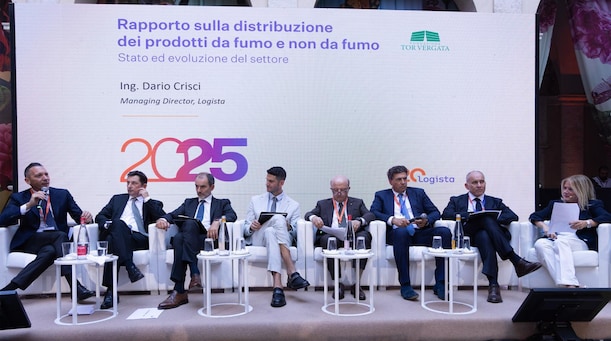
Tax revenues generated by the tobacco sector continue to grow, reaching a record level of €15.2 billion in 2024, of which €11.4 billion in excise duties and €3.8 billion in VAT. But there is also growing concern about the new European rules, which, with the aim of standardising taxation, announce themselves as a new fiscal squeeze. With the difference, however, that the increased revenue would end up directly in the coffers of Brussels. The supply chain, which met at the presentation of the 'Report on the Distribution of Smoking and Non-Smoking Products 2025', produced by Logista in collaboration with the Tor Vergata Foundation, immediately put its hands out: "It will be fundamental to adopt a balanced approach that ensures the pursuit of the various objectives without giving in to ideological and instrumental drifts".
Italy leads the way on taxation of smoking products
The tax calendar for the tobacco sector is drawing to a close,' emphasises Maurizio Leo, Deputy Minister for the Economy and Finance, 'and, with the next Budget Law, we are awaiting the definition of a new multiannual structure. It will be a crucial step that we will tackle with a spirit of listening and attention to the needs of a strategic sector for the country where tax planning represents a virtuous example in Europe'. Undersecretary for the Economy, Federico Freni, adds: "Taxation on tobacco products will continue to rise, but in a sensible, progressive manner and without demagogy". In this direction, 'the tax calendar will remain and continue to be an element of certainty, indicating today what will be paid tomorrow'. For Freni, it is the stability of the rules that guarantees the revenue, which in tobacco rises to 22 billion with the induced taxation. Italy has not been taken aback by the tightening of rates proposed by the EU "but it is wrong to assume that some people want to raise taxes to defeat smuggling. The numbers say that this is not the case'.
Hence the importance of bringing the Italian model to the negotiating table, which is more virtuous than the French and Spanish models, but also the Dutch model, where illegal products account for 44% of smoking products. "Italy, with the legislation introduced in 2015 that clearly differentiates between traditional and innovative products," recalls the Minister for Enterprise and Made in Italy, Adolfo Urso, "is at the forefront in Europe. Our aim is to continue to promote a balanced regulatory framework that equally considers health, economy and innovation also in the forthcoming interventions for the regulation and taxation of tobacco products in the EU'.
For the Minister for European Affairs, Cohesion Policies and the NRP, Tommaso Foti, therefore, "there must remain at EU level a fiscal and regulatory differentiation between smoking and innovative products, also referring in this case to heated tobacco and electronic cigarettes". The decision-making process towards this goal "must involve all states and, at the same time, guarantee flexibility of application by the individual states, also because of the operational and regulatory autonomy that we think we can claim".

