Reforms

Everything you need to know about the premierate: from the direct election of the PM to the abolition of senators for life

Opposition in the streets against reform. Schlein: no more divisions, we stand united
by Redaction Rome

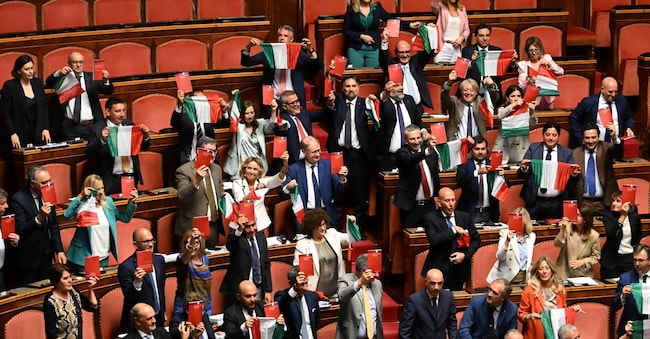
Reazioni bipartisan con bandiere tricolori e costituzioni al termine del voto sul Premierato presso l’aula del Senato. Roma, 18 giugno 2024. ANSA/CLAUDIO PERI

5' min read

5' min read

The Senate gave the green light to the Constitutional Bill on the premierate. The measure was approved with 109 yes, 77 no and 1 abstentions and now passes to the House. The majority forces were in favour, the oppositions all opposed. At the end of the vote, some senators from the majority and opposition waved the Constitution. Several senators of the majority also showed tricolour flags.

Oppositions in the square, Schlein: no more divisions, let's stay united

The vote comes at the end of weeks of tension, first in the Commission and then in the Chamber, culminating on 13 June with the Aventino of the PD, M5S and Avs who left the benches of the Senate while the last articles of the text were being voted on. And who gathered in Piazza Santi Apostoli to demonstrate against the reform. With important defections, however, at the Centre. Carlo Calenda prefers Action to do battle in the Chamber, at least for now. There will be no party delegations in the square. Instead, the Renzi-Bonino tandem splits. Italia Viva chooses not to go to the square. Instead, Riccardo Magi of +Europa will take the stage together with leaders Schlein, Conte, Fratoianni and Angelo Bonelli. But let us see what the main measures of the Casellati bill are.

Loading...

"I appeal to all opposition forces: no more divisions. Let us hold on to our differences, which are important if we can put them to good use. This is a crucial passage in Italian and European history. Let us be ready, united and united,' said the secretary of the PD Elly Schlein from the stage.
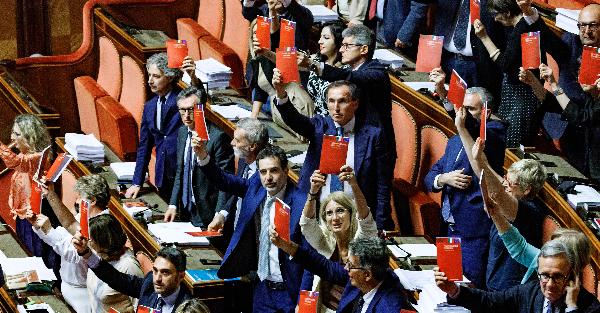
La protesta in Aula

I senatori dell’opposizione mostrano la Costituzione durante il voto finale sul ddl recante modifiche costituzionali per l'elezione diretta del presidente del Consiglio al Senato a Roma, Martedì, 18 Giugno 2024 (Foto Roberto Monaldo / LaPresse) Opposition senators show the Constitution during the final vote on the bill containing constitutional changes for the direct election of the Prime Minister in the Senate in Rome, Tuesday, 18 June 2024 (Photo by Roberto Monaldo / LaPresse)

Meloni: OK premierate first step forward, strengthens democracy

"The premierate reform passes in the Senate. A first step forward to strengthen democracy, give stability to our institutions, put an end to palace games and give back to citizens the right to choose who they will be governed by," commented Prime Minister Giorgia Meloni after the Senate's first green light to the constitutional reform bill for the direct election of the premier.

Direct Election of the President of the Council

.

Introduced (in Article 5, heart of the provision) is the principle of the direct election of the Prime Minister, who remains in power for five years thanks to an electoral system that 'guarantees' a majority of seats in Parliament and cannot be re-elected after two consecutive terms.

Two-term limit

"The President of the Council of Ministers," states the text rewriting Article 92 of the Constitution, "shall be elected by universal and direct suffrage for five years, for no more than two consecutive terms of office, increased to three if he has held office for less than seven years and six months in the previous terms. The elections of the Chamber of Deputies and of the President of the Council shall take place at the same time'.

Electoral system delegated to an ordinary law

The text does not specify how the Prime Minister will be elected, referring to a subsequent ordinary law, a point criticised by the opposition. Although the nationally based prize is constitutionalised. "The law," the bill states, "regulates the system for the election of the Chambers and of the Prime Minister, assigning a prize on a national basis that guarantees a majority of seats in each of the Chambers to the lists and candidates linked to the Prime Minister, while respecting the principle of representativeness and the protection of linguistic minorities". The constitutional reform does not fix the threshold necessary to trigger the prize. The Casellati bill does not clarify whether there will be a runoff to elect the Prime Minister and whether the 50% threshold of votes will be necessary. All these issues are deferred to the electoral law.

The Problem of Italians Abroad

By the same admission of the Minister for Reform Elisabetta Casellati (Fi) and the rapporteur Alberto Balbini (Fdi), the knot of the vote of Italians abroad remains to be solved: now it is channelled into the foreign constituency that elects 4 deputies and 8 senators, but with the direct election one is worth one and those five million could subvert any result. Minister Casellati anticipated the possible solution for Italians abroad: the 'weighting' of their vote, which would essentially weigh less than that of residents. But to do this - is the opinion of some constitutionalists - the electoral law is not enough but a provision in the Constitution is needed.

The premier can always dissolve the Chambers

.

In detail, the reform provides for three cases of government crisis resolution. Case one: 'In the event of withdrawal of confidence in the elected Prime Minister, by means of a reasoned motion, the President of the Republic shall dissolve the Chambers'. Here everything is clear: it is straight back to the ballot box, and therefore it is unlikely that such a no-confidence motion will be tabled unless one wants the end of the legislature. Case two: 'In the event of the resignation of the elected Prime Minister (e.g. in the event of lack of confidence on a measure, ed.) after parliamentary information, he may propose, within seven days, the dissolution of the Chambers to the President of the Republic, who shall order it'. The premier therefore has the power to request and obtain early dissolution if there is a political crisis. Case three: 'If he does not exercise this power and in the cases of death, permanent impediment, disqualification, the President of the Republic may confer, for a single time during the legislature, the task of forming the government on the resigning Prime Minister or on another MP elected in connection with the Prime Minister'. The Prime Minister may thus be replaced only once in the legislature, and only if he himself decides to hand it over, by an MP who is part of the coalition that won the elections. Translated: no more technical and broad-minded governments led by personalities not elected by the citizens (read Mario Monti in 2011 and Mario Draghi in 2021).

Changes to the power to dissolve Chambers in the white semester

The Head of State can also dissolve the Chambers in the white half-year (i.e. in the last six months of his term of office), when the dissolution 'constitutes a due act', i.e. it is requested by the elected prime minister who is challenged or resigns, as provided for in Article 7 of the bill. The new Article 88 of the Constitution would thus read as follows: 'The President of the Republic may, after consulting their Presidents, dissolve the Chambers or even only one of them. He may not exercise this power during the last six months of his term of office, unless the dissolution constitutes an act of due diligence'.

Senators for life abolished

The power of the President of the Republic to appoint life senators is repealed. The current presidentially appointed life senators shall remain in office.

Absolute majority for head of state election only from the seventh ballot

The two-thirds quorum for the election of the President of the Republic is no longer reduced to an absolute majority from the fourth ballot but from the seventh ballot.

The government's countersignature on a series of acts belonging to the President of the Republic has been waived

.

The government's countersignature on a series of acts belonging to the President of the Republic is eliminated. "The acts of the President of the Republic," reads the new Article 89 of the Constitution, "shall be countersigned by the proposing ministers, who assume responsibility for them. The appointment of the President of the Council of Ministers, the appointment of the judges of the Constitutional Court, the granting of pardons and the commutation of sentences, the decree calling elections and referendums, messages to the Houses of Parliament and the postponement of laws shall not be countersigned."

Copyright reserved ©
Loading...

Brand connect

Loading...

Newsletter

Notizie e approfondimenti sugli avvenimenti politici, economici e finanziari.

Iscriviti