
Alberto Cavalli: 'Today's masters of art are the creators and true custodians of the desire for luxury'
The director of the Fondazione Cologni dei Mestieri d'Arte is the true soul of Homo Faber, the Venetian event that has brought artisans back into the limelight and is preparing for the 2026 edition

Canaletto's cloud chases, Ivan Aivazovsky's marine reflections, Carlo Dalla Zorza's milky skies, but also Mariano Fortuny's patented dimmable light bulbs and Marinetti's hope to see "the ray of divine electric light rid it of its venal moonlight": light is part of the essence of Venice, an omnipresent and ineffable element that has challenged artists to interpret it, even to the point of exasperation in some cases. Throughout the month of September, when the summer light will degrade into that of the following season, another "island of light" will rise in the lagoon: "An Island of Light" is the title of the fourth edition of Homo Faber, the biennial event dedicated to high craftsmanship, organised by the Michelangelo Foundation for Creativity and Craftsmanship in the spaces of the Giorgio Cini Foundation, on the island of San Giorgio Maggiore. After director Luca Guadagnino, architect Stefano Boeri, designer India Mahdavi, curator Judith Clark and artist Robert Wilson, this edition's artistic director will be British designer Es Devlin, who will explore the link between light, materials and craftsmanship through 15 immersive installations.
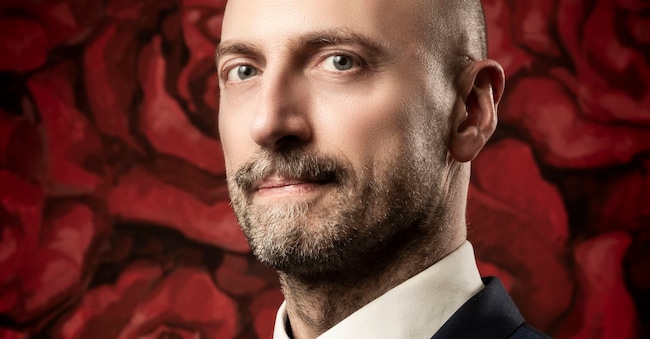
But if, eight years after its debut, Homo Faber has grown in terms of audience, exhibitors and global prominence, it is mainly thanks to the vision and passion of Alberto Cavalli. Fifty years old, from Monza, with a degree in international political science, since 2007 he has been general director of the Fondazione Cologni dei Mestieri d'Arte in Milan, which has been protecting and enhancing high craftsmanship since 1995 thanks to Franco Cologni's pioneering vision. Ten years ago, he also became director of the Michelangelo Foundation, a project of Cologni and Johann Rupert, founder and chairman of the luxury group Richemont, born at the dawn of a new era, both political, with the first Trump presidency and Brexit, and technological, because in December 2015 OpenAi was also born.
Sitting in the tea room of the Principe di Savoia in Milan, I first admire one of the magnificent vintage brooches that Cavalli collects and loves to wear: 'They remind me where the heart is, the key to everything,' he says. 'Homo Faber itself is not a fair, nor a salon, but a celebration of all that men and women are able to do and that excites us. Of course, 'Numerus rerum omnium nodus' (Cavalli, very cultured, loves Latin quotations) is engraved on the façade of the Istat headquarters, the numbers are important: we had eight hundred objects on display, hundreds of craftsmen from all over the world at work, two thousand visitors a day, sometimes we sold out. But there's more to it than numbers: I'm always there, I welcome people, and when it closes at 5 p.m. I go to the vaporetto embarkation point and watch the eyes of those who are leaving. Often I catch a glimpse of something that has struck them, moved them, I think because of the realisation that even in a world that is too full, in which one should reduce, there is still room to create something that represents us. This is why I believe that Homo Faber is not an event, but a movement. The attraction for an ancestral way of producing and relating to things could be a reaction to the hyper-digitalisation of the present. It was in Venice that John Ruskin, the most important theorist of the Arts & Crafts movement, who wanted to rediscover the manual creative act against mechanised processes, took refuge to get away from the Victorian industrial boom. How would he have judged artificial intelligence? 'I think it is a tool, and as such it is up to us to decide how to use it,' Cavalli replies. 'Certainly for craftsmen it can be a great support to make themselves better known. We have succeeded with the Homo Faber Guide, a platform that allows people to discover routes, gives suggestions, which today involves over 3,400 artisans and 500 workshops in 51 countries. However, I believe there is a risk, which is that Ai decides, evaluates, chooses for us, with criteria that are not always transparent. The tech world has sold its dream very well. For our part, we have to nurture a system that respects and favours us as individuals, and that does not treat us as passive consumers, but as interlocutors'.
As unique pieces, the works of craftsmen nourish uniqueness, both of those who produce them and of those who choose them. Uniqueness was also the prerogative of luxury, debased however by the progressive hyper-reproducibility of what has become to all intents and purposes an industry. "When Cologni and Rupert created the Michelangelo Foundation, they started from the observation that luxury was becoming banal," he notes, "the opposite of its essence, which is the desire for authenticity and originality. Today, the masters of art are the custodians and creators of this desire: authentic has the same root as authoritative, authoritative. Authentic is that which is authorial, which has authority. And everything derives from the verb augere, to grow. The author therefore is one who generates value, even for himself. In Almodóvar's film 'All about my mother', Agrado pronounces a magnificent phrase: 'One is more authentic the more she resembles the idea she has dreamt of herself'. The young people, from all over the world, for whom we finance the apprenticeships in the ateliers as part of our Homo Faber Fellowship, want to be authors of something new, to have their personal, original voice heard. Here again, craftsmen make us realise that 'original' means both that which is close to the origin and that which is different from everything, and show us that it is possible to be linked to one's origin but also to integrate something new into it. It is the tension between notum and novum, an encounter that generates value and that also translates into a price tag with a high figure, of course, but a wiser one, because unlike other productions it does not conceal hidden costs that we do not pay directly'.
The prospect is fascinating: can being a craftsman, or even just sharing his awareness, his sense of responsibility, his tension towards beauty, inspire a new form of participation in common living? "In our Constitution the protection of the landscape is foreseen in Article 9, the flag is mentioned in Article 12. When Montaigne came to Italia he was struck by the harmony between the cultivated and built landscape. Beauty is a gift, which we can dispose of'. Not always in an edifying way, as demonstrated by the proliferation of urban interventions far removed from the ideal cities of the Renaissance: 'Luigi Zoja writes that for an ancient Greek, the beauty of the city translated into respect for the values of justice. The more we remove the criterion of beauty from our lives, the more we undermine respect for these values. It is no coincidence that the areas with the highest crime rates are also those where architectural degradation is greatest. In the agora, in the squares, beauty had a political role, a role of aggregation; today beauty is paid for, it is hidden, it is not designed to be integrated into everyday life, and certainly not only in Italia". And yet, as early as 1585 Tomaso Garzoni wrote the 'Piazza universale di tutte le professioni del mondo' (Universal square of all the professions in the world), at the time an enormously successful treatise in which the trades were listed and arranged around an ideal square, a place of exchange and connection to develop all together - miners, jewellers, painters, weavers, glassworkers - society. Only in recent years has the contemporary craftsman regained space in the public discourse, also thanks to the repositioning of our economy towards productions of excellence that make his know-how a fundamental asset. In the 17th century, Colbert understood the greatness of the investment, both economic and political, in the craft and manufacturing excellence of Louis XIV's France. Today's Italia, on the other hand, is still struggling to form an organic system to attract and train young talents, and to enhance their vocation. On 1 December last, meanwhile, European regulation 2023/2411 finally came into force, extending Typical Geographical Indications to artisan and industrial products from EU countries, highlighting their provenance, history and production. But the path to giving the deserved recognition, and protection, to European high craftsmanship is still a long one. "Each country has its own difficulties,' notes Cavalli. 'In Switzerland, for example, even though apprenticeships work very well, young people are mostly directed towards activities related to watchmaking and jewellery. In France, there is the Institut National des Métiers d'Art, which is very structured, but struggles to read the changes, the contemporary: for example, it does not recognise the so-called métiers de bouche, those linked to food products. In the United Kingdom, Heritage Crafts works very well with the Red List, but it only deals with what is in danger of extinction. In Japan, it is the emperor himself who accords certain craftsmen the status of 'living national treasure', a world where women still struggle to enter. Today, there are less than ten female artisans out of a total of 120, a gap that sounds unacceptable to us today'.


