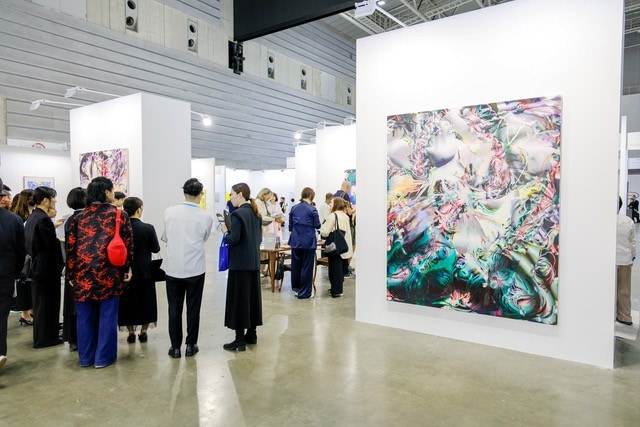
Tokyo Gendai, from Yokohama to the capital: taking on the international market
The fourth edition of the fair concluded with strong sales and announced that it will move to Ariake GYM-EX in 2027, to coincide with Art Week Tokyo

Key points
The latest edition of Tokyo Gendai, which concluded on 13 September at the Pacifico Yokohama, brings the first chapter to a close and opens a new one. After four editions in the port city, the fair is in fact moving to Tokyo: from 4 to 7 November 2027, it will be hosted by Ariake GYM-EX, in the Ariake area, with the aim of fitting even more seamlessly into the capital’s international calendar and coinciding with Art Week Tokyo.
The change of venue follows that of the dates. Tokyo Gendai had already moved the event from July to September to align it more closely with Seoul Art Week and attract an audience of collectors from across the Asia-Pacific region. This new choice now places the fair at the heart of Tokyo’s autumn programme, at a time when the city is brimming with fairs, galleries, museums and events dedicated to collecting.
The venue itself also reflects this shift. The Ariake GYM-EX was built to host the artistic gymnastics, rhythmic gymnastics and trampoline competitions at the Tokyo 2020 Olympic and Paralympic Games. Following the Games, the Tokyo Metropolitan Government converted it into an exhibition space, which is now managed as part of Tokyo Big Sight. The venue offers approximately 9,400 square metres of exhibition space.
Japan seeks a new role in Asia
The move is not merely a logistical decision. It comes at a time when the balance of power in the Asian art market is shifting. For years, Hong Kong has been one of the region’s main hubs, thanks to its financial infrastructure, favourable tax regime and the presence of major auction houses and leading international art fairs. Seoul has strengthened its position thanks to the growing internationalisation of its cultural sector and the arrival of major global galleries. Japan, on the other hand, has long had a highly developed art and museum scene, but its international presence in the contemporary art market has been less structured.
Tokyo Gendai is attempting to fill this very gap
This latest edition of the trade fair comes at a particular time for the Japanese economy. After decades of deflation, the country is experiencing a phase of moderate growth accompanied by a return to inflation and wage rises. The Bank of Japan forecasts GDP growth of 0.6 per cent for the 2026 financial year, set to rise to 0.8 per cent in 2027, whilst inflation is expected to remain above 2 per cent in both 2026 and 2027. Tourism is also helping to reshape the landscape. In 2025, international arrivals reached 42.68 million – the highest level on record – representing a 15.8 per cent increase on the previous year. The weakness of the yen makes the country particularly competitive for foreign visitors and, at the same time, may act as an incentive for international collectors interested in purchasing artworks in Japan. The advantage is, however, more limited for Japanese galleries when they need to import artworks from abroad.
Data on the Japanese art market
The art market landscape, however, is less straightforward than that of the economy. According to the Art Basel & UBS Global Art Market Report 2026, art sales in Japan fell by 1 per cent in 2025, after the country had been one of the few bright spots in Asia in 2024. In the same year, South Korea saw growth of 6 per cent. The figures therefore suggest a period of transformation rather than a genuine boom in the Japanese market. ‘The Asian art market is entering a new phase,’ explains Eri Takane, director of the fair, ‘from a system initially centred on Hong Kong, it has gradually expanded into a network of major cultural and economic hubs across the Asia-Pacific region. In Japan, new models are emerging that go beyond the traditional gallery format and foster collaborations between contemporary art, music, the restaurant industry and other sectors. It is an evolution which, thanks in part to the arrival of a younger generation, is making the Japanese art scene more open, accessible and capable of engaging new audiences.”
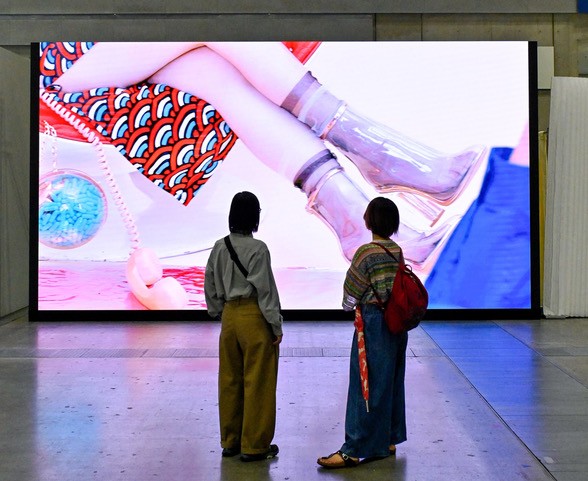
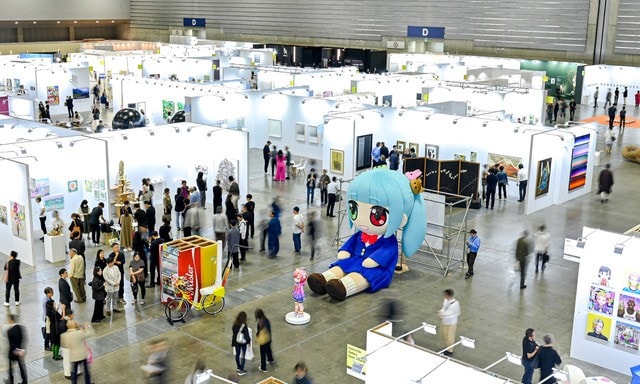
Five sections to showcase a market in transformation: the very structure of Tokyo Gendai reflects this strategy. The 69 exhibitors at the 2026 edition brought works from Japan and abroad to Yokohama, organised into five sections spanning different segments and artistic languages of the market. ‘Galleries’ is the main section, featuring works from international and regional galleries. Hana, ‘Flower’, is dedicated to emerging and mid-career artists, whilst Eda, ‘Branch’, focuses on established and historically recognised artists. New for 2026 is Miki, ‘Trunk’, dedicated to works on paper, ranging from photography and drawing to prints. Also returning is Tane, ‘Seed’, dedicated to digital media: NFTs, animation, film, augmented and virtual reality, and gaming.
The contrast between tradition and innovation, therefore, is not presented as an either/or choice. Paper and artistic practices deeply rooted in Japanese culture coexist with technology and new media. It is also a way of presenting the Japanese art market as a broader system than that of contemporary painting alone. The challenge, of course, is to transform this openness into sales, new collectors and a more stable international presence.
Different price ranges for collectors
It is above all through the new generation – and in particular the artists born in the 1990s – that this transformation can be observed. These are artists who move between Tokyo and the rest of the world, between traditional techniques and contemporary forms of expression, and who are entering the market at a time when the distinction between the local and international scenes is becoming increasingly blurred. A particularly significant example is that of Keita Morimoto, born in 1990, an artist represented by KOTARO NUKAGA. At the fair, the gallery sold two of his works, each in the $40,000–$60,000 range, alongside works by established artists such as Tomokazu Matsuyama ($250,000–$300,000) and José Parlá ($60,000–$100,000). This is an interesting observation because it demonstrates how a gallery can create a market progression within the same stand, bringing together established names and a younger generation.