
Tokyo to savour among whisky, sushi and bars with a view
Surprising cocktails and gourmet eels on a tour of bars and restaurants that tell of the capital's multifaceted identity

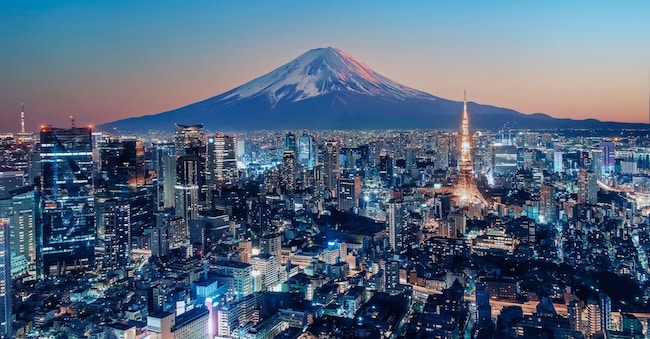
It takes little to realise the contrasts that coexist in Tokyo. Above, the skyscrapers of the Ginza district, the heart of the city's luxury shopping, are animated by Blade Runner-style three-dimensional moving advertisements, while below, young men in evident, dazzling form transport ecstatic tourists on jinrikisha - what we call 'rickshaws', Italianising the English term 'rickshaw' - along the downtown streets. The toilets are a concentration of technology that requires the neophyte to study in depth, and a first aid kit is always placed in the lifts, but in many places the bill is still done by hand, as perhaps only in some trattorias in Italy. Near the famous Shibuya crossroads, crossed daily by hordes of tourists who immortalise themselves there for at least one souvenir photo, a shop full only of vending machines for surprise capsules, each of which contains some miniature character from any of the anime in vogue, is a great success among the capital's youth. A few metro stops away, however, the Asakusa Sensoji temple is still frequented by people who, after washing their hands at a fountain, light incense sticks according to Buddhist ritual.
The Art of Sushi
Tokyo is future and past coexisting in the present, but the contradictions that at first seem almost jarring actually make up a harmony composed of ethics (courtesy is a virtue practised by everyone) and aesthetics. A union that is also perceived in the work of an itamae, the Japanese term reserved with great respect only for masters who master the art of sushi, the precious morsels of rice on which rest fillets of fish of all kinds. Measured gestures, few words, one portion at a time, given to the customer like a gift. At Otaru Masazushi's, even the colour and shape of the plate are chosen to match the sushi being served: at the counter of this restaurant in the Ginza district, one stands as if in a theatre and, although it might seem strange to Western eyes and if one accepts the suggestion, the food is accompanied by a highball, a long drink made of whisky and soda.
Where to taste whisky & Co
Japanese whisky, of course, because after Scotland and Ireland, Japan is the third cradle of malt distillate. And not since yesterday. The adventure of Nikka, for example, one of the country's most important distilleries, took its first steps in 1919, when 20-year-old Masataka Taketsuru, scion of a family of sake producers, decided to embark for Scotland. When he returned home after a few years, he did so with a Scottish wife and a profound knowledge of stills and barley malt. He founded his first distillery in Yoichi, on the island of Hokkaidö, and a second, in 1969, further south in the mountains of Sendai. Nikka has its most famous product in Nikka From the Barrel, which celebrated its first 40 years in 2025, but for the Nikka Highball that is drunk in Japan the less demanding Black (in Europe known as Nikka Days) is usually used, precisely because the drink is a popular, low-alcohol beverage, perfect to accompany sushi and sashimi but also the more informal katsukarē, a simple dish of rice covered with a curry sauce of which the degree of spiciness can often be decided, accompanied by meat or vegetables. Or, again, eel dishes, the speciality of Unatetsu, a small restaurant in the Shinjuku district devoted to unagi, freshwater eels other than anago, those from the sea. For more than sixty years, the restaurant has been serving eels in a thousand different ways, and of the fish nothing is thrown away, serving even their bones, grilled as a crunchy snack that introduces dinner. But Japanese whisky, which has risen to world prominence in recent years precisely because of the renewed success, in line with the new trend towards moderating alcohol consumption, of the highball, is making a comeback in the suggestive cocktail bars that enliven Tokyo's nightlife. There, too, one can experience the supposed contradictions of Japan's capital city: on the one hand, the refined elegance of Virtù, on the upper floors of the Four Seasons hotel in the Ōtemachi district, where one can sip their version of the Old Fashioned while admiring the lights of the city below through large windows, and on the other, the informal and somewhat chaotic atmosphere of the narrow alleys of Golden Gai, where every door leads to a bar so small that it only takes five or six people to fill it, but where it is certainly easier to make friends with the owner.
Concluding the evening strolling around downtown Tokyo is always an experience too, not only because the city is notoriously at the top of the world's safety charts, but because you can always come across some stall selling taiyaki, a fish-shaped cake invented in Tokyo in 1909 that, in its classic version, contains a filling made from sweetened adzuki beans, and is surprisingly good in spite of the idea we Westerners have of beans. Not far from the one we had about eel bones, actually.

