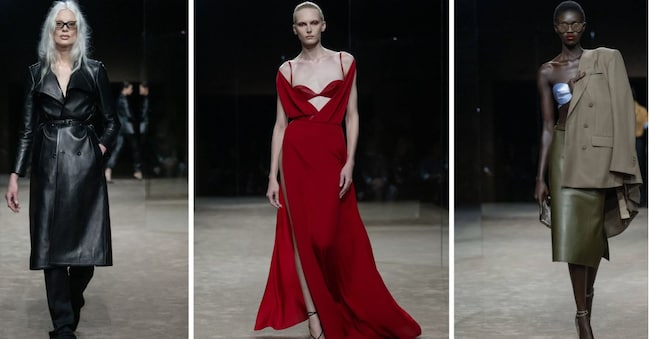
Away with artifice, storytelling, concepts, pretences and, above all, ecumenical imperatives – the frenzy of political scientists hungry for proselytising. In Paris, as in Milan before, designers are getting back to making clothes.
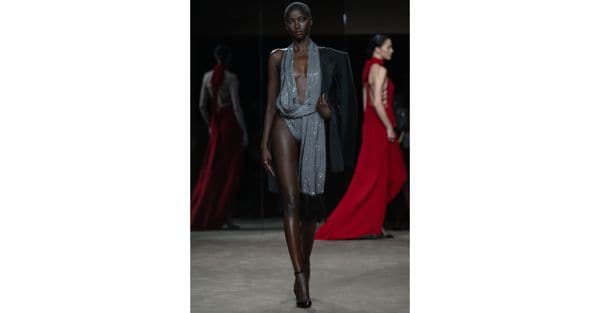
Haider Ackermann, from Tom Ford, goes straight to what has been and remains the brand’s founding principle: desire. He has done so from the very start, right from his first collection, but in this one he is taking greater risks; he declares sexuality in no uncertain terms, incorporating it into the clothes: not in how they are worn, but in how they are cut.
Loading...
Tom Ford, la collezione per la PE 2027
Photogallery24 foto
It is a calculated risk, but not a complacent one. A challenge, because today, baring one’s bottom or consciously and freely offering oneself to the gaze is far more perilous than it was thirty years ago, when Tom Ford was at the height of his career and was rewriting the rules of seduction, taking his cue from Halston.
Tom Ford PE 27
Conformity is rife, and Ackermann evokes that moment without replicating it, playing with the precision of the cut, the richness of the fabric and colour, and the counterpoint between control and abandon. The scene is tense and dramatic, yet the entire narrative is underpinned by the garments, conceived as possibilities that will eventually come to life on real bodies, when desire becomes a reality.
Loading...
After years of Japanese influences, monastic volumes and Protestant abstractions, from The Row, Ashley and Mary-Kate Olsen have reached the zero point of minimalism: a sort of ultra-luxurious banality, a form of reverse snobbery. What they send down the catwalk, in the equally stripped-back rooms of the patrician mansion that serves as their headquarters in the august heart of the city, worn by models with no make-up and their hair left natural, beautiful replicas of passers-by seen in the upmarket districts of any city in the wealthy West, are garments that The Row’s customers already all have in their wardrobes: from trench coats and tank tops for city outings to minimalist exotic pieces and doilies worn as capes, collected during their numerous travels and holidays around the world. Everything is at once perfect and familiar, understated yet incredibly precious. Whilst luxury conglomerates opt for a bold, overt message, The Row chooses silence and enigma, and a highly exclusive notion of ‘anti-fashion’ as the absolute norm.
From Courrèges, Drew Henry’s debut as creative director marks a complete fresh start: gone are the echoes of the sixties, the galactic vibes, the sharp lines and the plastic or vinyl materials; in their place comes an abstract chaos of shapes and colours with a somewhat realistic feel, save for the colourful headpieces plucked from the archives. Pieces put together as if by chance, playfully, without needing to offer explanations or justifications. It’s the nonchalance of Phoebe Philo, the fairy godmother of an entire generation of designers, with whom Henry has in fact worked, at Céline and on her eponymous line.
The limitation lies precisely here: Henry makes it clear that he wants to capture André Courrèges’ disruptive energy and his vision of the younger generations – in short, his intent, which is all well and good – but ultimately this results in a style we’ve seen before, one that is, paradoxically, rather generic. But it is a debut, and that calls for leniency. With one immediate caveat: less Phoebe, more playfulness, and the men in those trapeze-cut suits – which are de trop and rather unnecessary – so best avoided.
Dries Van Noten, la collezione per la PE 2027
Photogallery20 foto
The world of Dries Van Noten is always sprinkled with magic, shrouded in sparkle, steeped in painterly colour – yet set against a Belgian backdrop that shatters any sugary gloss and results in real clothes, just a few crucial millimetres off-key.
This season, sparkle is everywhere: Julian Klausner, the talented creative director, explores the notion of glamour and the cinematic allure that often goes hand in hand with it. The collection paints a fascinating, feminine kaleidoscope of aspiring actresses and has-beens who, after a day on set, return to reality. This state of transition, combined with a naive and instinctive approach to putting outfits together, results in a vision of glamour that’s just a little dishevelled, not perfectly held together – just like life, in fact. With prints reminiscent of fictional film posters, sparkling brooches and jewellery, and cocktail-inspired motifs, it is a quintessential Dries collection: fresh and authentic.
Loading...
Finally, at Balmain, Antonin Tron returns to the aesthetic of Christophe Decarnin, the designer behind the fashion house’s first revival in the noughties: very sexy, but without artifice, without the forced trappings of seduction. His style, however, is more angular, at times heavier, yet paradoxically less conspicuous. In short, the collection is appreciated but does not leave a clear mark, one way or the other. Nevertheless, the decision not to turn seduction into camp or a sex club, but to keep it – albeit within the limits of fashion’s imagination – within the realm of reality, is to be commended.