Mobilisation in Rome

Ncc decrees, black cars in the square again: 'Meloni meets us'

According to the operators of chauffeur-driven hire cars, discriminatory rules are on the way, which will sink the sector by benefiting only taxi drivers, to the detriment of the traditional users of their services, such as companies and tour operators.

by Flavia Landolfi and Vittorio Nuti

Aggiornato il giorno 25 marzo 2024 ore 18:00

Roma, Noleggiatori con conducente in piazza contro Salvini: "Ci ha tradito"

6' min read

6' min read

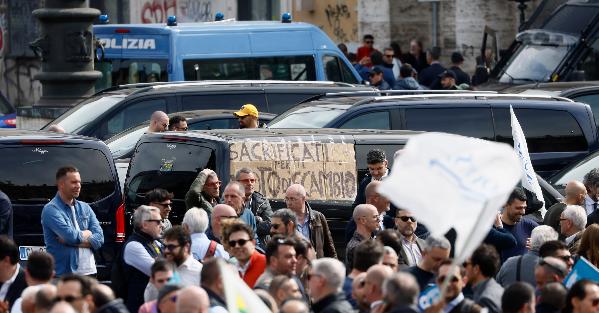
Dozens of 'black cars' from all over Italy marched from Eur to the centre of the capital - with some negative effects on traffic in the capital - and a crowded static demonstration in Piazza della Repubblica in Rome: this, in short, was the second day of protest - after the one at the end of February - promoted by Ncc companies and operators against the so-called "Salvini decrees", the package of measures that should fully implement (with a five-year delay) the rules regulating the car rental service with driver, but are considered penalising and vexatious by most companies and workers in the sector.

The Nccs, explains Francesco Artusa, president of Sistema Trasporti, 'urge the intervention of Palazzo Chigi as we consider Minister Salvini to be hopelessly compromised in an election campaign in favour of taxi drivers. We need third parties and to be able to present our reform proposals. We will no longer accept the rules imposed on us by the taxi drivers,' he says. 'It is shameful that there can still be two competing categories in the same law in which for one, the Nccs, there is a demand for the dossier of customer operators, an hour's stoppage between one service and another, a ban on working for intermediaries such as tour operators and agencies, and administrative arrest for any infringement, even alleged. The other instead, the taxi, is pampered and exempt from any obligation, including tax obligations, and with much lighter penalties, when rarely imposed, for far more serious violations'.
Loading...

Noleggio Con Conducente protestano a Roma con un corteo di auto da via Cristoforo Colombo che attraversa la città fino a piazza della Repubblica contro le nuove direttive del Ministero dei Trasporti promosse dal ministro Salvini per lo stralcio dell’articolo 8 del ddl Concorrenza - Cronaca - Roma, Italia - Lunedì , 25 Marzo 2024 (foto Cecilia Fabiano / LaPresse)

The event, called by Sistema Trasporti, Anitrav, Associazione Ncc Italia, AsiNcc, Comitato Air was also joined by the MuoverSì federation, whose president Andrea Romano, in a note, recalls that "Salvini is preparing to place further and incomprehensible restrictions on the activities of Ncc companies and operators using the surreptitious instrument of implementing decrees and basing himself on legislation that is more than thirty years old and has been reworked several times by the Constitutional Court (most recently a few days ago). All this to protect and safeguard the few and untouchable taxi drivers'.

Majority and Opposition voices

.

Signs of support for the line of the Nccs in the procession in Rome came from politics, with adhesions from both opposition and majority representatives. For senator Raffaella Paita, national coordinator of Italia Viva, the minister Salvini 'confirms his inability to reform the sector properly, there is a clear strategy to pander to all the demands of the taxis and instead go against the Nccs'. Also siding with the Nccs is +Europa, which attacks the government's "vexatious, corporative and anti-competitive policies that are harmful to citizens, businesses and tourists". "The Meloni government should stop and listen to all the voices of non-scheduled public transport," asks Senator Antonio Misiani, in charge of Infrastructure at the PD national secretariat, according to whom "the demonstration of the operators of chauffeur-driven hire cannot go unheard. And also Giorgio Mulè, vice-president of the Chamber of Deputies and Forza Italia deputy, calls for the Ncc category to be listened to, because the chauffeur-driven hire service is "an integral part of a strategic sector for mobility, and for this reason Forza Italia "will continue to work with determination so that a point of balance is reached that contemplates the reasons of all those involved" in the debate on the 'Salvini decrees'.

Taxi unions: 'On the streets those who don't want rules'

The Ncc mobilisation has provoked a strong stance by several taxi drivers' unions (Fit Cisl taxi, Ugl taxi, Federtaxi Cisal, Satam, Tam, Claai, Unione Artigiani, Unione Tassisti d'Italia, Uritaxi, Fast Confal taxi, Associazione Tutela Legale Taxi and Ati taxi), united in defining the 'black car' rally as "an instrumental protest fuelled by the interests of the multinational Uber, which has always been opposed to any form of regulation". "Only a few hundred operators took to the streets in an attempt to politicise the conclusion of the reform process of the sector envisaged by law 12/2019, which has been awaited for more than five years, just because they are refractory to any kind of control". Of the same tenor is also the opinion of Confnoleggio, another trade union but of the Ncc front, which judges Article 85 of the Highway Code - also in the crosshairs of rental car operators who consider it punitive for the category - as 'the only means of opposing and protecting our profession from the illegitimate use of Ncc titles, imposing sanctions on those who do not respect the rules'.

Mit-Ncc-taxi table not very fruitful

.

For the time being, the Ncc mobilisation is not reflected at the MIT, which in recent days has reiterated how the decrees in the pipeline (two DMs and a Dpcm) at the attention of the 'MIT-Ncc-Taxi table' at the Porta Pia ministry serve 'also to unblock the Ncc authorisations that have been at a standstill for years', and that 'in no way will illegal drivers be protected'. Ministry sources then defended the 'open and transparent debate with the categories' and the proposals made to the operators 'on which the contributions of the categories are awaited: the debate is useful for finding solutions, the demonstrations with lots of insults certainly not'.

So far, the confrontation at the 'table' has not been very fruitful: at the end of February, most of the unions (21 out of 27), including those most representative of the hire car companies, pulled out as soon as the details of the draft measures in the pipeline emerged, which regulate the use of technological intermediation platforms (apps) and govern the electronic service sheet model. According to the NCCs, discriminatory regulations are on the way, which will sink the sector by only benefiting taxi drivers, to the detriment of traditional users of Ncc services, such as companies and tour operators.

The exception to this is the Dm Mit regulating the National Electronic Register (so-called Ren), for the registration of Taxi and Ncc licence holders: the rental car world is in favour of its introduction because it is a useful measure to combat abusive practices, and would open the way for the issue of new Ncc licences, which have been blocked since 2019 precisely pending the implementation of the Ren. On this point, the Constitutional Court has also recently intervened, rejecting the suspension of new permits provided for by Law 12/2019 (Count 1 government), which appears to respond to 'a protectionist demand' and not to 'an interest of the community'.

The reasons for the Ncc protest

.

But let us take a closer look at the reasons for the protest of the 'black cars', which have been mobilised for weeks to induce the government to change course in its handling of the Ncc dossier.

1) One of the main knots in the discussion with the Minister of Transport concerns the obligation to allow at least one hour to elapse between the performance of an individual Ncc service and another. This is the so-called minimun waiting time envisaged by the drafts of the Dpcm technological intermediation platforms: a stake that operators consider punitive and with very serious repercussions for tourists and pilgrims.

2) Another point of friction concerns the risk that the implementing regulations of Law 12/2019, and in particular the Dpcm technological platforms, would prohibit the Ncc from using intermediation services guaranteed not only by platforms but also by service companies, hotels, travel agencies, cooperatives and companies. In practice, hire car operators would not be able to use the intermediation provided by travel agents. For instance, booking NCC services also as part of package tours provided to customers.

3) The draft of the Dm Electronic Worksheet provides for an obligation for coach operators to specify the route of the service requested by the customer and at what times, with an indication of the destination and the customer's name, For operators, this fulfilment poses great risks on the privacy front, with burdensome obligations on the data retention front.

4) The drafts of the 'Salvini package' reintroduce in practice the controversial remittance obligation for Ncc operators, except in the case of the existence of a contract of duration concluded without intermediation, indicating 'the remittance or the premises of participating carriers' as the place of collection of service requests

Pressing to change penalties in the Highway Code

.

There is then a further reason for discontent for the Ncc, which is outside the 'Salvini package' but which is very close to the heart of the category. We are talking about Article 85 of the Highway Code, which deals precisely with the 'Service of rental with driver' and, in the event of an infraction, provides for, among the accessory sanctions for those in possession of a driver's licence, the administrative detention of the vehicle from two to eight months. For the operators, this is a 'blank rule' that allows the ascertaining agent to block the Ncc activity for months, even for minor infractions and without the need for a judge's ruling, with an obvious unequal treatment with respect to taxi drivers.

For the acronyms representing Ncc companies and operators, the opportunity to correct the shot is the reform of the Highway Code - another dossier close to Minister Salvini's heart - from Tuesday 26 March on the home straight at first reading, but so far every attempt to pass a corrective amendment to Article 85 has been futile, putting the sector in a further state of agitation. For this reason, the 'black car' march aims to obtain an amendment in Parliament to Article 85 CdS, which would make the penalties less aletary.

Copyright reserved ©
Loading...

Brand connect

Loading...

Newsletter

Notizie e approfondimenti sugli avvenimenti politici, economici e finanziari.

Iscriviti