
Torino Campus, new ESCP Business School headquarters inaugurated
From the restoration of historical heritage to the creation of state-of-the-art teaching spaces: 8,000 square metres for over 1,000 students

4' min read
4' min read
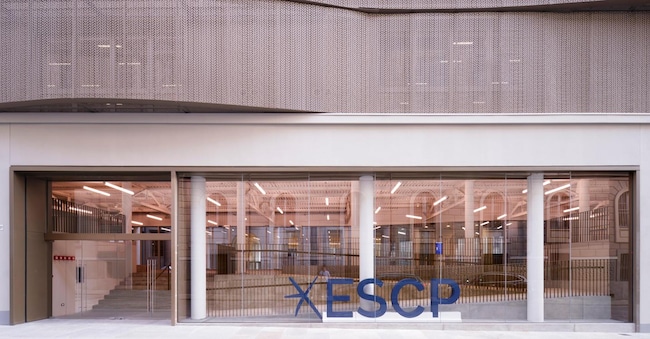
ESCP Business School's new Turin Campus officially opens to the public: the campus welcomes over 1,000 students and lecturers from all over the world, consolidating the link between the business school and the Piedmontese capital. The 2024-2025 academic year stands out for its exceptional diversity, with students coming from 76 different nationalities, representing all continents and reaching an internationality rate of 75%. Among the matriculated students, only 259 are Italian, a fact that underlines the multicultural and dynamic climate that characterises the Turin campus.
The new headquarters
.Located in the heart of the city, in a historic building owned by BNL BNP Paribas, which carried out the work for ESCP. The campus covers more than 8,000 square metres and is one of the symbols of the architectural recovery of Turin's historic buildings.
Originally built in 1877 as a prestigious residence in neoclassical style, the building suffered damage during the bombing of 1942 and was subsequently transformed by BNL in 1983.The current project, realised in collaboration with TRA - Toussaint Robiglio Architetti, GAA*, Subhash Mukerjee Studio, Conrotto Progetti, Fionda and Fred s.r.l in fact preserves the building's historical identity while integrating it with a contemporary extension. This fusion of tradition and innovation perfectly represents the core values of ESCP Business School - founded in 1819 and the world's first management school - making the Torino Campus not only an innovative academic model, but also a material manifestation of ESCP's vision: to respond to modern educational needs without losing the importance of its historical heritage.
The campus
The Turin campus, designed as a space where tradition meets technological innovation, is at the centre of an important reflection on the spaces of education in relation to pedagogical innovation. The physical spaces of the new campus dialogue with technological transformations, in particular artificial intelligence, which plays a key role in defining new modes of learning and interaction. AI is an integral part of teaching and research activities, but it is always related to human intelligence, which remains at the centre of the educational process. This approach emphasises that although technological innovations are fundamental, it is intellectual ability and more human qualities such as empathy, creativity and critical thinking that enable true growth. The campus is therefore set up as a dynamic laboratory, where the integration of technology and humanity is the key to building the future of education.
The Interaction
.The campus encourages interaction between students, lecturers and guests thanks to common spaces such as the Library, MeetUp rooms, the future cafeteria, corridors and lounges designed as spaces for dialogue. In particular, the Agora, a covered and glazed square accessible to all, represents an important solution developed in collaboration with the City of Turin. The flexible and reorganisable classrooms feature configurations that stimulate collaborative learning. Unicum of the new pole are the hemicycle classrooms: an evolution of ex cathedra teaching, they offer dialogue spaces for seminars, discussions and workshops, both in presence and online. Their conformation guarantees optimal visibility and perfect interaction between lecturers and students at all times, as well as acoustics designed for maximum effectiveness.
The modular auditorium and the modern and accessible signage, finally, complete the overview of the new ESCP Business School campus, defining it as a cutting-edge place of learning that prepares tomorrow's global leaders.
Sustainability
ESCP thus establishes itself as an institution that not only looks to the future, but helps to build it by focusing on a cornerstone for all areas of development: sustainability. The project includes the integration of photovoltaic and solar panels, the use of recycled materials and an innovative energy management system to reduce environmental impact and ensure efficiency.
Brand connect


Newsletter Scuola+
La newsletter premium dedicata al mondo della scuola con approfondimenti normativi, analisi e guide operative
Abbonati