Industrial Assembly

Turin 'the factory of Italy', Orsini on the manoeuvre: 'We need courage and look to growth'

President Gay to industrialists: 'We are the factory of Italy that does not give up' - President Cirio nominates the city to test autonomous driving in Europe

5' min read

Translated by AI
Versione italiana

5' min read

Translated by AI
Versione italiana

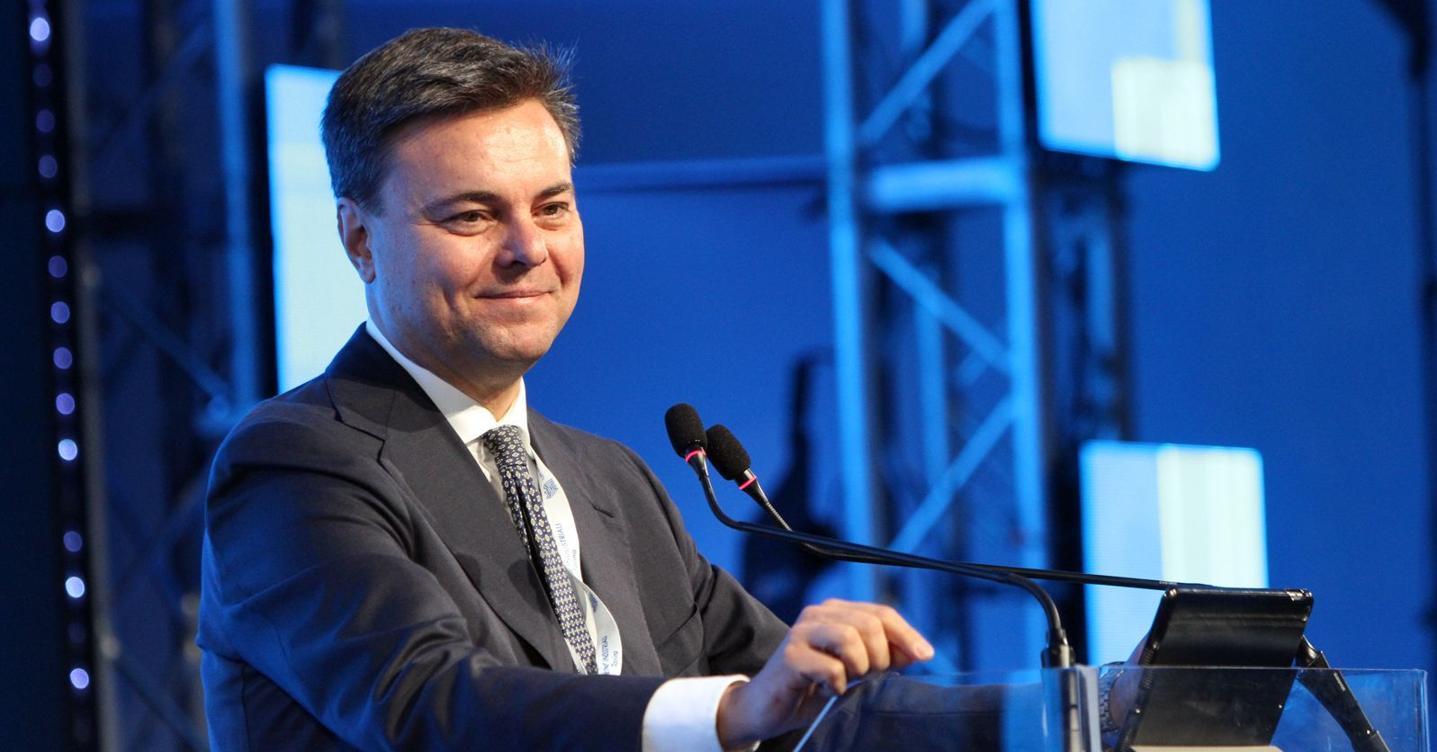
It is an assembly with important numbers that is taking place in Turin, where 800 entrepreneurs and managers have gathered in the historic headquarters of the Industrial Union. The Turin area, which more than others is experiencing the depth of the change that is taking place in industry, all of it, and in the automotive sector in particular, is telling itself that it is 'the factory in Italy that does not give up,' repeats the president of the Turin Industrial Union, Marco Gay, and is a candidate, as the president of the Piedmont Region, Alberto Cirio, anticipates, 'to become the first European city to experiment with autonomous driving.

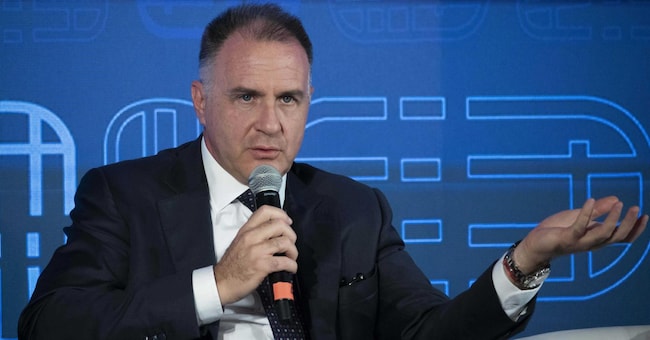
At the centre of president Emanuele Orsini's speech, a theme taken up in the report by Ui president Marco Gay, is that of the manoeuvre and the impasse in Europe. 'Courage is needed, because the courage of development and growth is fundamental. But in the first draft of the Def, as far as we have seen so far, we have not seen it,' Orsini returns to the request of industrialists, 'an industrial plan with a three-year vision,' he reiterates, 'we are asking for a powerful measure,' otherwise we are fuelling uncertainty and looking instead at a plan with 'simple and automatic measures suitable for SMEs, such as super depreciation, integrating development contracts by reducing the time required for their disbursement, and finally looking to the South, continuing what has been done on the Zes.
Loading...

Orsini recalls the EUR 5.6 billion in resources over two years for the SEZ, against EUR 28 billion in investment and 35,000 new hires, 'this is a good debt and courage is needed, we did not read the word growth in the first part of the DEF'. The old automotive numbers will not return, Orsini repeats, 'if Stellantis invests EUR 13 billion in the US it means that it had prospects there, we are not able to give them on bureaucracy, time, and energy. We need to make ourselves competitive'. A central aspect for 'our Europe and Italy', Orsini recalls, in the face of China's commercial push towards the Old Continent.

After the Manoeuvre was passed in the Cdm, Orsini: we were listened to by the government

"The Prime Minister has spoken of 8 billion for companies, 2.3 billion for the Zes that we have always supported and requested and, another thing, together with the unions we have asked for the fiscal decontribution of contracts. So on these things we have dialogued and I believe that we have been listened to". This is how the president of Confindustria Emanuele Orsini comments on the manoeuvre launched today by the Meloni government. "Let's read the texts," he added, "but we appreciate the words that the Prime Minister has publicly said today".

The weight of the car

The issue of cars does not remain in the background, with deputy prime minister Matteo Salvini insisting on criticising the 'electric-only' Europe and recalling the 23 billion euro earmarked for projects and construction sites in Turin and Piedmont, and the minister for companies and Italian manufacturing Adolfo Urso reiterating how 'the car crisis is the crisis of Europe' and recalling the main stages of the negotiations underway with Brussels: 'We have asked Europe, together with the German government, to go beyond the 2035 date set for the end of thermal engines and open up to the principle of technological neutrality. We are building the majority needed to review the Green Deal'. As for Stellantis, 'governance speaks increasingly Italian,' he says, 'in Italy we are resisting without closing down and laying off'.
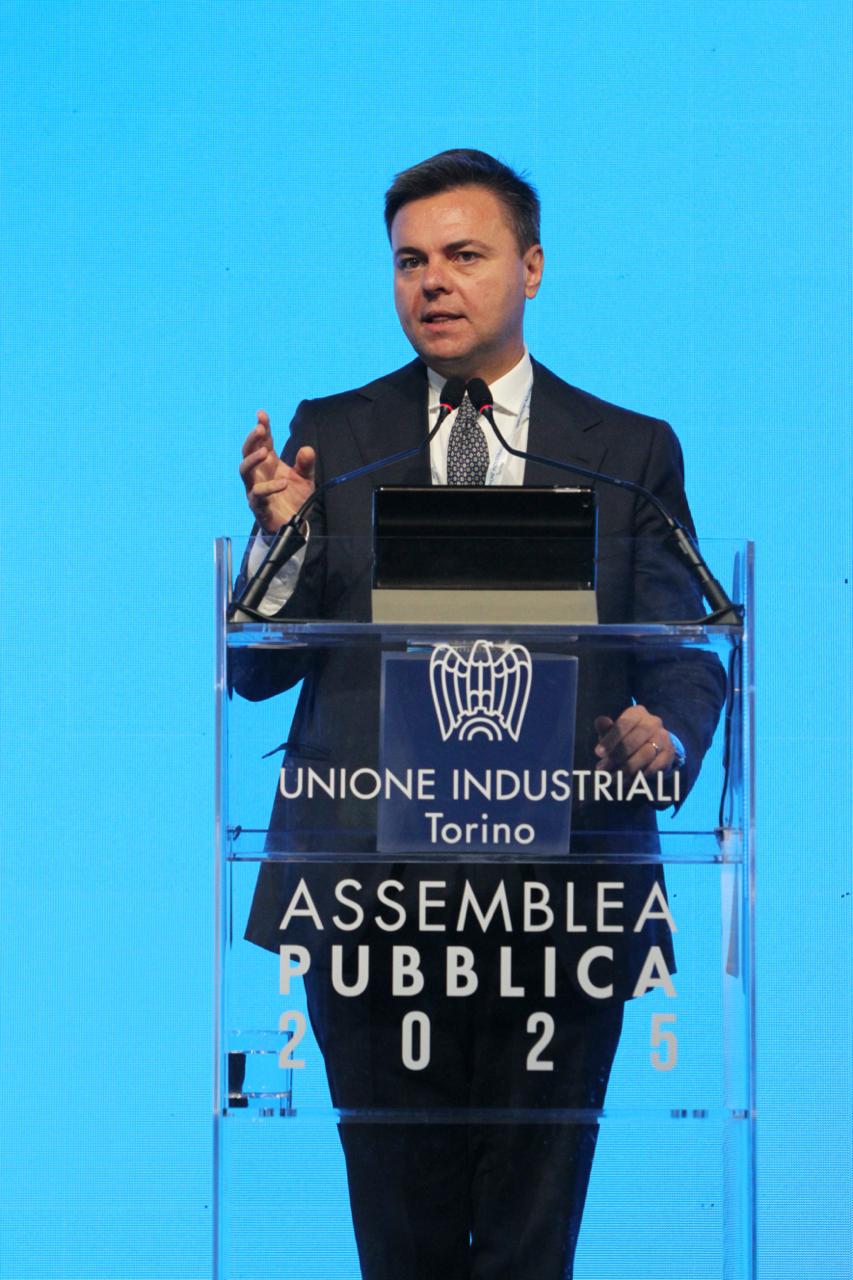
Between 2019 and 2024, recalls Gay, China produced 6 million more vehicles and Europe 3.8 million less, Japan 1.2 million less, and the United States 70 thousand less. 'The day before yesterday, the Turin Chamber of Commerce together with our Anfia presented data on the automotive supply chain, which in 2025 in Piedmont lost more than 1 billion euro and 1,500 jobs,' recalls Gay, 'and 2026 we fear will go in the same direction.

On the one hand, the state of things, and on the other, the outlook. In an international context, President Gay analyses, that has changed profoundly. 'Global trade is growing less than world GDP. The economic system is more closed and distrustful,' adds the president of the Turin industrialists, and this means for an exporting region having to reckon with a 2.5% drop in exports in the first half of the year, certainly conditioned by the heavy drop in automotive volumes.

American tariffs alone, 'for which we estimate a loss for Italy of EUR 23 billion,' recalls Gay, will mean 445 million less in exports for Turin. The first response, Gay insists, must be to seek new markets, 'we must create new partnerships with India, Africa, the Caucasus countries, and make the most of the opportunities of the Mercosur agreement.

The Factory of Italy

Turin is the 'factory of Italy that doesn't give up,' says Marco Gay. 'In ten years, companies in Turin with a turnover of over 5 million have grown by 37% and employees by 24%,' he analyses. 'Fixed assets - i.e. plants, robots, software - have grown by 57%: we are talking about billions of euros of new technology pulsating around the city,' he recalls.

Turin remains a land of industry. 'This sector is worth 510 billion euro, 23.4% of the national GDPx, twice as much as France. Here, in Turin, it is worth 26% of GDP,' Marco Gay emphasises. But there is a catch. 'We do not invest enough where it is needed, i.e. in our industrial intelligence. Investment in plant and machinery has dropped from 37% to 32%. Intangible investments, i.e. software, patents and research results, which are now the most important, are stuck at 7%.

As for the manoeuvre, Gay speaks clearly: "There is little for business," and criticises, for example, the lack of resources on tax credits for research and development. The main measure, he recalls, will be the restoration of the super depreciation for tangible assets, with an allocation of 4 billion euro for the three-year period that will be recovered from Pnrr funds. But the problem is twofold, Gay points out: on the one hand, funds allocated only to tangible assets at a time when digitalisation is becoming increasingly important; on the other, the fact that "it is unthinkable to make development and growth with these resources.

The new direction for Turin

The direction for Turin, suggests Gay, is to give life to a new Turin mobility industry with cars, microcars, drones, and even soft mobility at its centre. And on the innovation front, he emphasises, 'it is product innovation and not just process efficiency that will allow us to be competitive'. So, alongside the mobility of the future and experimentation on autonomous driving, there must be robotics - Turin is the third largest city in Europe in terms of investment in robotics - and the opening up to the drone industry.

In this context, in general, Gay emphasises, 'we need more Europe and more economic freedom'. And we need, he adds, to put the issue of innovation and investment at the heart of development. A passage supported by the mayor of Turin Stefano Lo Russo, who recalls the city's vocation on the innovation front with its recognition as European Capital of Innovation and the heritage of knowledge in the hands of the Polytechnic and the University.

Copyright reserved ©
Loading...

Brand connect

Loading...

Newsletter

Notizie e approfondimenti sugli avvenimenti politici, economici e finanziari.

Iscriviti