Venice 82

Tortora 'avenged' by Bellocchio: the beautiful series on miscarriage of justice

Presented at the Lido the first two episodes of 'Portobello' in which the TV presenter is masterfully played by Fabrizio Gifuni

3' min read

Key points

  • Six episodes ready in 2026
  • The plot
  • Bellocchio and the cast at the Lido

3' min read

Watching Fabrizio Gifuni as Enzo Tortora is initially unsettling. He has been impersonating the DC secretary, Aldo Moro, for so long, both in the excellent television series Esterno notte by Marco Bellocchio and in the theatre, that it is now difficult to identify him with another character from the First Republic, belonging to the world of show business, the inventor of the show Portobello. First of all because the director is always the same, Marco Bellocchio, who brings with him his own unmatched style, among the last, Il traditore and Rapito. Secondly, because Tortora's clothes and historical period coincide with Moro's, and although Gifuni perfectly enters into the moves and tics of the showman, a glint of the DC secretary always remains in the spectators' eyes.

Six episodes ready in 2026

The first two episodes of six of Portobello were presented out of competition at the Venice Film Festival. The Hbo Original series, designed for the small screen, i.e. for the new streaming platform Hbo Max, is expected to be ready in early 2026.

Loading...

Marco Bellocchio presenta a Venezia le prime due puntate della serie su Enzo Tortora

Photogallery5 foto

The plot

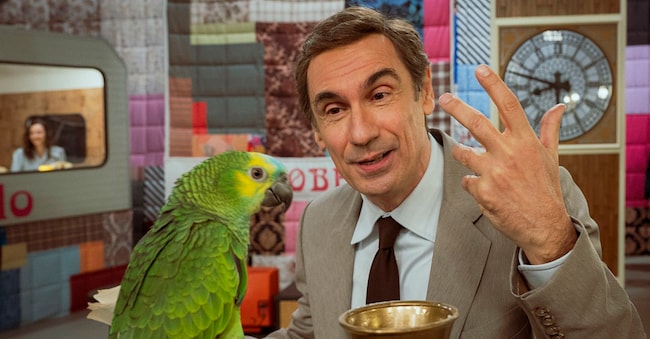
It is 1982 and Enzo Tortora, author and television host, formerly a journalist, is one of Italy's most powerful media men. He revolutionised the way of making television, enormously widening the audience with original games and formats that were to become a school and that had their climax in Portobello, a programme of varied humanity: from acrobats to conjurers, to paragnostas, including a market that involves people in their homes. The point of interest and suspense is, however, centred on whether one of the contestants makes the parrot say the word 'portobello'.

When he reaches the threshold, never reached before, of 28 million viewers, Pertini appoints him Commendatore della Repubblica and Tortora is so popular that he manages to raise a considerable sum for the Irpinia earthquake victims.

But on 17 June 1983, the Carabinieri knocked on his hotel room with an arrest warrant: Giovanni Pandico, a trusted man of Raffaele Cutolo, a boss of the new organised camorra and a spectator of Portobello from his cell, decided to repent and listed Tortora among the colluders. The presenter of Portobello ends up in a cell for camorristic association and drug trafficking. From there begins his judicial battle to be recognised as innocent.

L’epopea di Enzo Tortora nella serie Portobello

Bellocchio and the cast at the Lido

The director at the Lido told how the affair did not hit him the moment it broke out, but how he was, instead, instigated to think about it by reading the correspondence between Tortora's then partner, journalist Francesca Scopelliti, and the defendant. How the miscarriage of justice, realised through the personal affair, moved his indignation and compassion.

In Venice, along with Bellocchio, were Fabrizio Gifuni (Enzo Tortora), Lino Musella, in the role of the turncoat Giovanni Pandico, Barbora Bobulova, who played Anna Tortora, the presenter's sister and creator of the format, and Romana Maggiora Vergano, in the role of Francesca Scopelliti.

'There are things you don't know,' Bellocchio explained, 'things that are obscure and on which, when writing, you have to take a risk. The scene of the young woman who proposes herself on the programme because she can cry on command, was born after seeing an audition Andy Warhol did for a girl, who for ten minutes remained motionless and then began to cry. So I wanted to tell the cynical dimension of Enzo Tortora who discards her because the time wasted 'warming up' the crying could damage his success. Only later, in his painful legal travails, do we understand why this scene is important. Even for the character of Pandico, we used many things that have been written, and yet, we put lines in his mouth that I don't think Pandico ever said and that we invented there and then'.

The Style

.

Filmed with the grain of the 1980s, as if it were a videotape and in a television style in consonance with the environment in which the protagonist is immersed, the first two episodes dissect the origin of the miscarriage of justice, the pretext by which the drug arrest could be made plausible. In fact, the first episode begins with the conductor snorting cocaine. Hence the hooking, nourished and corroborated by envy for success, which causes the media and noisy descent into hell. Bellocchio in Portobello is more attached to reality than he was in Esterno notte. Here, the director is all about uncovering, together with the spectator, the pieces of an enigma that has the depth of verisimilitude and becomes 'truth'. The prison scenes are very vivid, the iconography of the obedience of the organised underworld, the statements of the prosecutors disturbing. At one point, Bellocchio allows himself an imaginative freedom: a puffin in magistrate's robes that challenges the screen. But we are only at the beginning, four episodes left...

Copyright reserved ©
Loading...

Brand connect

Loading...

Newsletter

Notizie e approfondimenti sugli avvenimenti politici, economici e finanziari.

Iscriviti