Cycling

Tour de France, the Pyrenees super stage arrives: when, where to follow it and why it is legendary

The Pyrenean mountains, between myths and history, are the stage for the toughest challenges in international cycling

by Dario Ceccarelli

4' min read

4' min read

Miss Maccabees, please, where are the Pyrenees?" Professor, I don't know, you tell me...'.

If you too, as in the amusing nursery rhyme of the Donkey Class, can't quite remember where the Pyrenees are, this Saturday 19 July you'd better tune in to the roads of the Tour de France (Raidue from 2.45pm, Eurosport from 1pm) to enjoy the highlight of the Pyrenean triptych: namely the big stage from Pau to the high-altitude finish at Luchon Superbagnares.

Loading...

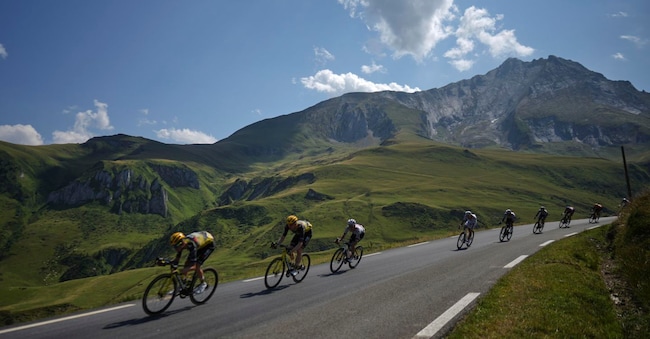
We are in the heart of these mountains located in the Occitania region in the High Pyrenees department. And the stage in question, the 14th of the Grande Boucle, is a stage through the clouds that arrives at its destination after climbing in sequence giants such as the Tourmalet, Aspin and Peyresourd. A total of 182 kilometres. The grand finale, like a firework display, includes the final 12.4-kilometre climb with a 7.5 per cent gradient that ends in Superbagnares.

Here, you will have realised, we are not only in the heart of the Pyrenees but also in the deepest heart of cycling. Every climb evokes a feat, every summit a legendary passage of some champion who has left a trace in the collective memory

What is the magic? Why do the Pyrenees, thanks also to the Tour, continue to exert this mysterious fascination? Indeed, there is something unfathomable about the lure of these peaks, which are not particularly beautiful. They are often barren and arid. Lacking the elegance and majesty of the Alps. Nor can they be compared with the alien volcanic nature of Mont Ventoux.

In July, when the Tour passes, there is a blinding sun, few trees and a heat that gives no respite. A sudden sense of emptiness that borders on the bright sky. Looking at it at night, in the immense starry night, unclouded by unnatural lights, gives an unparalleled vertigo. The presence of Spain, just across the border, with its cuisine and customs, is also very much felt. Like the sea when you know it is there but cannot see it.

The intertwining with the Tour is very strong. Because the Pyrenees, for the Grande Boucle, are soul and identity together. It is no coincidence that President Francois Macron in rolled-up shirtsleeves this Thursday brought his greeting in the Hautacam stage, the one dominated by Pogacar.

The Tour was born in 1903. And already seven years later - in 1910 - it passed for the first time through these mountains, which stretch for some 400 kilometres. Many riders, even after the war, never liked the Pyrenees. Charly Gaul, a climber who needs no introduction, called the Pyrenees 'infamous places with shitty roads'. An elegant Frenchism that nevertheless renders well the idea of the character, as he was nicknamed, of the Angel of the Mountain

One cannot count the great champions who wrote the myth of the Pyrenees, starting with Ottavio Bottecchia, the first Italian winner of the Tour (in 1924 and 1925). Gino Bartali in 1948 won in Lourdes and then triumphed in Paris. The great Fausto Coppi raised his arms in Pau in 1952 (it was the year of the second Giro one-two). The irrepressible Eddy Merckx dominated in 1969 with a memorable breakaway that was the viaticum for the first of his five victories. The last Italian to win a Pyrenean stage of the Tour was Nibali, first in the yellow jersey at Hautacam in the never-to-be-forgotten 2014 edition, which Vincenzo dominated.

But there is no point in skirting around it. The beating heart of this stage is the magical Tourmalet, with its 2015 metres in height. Here you can find a stele commemorating Jacques Goddet. the historic Tour director. If it could talk, the Tourmalet would have many stories to tell. One of them is summed up by a desperate cry: 'Murderers! "Murderers!" It was Octave Lapize, who won, exhausted, the first two Pyrenean stages in history. On 21 July, he was the first to climb - they say on foot - on a route that also included the Aubisque, the Aspin and the Peyresourde itself. The newspapers of the time crowned him 'Lord of the Pyrenees'. He died during the First World War, four years later. Difficult to understand where the chronicle ends and the legend begins.

But the most beautiful story, certainly the most evocative, is the one that attributes to Adolphe Steines, the historical designer of the race invented by Henri Desgrange, the discovery of this summit, which, before the Tour, was habitually travelled by shepherds and pilgrims on a thermal road inaugurated in 1864 by Napoleon III.

But this discovery was no picnic. According to legend, reinforced by many glasses of red, Steines arrived at the Tourmalet in the middle of winter in a blizzard that blocked his car. Trying to move forward on foot, he ended up in a ravine where he was rescued the next day.

'We can safely include the Tourmalet in the next route,' Steiner wrote to Desgrange in a timely telegram. In which, of course, no mention was made of his incredible misadventures.

Those were other times, not very social, when complaining was not contemplated. Neither was taking centre stage. However, the Tourmalet, over time, has had enormous recognition. Suffice it to say that no mountain has been climbed by the Tour like this peak: 86 times. And three stages have ended in the summit: the 1974 stage won by Jean-Pierre Danguillaume, the 2010 stage by Andy Schleck and the 2019 stage by Thibaut Pinot.

Long live then the Pyrenees and the charismatic Tourmalet. Some say that the Alps - with the Galibier, the Izoard, the Alpe d'Huez - are more evocative, more full of references to the ancient world, to knights errant. But the true gourmets of the Tour, those who follow the caravan by bike and caravan for three weeks, prefer these wilder, more primitive mountains. Which, not surprisingly, are still beaten by bears. The proud brown bears that the farmers oppose more than the wolf.

Copyright reserved ©

Brand connect

Loading...

Newsletter

Notizie e approfondimenti sugli avvenimenti politici, economici e finanziari.

Iscriviti

Tutto mercato WEB