Cycling

Tour de France, a spectacular finish in Paris: Van Der Poel wins and Pogacar goes down in history

A splendid victory for Mathieu Van Der Poel, who was the first to cross the finish line on the Champs-Élysées, ahead of his team-mate Jasper Philipsen and the green jersey holder Mad Pedersen

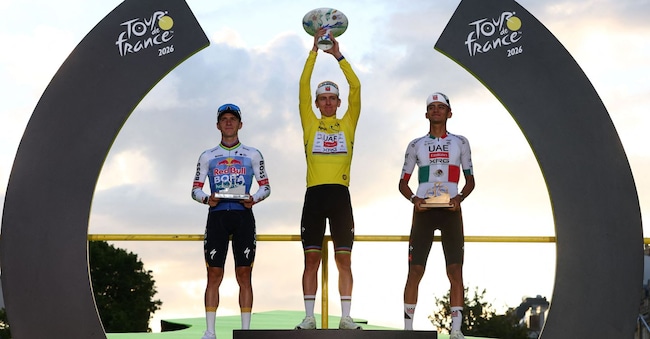
Ciclismo - Tour de France - 21ª tappa - Parigi, Francia - 26 luglio 2026 Tadej Pogacar dell'UAE Team Emirates XRG festeggia sul podio indossando la maglia gialla dopo aver vinto il Tour de France, affiancato da Isaac Del Toro dell'UAE Team Emirates XRG, che indossa la maglia bianca, e da Red Bull - Remco Evenepoel della BORA - hansgrohe REUTERS/Gonzalo Fuentes REUTERS

5' min read

Translated by AI
Versione italiana

5' min read

Translated by AI
Versione italiana

This 113th Tour de France ends on a high note, with a splendid victory for Mathieu Van Der Poel. On the Champs-Élysées, after breaking away with Pogacar on the final climb up Montmartre, the Dutch champion, despite the peloton closing in, crossed the finish line first ahead of his team-mate Jasper Philipsen and the green jersey holder Mad Pedersen.

A spectacle within a spectacle, this finale set against the backdrop of Paris’s wonders, characterised by the exploits of the very best, who remained at the front throughout the final kilometres. A nail-biting finale, as it seemed the sprinters, like a pack of wolves, had managed to draw the leaders back into the peloton. Instead, with around 500 metres to go, Van Der Poel, claiming his second victory in this Tour, produced one last burst of speed that saw him win by a matter of centimetres.

Loading...

Meanwhile, Pogacar – who also shone in Paris – has officially gone down in history by winning his fifth Tour, following his victories in 2020, 2021, 2024 and 2025. This triumph sees him join the pantheon of cycling legends alongside Anquetil, Merckx, Hinault and Indurain. The Slovenian, with five stage wins to his name, was also a key figure in this final stage, which was shortened due to the wildfires (from 133 to 89 km) affecting France.

And so, with yet another masterclass from Pogacar, the Tour came to an end. A Tour which, despite this spectacular finale, was rather lacklustre. A one-man show. And not because of the yellow jersey, who was always centre stage, but because of the lack of rivals, who were never really able to give him a run for his money. Even Remco Evenepoel, a time-trial specialist and second in the general classification, 6 and a half minutes behind, put it plainly: “What would it take for me to finish first in Paris? Simple: Pogacar not being at the start.” Words set in stone, spoken by a rider who has no inferiority complex; on the contrary, he is fully aware of his own worth.

The problem is that the more Pogacar improves, the more the others – his potential rivals – seem to fade into the background. Even Vingegaard, who withdrew due to a broken collarbone, never really managed to put him under serious pressure. Apart from the opening team time trial in Barcelona, the Dane always struggled to keep up with the Slovenian’s surges. And we’re talking about a great climber – who, after all, has won two Tours – not just any old novice. It happened in Merckx’s day too. He was so strong that – apart from Gimondi and a few others – everyone started out already beaten, more concerned with securing a respectable second place than getting themselves into trouble by taking on that giant.

Pogacar’s statistics, in fact, speak for themselves. Not yet 28 years old (he’ll turn 28 on 21 September), the Slovenian boasts a formidable track record: his 126 victories include 5 Tours de France, one Giro d’Italia, 13 Monument classics and 2 World Championships. With 21 major titles to his name, only Merckx, on 33, ranks ahead of him. However, even the Belgian’s reign – as Eddy himself admitted in a recent interview – risks being overshadowed, as the Slovenian has plenty of time to surpass him by winning a sixth Tour. And then perhaps even to win all three Grand Tours in the same year. A prestigious ‘Triplete’ which, in modern cycling, only the UAE Team Emirates captain can realistically set his sights on.

It is this realisation – that Pogacar is an unbeatable cycling phenomenon on any terrain – that divides cycling fans, and not just them.

Champions who are too dominant – think of Merckx and Binda in cycling, Usain Bolt in athletics, or Sinner himself in tennis – inevitably become monotonous. Pogacar’s surges, his kilometre-long breakaways, are certainly spectacular, unique in their competitive grandeur. However, if you already know that as soon as the road climbs he’ll make his move – and then win – the magic of sport – which also stems from its unpredictability – suffers as a result. It’s an issue that Pogacar’s fans don’t like. The Slovenian’s most ardent supporters, as soon as it is pointed out to them that his dominance flattens the races, are outraged by this perceived lèse-majesté.

But the issue is there. Merckx, when criticised for his greed, would retort: “I don’t race to do charity work”. Pogacar, whilst less confrontational in his responses, is nonetheless just as ruthless – a serial predator who, with a smile and a couple of pats on the back, leaves nothing but dust in his wake. Can we blame him for that? No, a champion is a champion; it would be like saying that Maradona or Messi shouldn’t have gone overboard with their talent. Yet cycling also thrives on rivalry, on battles fought to the very last breath, on fans divided into factions. With our ‘Martian’, all that has faded somewhat. It’s a bit like going to see a film when you already know the ending. The actors are brilliant, the director is brilliant, but you’re left feeling a bit cold. It’s like always eating truffles and caviar – in the end, you start craving polenta and sausages.

The French, who perhaps expected a little more from their rising star Paul Seixas (a fourth-place finish is still an excellent result for a 19-year-old), even booed the yellow jersey during some stages. Only a few, to be sure, but it’s an old story: France doesn’t like those who dominate the race. Regardless of what the French think (they criticised Merckx too), Pogacar’s rivals should view his superiority as an extra incentive – an important one for overturning too many pre-determined outcomes. Instead, a growing sense of resignation prevails. The only ones trying to stand up to him – in one-day races – are Van der Poel, Van Aert and Evenepoel himself. After them, it’s a free-for-all.

Loading...

The general classification of this Tour is staggering. Evenepoel, in second place, is almost seven minutes behind, followed by Del Toro at +9’ 42”. Seixas is off the podium, almost 12 minutes behind. The Spaniard Ayuso, hailed as a rising star, is seventh, over 17 minutes behind. The Ecuadorian Carapaz, despite his exploits on Alpe d’Huez, is eighth, twenty minutes behind.

The highest-placed Italian, Piganzoli from Valtellina – Vingegaard’s domestique – is 14th, more than an hour behind. It’s a bloodbath, not a classification. There’s a ‘Phenomenon’ – Pogacar – and we’re happy about that; and then there are all the others who are content with the crumbs the King leaves behind. It’ll all be very nice, as Pizzul used to say, but every now and then we wouldn’t mind a few more surprises, like Van Der Poel’s in Paris.

Copyright reserved ©
Loading...

Brand connect

Loading...

Newsletter

Notizie e approfondimenti sugli avvenimenti politici, economici e finanziari.

Iscriviti

Tutto mercato WEB