
Tourism, 600 million lost every day to war
Around 526,000 passengers pass through the region's hubs every day. Fiavet member agencies estimate lost revenue for Italia at over 222 million

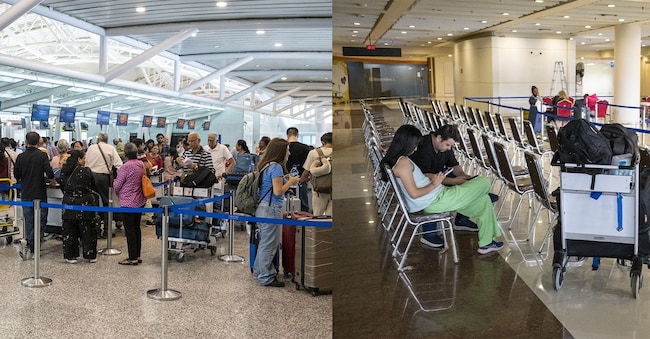
The Gulf War risks becoming the most serious crisis for organised tourism since Covid. According to the Wttc, a worldwide organisation representing companies in the travel and tourism sector, Operation Epic Fury is causing more than $600 million in losses to the industry every day, including lost air travel, cancelled airspace, and reduced or blocked operations at Middle East hubs.
Hubs such as Dubai, Abu Dhabi, Doha and Bahrain are 'worth' 5 per cent of the world's arrivals and 14 per cent of transits, some 526,000 passengers every day. Instability and cancellations then create a domino effect that affects hotels, restaurants, cruises, car rentals and travel-related services. "History shows that the industry can recover quickly, especially when governments support travellers through hotel support or repatriation," explains Gloria Guevara, president and ceo of the World travel & tourism council (Wttc). Our analysis of previous crises shows that security incidents often have the fastest recovery times for tourism, in some cases by as much as two months, when governments and industry work together to restore traveller confidence'. This year before the war, international visitor spending across the region was forecast by the Wttc to reach USD 207 billion.
As far as the consequences for Italia are concerned, the Fiavet Confcommercio Observatory reports the rainfall of cancellations and customer postponements that have so far caused travel agencies a loss in turnover of over 222 million euros. For each agency, on average, this amounts to almost 39 thousand euros in lost revenue, while for the more structured ones it reaches 71 thousand euros and more. "In this context, almost all our associates are clamouring for institutional intervention before it is too late," says Luana De Angelis, deputy vice-president of Fiavet Confcommercio. "If the crisis continues, there could be a need for economic relief, and certainly a suspension of tax obligations would be ideal, with moratoria on tax or contribution deadlines for the most exposed agencies.
At the moment, the destinations with the greatest operational difficulties are the Arab Emirates with 92% criticality, a number that does not only concern the destination itself, but the entire air traffic system for the long haul, i.e. Asia, Oceania, and the Indian Ocean. This is followed by Qatar, the second hub affected by the war, reinforcing the thesis that the emergency is infrastructural in nature, i.e. air, before being local geopolitical. The domino effect affects destinations such as, for example, China, Thailand, the Maldives, India, Australia, which are normally reached via the Gulf area. Around four out of ten customers cancel their trip, another 45% put it on stand-by, waiting for better times. Only 17% of travellers agreed to change their trip by choosing other destinations, an alternative destination to what they had booked. Requests to countries deemed safer such as the US are also creating difficulties. Before booking, travellers fear a tightening of entry procedures and 40% of customers do not cancel but neither confirm their trip to the States. Looking ahead to the summer, there is a growing fear that continued increases in crude oil prices will impact the cost of airline tickets. And for almost two out of three travel agents it will be necessary to ask for an adjustment.

