Automotive

Toyota and Mazda suspend sales of 5 models due to certification irregularities

Investigation and inspection by the Ministry of Transport. Honda, Suzuki and Yamaha also involved. 'Inadequate data' in safety tests. Share price falls

by Finance Review

Aggiornato il 4 giugno 2024, ore 10:00

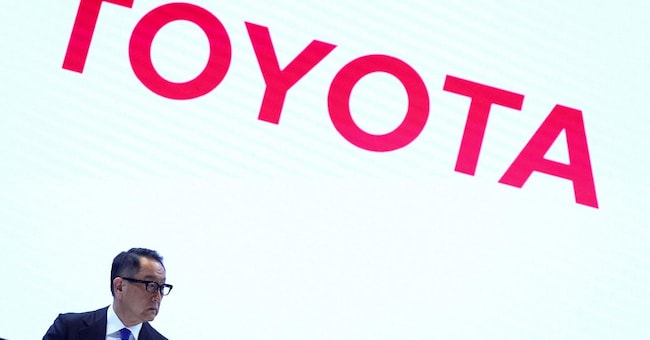
Il presidente del colosso automobilistico Toyota, Akio Toyoda, durante una recente conferenza stampa .

5' min read

5' min read

Six months after the Daihatsu crash test rigging scandal, a new case is shaking up the automotive world in Japan following an inspection by the Ministry of Transport of 85 manufacturers and component suppliers. Toyota and Mazda have temporarily suspended shipments and sales of some vehicles after the Japanese Ministry of Transport found incorrect data in certification applications for their models. The ministry also found irregularities in the applications of Honda, Suzuki and Yamaha.

In particular, Toyota has suspended shipments and sales of three models manufactured in Japan: Corolla Fielder, Corolla Axio and Yaris Cross. Four others are no longer. According to the world's leading car manufacturer in terms of volume (11.2 million cars sold in 2023 - +7.2% - almost 99 thousand in Italy, third brand after Fiat and Volkswagen; but in the first five months of 2024 the German brand was overtaken: 55 thousand units against 54 thousand thanks to +24% against -4.3%) these models 'were tested using methods other than government standards'. The suspensions affecting the three models will affect two assembly lines from which 130 thousand units per year come out.

Loading...

Toyota's chairman of the board, Akio Toyoda, 68, apologised for the irregularities found. 'We neglected the certification process,' he said, 'and mass-produced our cars without having taken the necessary precautions first. For this we apologise to our customers and to all car enthusiasts'. However, Toyoda, who was CEO for 14 years until January 2023 before handing over, assured that the vehicles 'passed certain standards set by law'. The falsified tests involved the use of inadequate or outdated data in collision tests and the incorrect verification of the proper functioning of airbags and rear seat damage in the event of a crash. Engine power tests were also found to be false, including discontinued models. "We sincerely apologise," said Toyoda, with a deep bow, during a press conference in Tokyo. Yoshimasa Hayashi, a spokesman for the Japanese government, called the behaviour of the manufacturers concerned 'regrettable'.

The possible consequences of the scandal

.

This new scandal could be a blow to the Japanese giant's reputation, just on the day after the presentation of new low-emission endothermic engines on which Toyota's philosophy is based. The Japanese manufacturer has not followed the wave of the electric revolution while its hybrid cars are successful worldwide. The market has taken notice: the share price in Tokyo is up 65% over the past 12 months (+46% on Wall Street), which is considerably better than its main competitors.

In the first two sessions of the week Toyota lost just under 4%. Mazda lost 5.6%. Honda lost 3.8 per cent, while Yamaha dropped 1.8 per cent and Suzuki shares fell 4.7 per cent from Monday's session highs. The Nikkei index on Tuesday closed down 0.2 per cent.

Some analysts believe that pressure for a change in governance will increase on Toyota, led by ceo Koji Sato (54) from 26 January 2023. Proxies Glass Lewis and Institutional Shareholder Services recommended shareholders - even before the new developments - to vote against the re-election of chairman Toyoda at the annual meeting on 21 June. Toyoda, grandson of the company's founder, was re-elected last year with about 85% of the vote, down from 96% the year before. The Japanese company had previously stated that its board of directors meets the governance standards set by the Tokyo Stock Exchange.

Other analysts say the impact on sales is likely to be limited, since it is suspending sales of only three models and many of its domestic rivals have also failed to meet government standards. Safety testing scandals have previously caused production disruptions at Toyota group companies, and the latest revelations could disrupt production at subcontractors and small businesses in Japan's vast supply chain.

This could lead to a knock-on effect on the Rising Sun economy, saidToshihiro Nagahama, chief economist at the Dai-ichi Life Research Institute. "The impact cannot be ignored," Nagahama noted, adding that it could hurt Japan's economic growth this quarter if subcontractors suffer disruptions and consumers become more reluctant to buy cars.

At present, however, this is the defence argument of Toyota, 'there are no violations of laws and regulations. Consequently, it is not necessary to stop using the vehicles in question'. The group, as mentioned, has complied with the ministry's injunction, suspending sales and deliveries in Japan of the three affected models still produced in the country.

Toyota also stated that it is still working on issues related to fuel efficiency and vehicle emissions, with the aim of completing the investigation by the end of June.

Mazda rejects forgery hypothesis

Mazda, for its part (1.25 million cars sold in 2023 - +14.8% - of which 15 thousand in Italy), admitted communication problems with test results in five models, including the Mazda2 and Roadster RF. Irregularities were identified in more than 150 thousand units produced since 2014 for the Japanese market and shipments of the two models, Roadster and Mazda 2, were stopped. CEO Masahiro Moro attributed the data problems to misinterpretations of unclear procedure manuals by employees, not to 'malicious falsification'. The suspension could affect 3,500 orders and the carmaker is not considering recalls.

Turning to Yamaha, however, the model under scrutiny is, of course, a sports bike. As for Honda, it found irregularities in noise and performance tests on some models produced up to October 2017.

In the Daihatsu case, a company known for the production of the small kei car (Japanese phenomenon) , serious irregularities in vehicle safety tests, dating back as far as 1989, had come to light at the end of December. The investigation, conducted by an independent committee, had found that Daihatsu had manipulated safety tests, in particular those relating to airbag control and the structure of vehicle doors to avoid dangerous ruptures during side impacts.

Specifically, Daihatsu admitted to falsifying safety tests for 64 models, including those sold under the Toyota brand and in collaboration with other manufacturers such as Mazda and Subaru. These manipulations involved altering test results to ensure compliance with safety regulations, using different airbag control units than those sold to the public, and modifying the internal structure of doors to prevent them from breaking into sharp pieces during crash tests.

Daihatsu resumed production in early May. The Toyota subsidiary withdrew from the European market in 2013 due to disappointing sales.

Ministry of Transport inspection

.

Japanese transport ministry officials launched an investigation at Toyota's headquarters on Tuesday after Toyota, Mazda, Honda, Suzuki and Yamaha Motor claimed they submitted incorrect or manipulated data when applying for vehicle certification. (Al.An.)

Copyright reserved ©
Loading...

Brand connect

Loading...

Newsletter

Notizie e approfondimenti sugli avvenimenti politici, economici e finanziari.

Iscriviti