Technology Plan

Toyota aims at mobility for all with a multi-technology strategy for 2050

The Japanese brand aims to offer low- and zero-emission solutions in the coming years that are able to meet different energy situations and user needs.
by Corrado Canali

2' min read

2' min read

PARIS (France)

Toyota has launched a wide-ranging programme called Environmental Challenge 2050 that includes six grand challenges spanning every aspect of the business as well as the exploration of new products and technologies. The central goal is to tackle climate change by reducing environmental impact and achieving global carbon neutrality by 2050. In Europe, Toyota aims to be completely carbon neutral by 2040, ten years ahead of the global target.

Loading...


Three steps for the energy transition

The Japanese manufacturer has identified three different milestones that it considers crucial in the energy transition with corresponding implementation plans. Firstly, by 2030, all company-owned facilities, including offices, research and development, warehouses and even production plants, must be carbon neutral. Then, by 2035, Toyota will offer a range of models with 100 per cent lower CO2 emissions. Finally, by 2040, total carbon neutrality will be achieved in logistics and especially in the value chain.


An offer with different energy options

.

It also aims to offer vehicles that can contribute to reducing emissions on the basis of a selective choice of different options in the multi-technology approach programme aimed at carbon neutrality: these will include fully electric vehicles (Bev and Fcev), as well as hybrid and plug-in vehicles (Hev and Phev), evolving technologies and fuel diversification for internal combustion engine vehicles (Ice), zero emission fuels and hydrogen. In short, a wide range of choices for everyone.

Toyota Land Cruiser First Edition, tutte le foto dell’edizione speciale

Photogallery8 foto

Toyota at the Paris Olympic and Paralympic Games

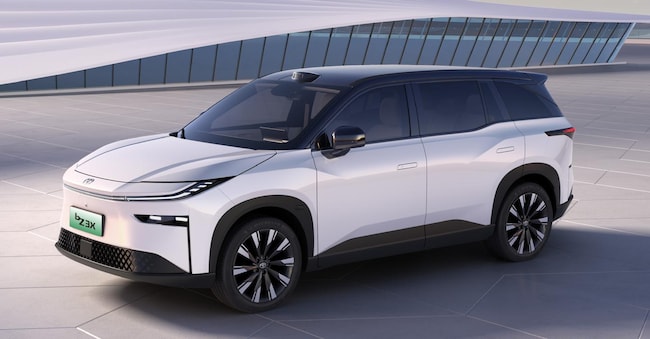
 The Paris 2024 Games are an opportunity for Toyota to offer the brand's multi-technology approach. The goal is to reduce the average carbon emissions of vehicles at the Games by 50 per cent compared to previous Games. Toyota's planned fleet consists of 2,650 electrified passenger vehicles, 150 of which are wheelchair accessible. Of 1,150 electric, 60 per cent passenger fleet, bZ4X, Proace Verso and Lexus RZ. And 1,000 hybrids and plug-ins with Rav4 Phev and Hev, Corolla TS, Yaris Cross and Highlander Hev. Plus 500 hydrogen-powered Mirai taxis in addition to the existing fleet of 1,000 Mirai taxis in Paris.


Hydrogen central to low emissions

.

 At Toyota, they confirm that hydrogen is fundamental to the creation of a low-carbon and even more sustainable society as one of the elements of the multi-technology approach. Hydrogen remains at the heart of Toyota's mobility concept with various applications. Toyota brought no less than 10 different hydrogen mobility applications to Paris 2024 to demonstrate that the goal will be to create a hydrogen ecosystem with the further spread of refuelling infrastructure. 60% of the fleet at the Games is produced in Europe, 37% in France.

Copyright reserved ©
Loading...

Brand connect

Loading...

Newsletter

Notizie e approfondimenti sugli avvenimenti politici, economici e finanziari.

Iscriviti