
Toyota Land Cruiser: how the off-roader made in Japan performs
While retaining its off-road DNA, Toyota's Land Cruiser gets a makeover, now offering more comfort and a lot of technology that allows even the most inexperienced to tackle the most challenging conditions
5' min read
5' min read
For over 70 years, the Toyota Land Cruiser has been one of the benchmarks for those who want to venture off-road and over rough terrain. There are few cars that can boast so much history: since its debut in 1951 (at the time it was called Jeep BJ1, the name Land Cruiser arrived in '54) it has been able to renew itself and diversify; in 1967 with the station wagon version (not available in Europe) and in 1985 with the light duty, designed more for everyday use and equipped with greater driving comfort. This year, the Japanese manufacturer chose to renew its design and contents to make it more comfortable, safer and more technological while maintaining its off-road character capable of climbing any terrain.
A modern design
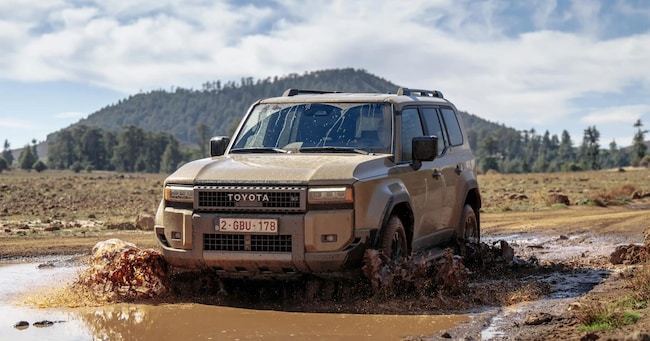
.The design of the new Land Cruiser is rather boxy, with large measurements (4.9 metres long, 2 metres wide and 1.9 metres high), a long bonnet moulded for maximum visibility, an almost vertical windscreen and characteristic trapezoidal wheel arches. These elements are complemented by interesting solutions such as deformable spoilers in front of the front wheels to channel airflow towards the brakes, a grille shutter that activates at high speeds and a high rear spoiler that contributes to better aerodynamics. The fog lights, set into the bumper for added protection, and the more exposed elements such as the corner and underbody guards have been designed for easier and cheaper replacement.
Special design features include a bonnet sculpted in such a way that the taller side parts serve as a reference to determine the car's footprint precisely, while the central part is lowered for greater visibility of the terrain; the tailgate can also be opened with the glass top only.
The Land Cruiser interior
.There is plenty of space, both at the front and at the rear, and the many physical buttons on the centre console stand out: in addition to those for climate control, there are in fact those for engaging the reduced gears, locking the differentials and decoupling the anti-roll bar, as well as a multifunction wheel that allows you to select the different driving modes, on and off-road. Standard for all versions are two large 12-inch displays with the Toyota Smart Connect+ multimedia system, dual-zone automatic climate control and the ability to heat, cool and electrically adjust the seats. There are two versions available, Adventure and Lounge, the richer one, which in addition to using natural leather seats (those in the Adventure are in synthetic leather) optionally offers seven seats with a second row of seats that can be folded down manually or by means of an electric control. Luggage compartment capacity varies from 742 to 1,292 litres for the five-seater version, and from 130 to 1,053 litres for the seven-seater: these measurements are under the canopy, from the ground to the sky they reach 2,000 litres.
The chassis and engine
.The Toyota Land Cruiser has a classic long-slung chassis, the platform used by the Japanese manufacturer is the new GA-F, which provides 30 per cent more torsional rigidity (50 per cent more for the chassis alone) and allows the use of a permanent four-wheel drive with two lockable differentials (rear and centre) for off-road use. The engine chosen by the Japanese manufacturer is a 2.8-litre turbo-diesel inline four-cylinder capable of generating 204 horsepower (151 kW) and 500 Nm of torque, combined with an eight-speed automatic transmission. In my opinion this represents one of the few weak points of the new design: designed more for off-road than for the asphalt road, it offers extremely smooth gear changes but delays the shift to the higher gears a little too much with an annoying increase in engine revs. A 48 volt mild hybrid version will also arrive by the end of 2025.

