
Toyota, the recipe for ecological transition remains unchanged: ahead with electrification without ideologies
The Japanese manufacturer started first with battery-powered cars and continues to steadily increase the electron rate for its models

4' min read
4' min read
Forward, but without haste and without tears. Toyota looks to the future with reasonable optimism, trusting in a simple truth: the early start in electrification and its gradual application to the entire range now allows the Nagoya-based manufacturer not to make rash moves on electric, not to make ignominious backtracks and to present itself to the market with a broad and consistently expanded range. The latest act is the Toyota Aygo X, the first full-hybrid in an A-segment that is on the verge of desertification and which is about to restart thanks to the arrival of electrics from Chinese manufacturers and Renault and Volkswagen.
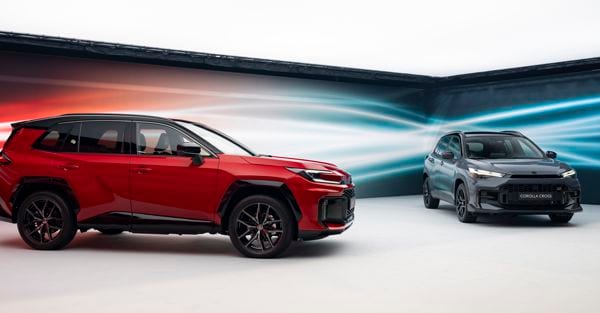
The question arises: are the others right to give up the pistons for good, or is Toyota right, which, after the launch of the Prius in 1997, is about to complete the hybridisation of its entire range after almost 30 years of patient and relentless work? Meanwhile, its electrification rate has increased with the plug-in hybrid. The first sign was in 2022 with the fifth-generation Prius, marketed in Europe in rechargeable version only, followed by the C-HR and two other Lexus models (NX and RX). Now it is the turn of the new RAV4 which, for the second instalment of the plug-in variant, continues in the sign of progressiveness with a battery that has grown by 30% in capacity, but is also ready to meet the challenge of super hybrids with a range of at least 100 km and a 50 kW DC on-board charger.
Loading...
The RAV4 also opens another chapter in Toyota's history: that of software defined vehicles with the application, for the first time, of the Arene software and the GA-K platform. For the time being, the Japanese are not saying a word about the work carried out by the Toyota Research Institute for the Japanese manufacturer's new proprietary operating system, but it is clear that the next challenge is to turn the possibilities afforded by Artificial Intelligence and those of adapting and updating vehicles into business by turning them into a self-propelled service store. It is logical to expect more 'intelligent' and/or dual-door models in the near future. Following the logic of cascading technology, Toyota's next plug-ins could be members of the Corolla family, whose life has come to an end for the saloon and station wagon and which will rest on the restyling of the Cross for at least three years.
In Nagoya, they must also decide what to do with the plant in Burnaston, UK, which in 1993 was inaugurated by the then Prince Charles as Toyota's first plant in the Old Continent and in 2010 was home to the first hybrid built in Europe: at the time it was called the Auris, but it was nothing more than the European Corolla. And in 2026, the current Yaris will be six years old, the canonical average age for a vehicle in its class. Could it too become a plug-in hybrid? Internally, the thinking has already begun and must necessarily include for models worth a third of the Group's sales in Europe - and produced locally - all the possible scenarios that will open up in three years' time, when a line will have to be drawn for the CO2 accounts, momentarily set aside.
In the meantime, Toyota is growing its electric range and, after the Urban Cruiser, the revised bZ4X and the CH-R+, has the bZ4X Touring, a high-wheel station wagon, ready, and is preparing other novelties. Now there are two more to come by 2026. One is undoubtedly the electric Land Cruiser and, outside this count, there is a much smaller off-roader that would be under consideration for 2027. It would, on the one hand, serve to put a more specialised SUV vehicle in the range, following Toyota's classic recipe, and on the other hand it would fill the void left in North America by the FJ Cruiser, a style icon that harks back to the past. After all, practically all manufacturers today have a model in their range inspired in style by the past, and Toyota too could give in to the same temptation, perhaps in order to give the new technologies a nostalgia-based package. Before that, there could be a small sports car to take up the legacy of other big names such as the Celica, MR-2 and GR86.


Brand connect
Loading...
