
Tragic Lady Macbeth from the Russian province
Šostakóvič's opera, based on Leskov's novella, tells a story punctuated by death and betrayal, featuring a woman who kills out of tragic necessity and brings to light the issue of female oppression

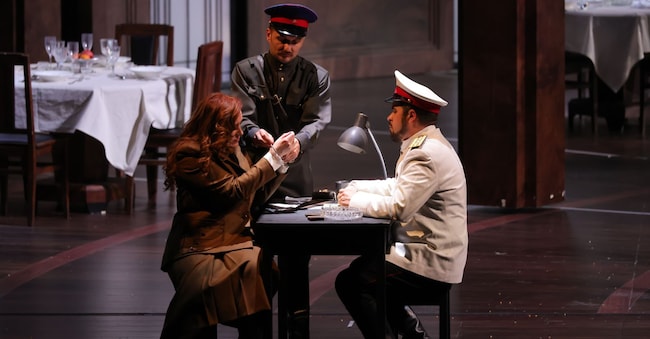
"One sometimes finds, in our parts, characters so terrible that, even long after one has met them, one cannot help but feel, remembering some of them, a frisson of fear in one's soul. To this group belongs the merchantess Katerina L'vovna Izmajlova, who was the protagonist one day of an atrocious drama, after which the lords of our nobility, following the example of some of them, took to calling her 'the Lady Macbeth of the Mcensk district'".
Thus begins the novella of the same name by Nikolai Leskov (1864) from which Šostakóvič's opera is taken, which tells of Katerina Izmajlova, a young woman married to the impotent Zinovij, son of the merchant Boris, who, having succumbed to the charms of the labourer Sergei and no longer willing to be oppressed and suppress her desire, is guilty of several murders until she ends her own life, betrayed in love and a prisoner. It is clear from the outset that we are far removed - geographically and symbolically - from Shakespeare's Lady Macbeth. And indeed, it is the 'gentlemen' who call Katerina a Lady Macbeth, and a provincial one at that, perhaps because the Scottish lady is a generic embodiment of the fear aroused by a woman who is not entirely passive - fear to be exorcised in a tragic fate.
In 1932, Šostakóvič and his librettist Preis gave voice to Katerina, no longer mediated by a narrator who observed and judged her, making her the protagonist of an opera that was at first destined for great fortune, then fell into disgrace, but had long since been redeemed and is now firmly in the canon of 20th-century classics. Šostakóvič and Preis look at Katerina at the end of the post-revolutionary season in which the liberation of women had been the order of the day. Thus, from the possibilities offered by the stage adaptation as well as from that new outlook, a heroine emerges who is no longer a heinous multiple murderer, the embodiment of "unbridled ardour", as Walter Benjamin defined her in his essay on Leskov, but a woman who also kills out of tragic necessity, to free herself from the oppression of mercantile society and male domination. This is how the opera was staged from 1934 to 1936, when an enormous public success was followed by irrevocable censorship by 'Pravda'. In 1955 Šostakóvič began work on a revised version, Katerina Izmajlova (1963), but in the Western Bloc, and especially after Rostropovič's revival in 1979, the first version also circulated.
Such an affair of adaptations, on the one hand, and of refractions of the archetype of Lady Macbeth, on the other, takes place throughout the 20th century, the 'short' century (or 'century of extremes', as Hobsbawm himself called it) but also 'of women'. Many issues converge in Katerina. Having reached a quarter of the twenty-first century, one wonders how we read - and look at - them today, accepting an invitation from Virginia Woolf: 'Read the Agamemnon and try to see if over time your sympathies have not shifted almost entirely to Clytemnestra's side'. If the perspective on Katerina already changes radically from Leskov to Šostakóvič, how do we witness a work in which the issues that converge in Katerina are irrevocably marked by violence, or rather, are expressed through at least two scenes in which we, as spectators, have to live with violence? In the first, the peasant girl Aksin'ja is immobilised inside a barrel and abused by several men; in the second, Sergei's embraces leave Katerina no chance despite her trying to wriggle out. But, in an even more perturbing twist, Katerina suddenly says 'You exist only for me'.
Šostakóvič's protagonist is able to oppose the violence suffered by Aksin'ja with a speech that culminates in 'I'm going to catch you and I'm going to play them for you so that you know what a woman is capable of', or to dismiss her husband with 'Neither you nor anyone else will I allow to talk about my loves'. But the destiny that awaits her is doubly tragic: not only because - as verisimilitude would have it - she and Sergei, having discovered Zinovij's murder, are deported to Siberia, but because the liberation - of her will and her desire - is shattered by Sergei's betrayal that leads her to suicide, an execrable gesture into which she drags her rival in love, the prisoner Sonetka. And this is a gesture of violence, perhaps less visible but no less profound: as if it were not possible to liberate women even from a delimited imagination. Katerina's trajectory remains between submission, violence cloaked in romanticism, and the jealousy that drives her to the desperate gesture and which is configured in opposition to the solidarity expressed to Aksin'ja. Šostakóvič has partly liberated Katerina, unleashing her political strength along with her desire. To the director the challenge of managing the representation of violence on stage, to us spectators that of freeing the women from an irredeemably tragic fate.

