
Trains and cinema: a journey through Italy’s past
From the first railway in 1839 to the opportunity it has given everyone to travel, explore and get to know Italia, the train has been an integral part of the country’s history.

It was 3 October 1839 when King Ferdinand II of Bourbon opened the first section of railway in Italia, the Naples–Granatello di Portici line, just over seven kilometres long. In the first forty days of operation, over 85,000 passengers were recorded: in a very short space of time, the train had won the trust and enthusiasm of the people. Italia at that time was a rural country where people travelled on foot, following the changing seasons and the routes of small-scale local trade. It was the Italia of shepherds who descended from the Apennines towards the Maremma and the Agro Romano, of farm labourers from the South who migrated for the harvest, and of tinsmiths, knife-grinders and street vendors who travelled from town to town.
According to Istat, just over twenty years after the Unification of Italia, there were around 2,500 kilometres of railway lines organised into a network that was still fragmented and uneven. Then, with the Brenner Railway (1867), which linked Verona to Innsbruck, and the Fréjus Tunnel on the Turin–Modane line (1871), Italians began to look towards Europe. Meanwhile, the railway network continued to expand, almost quadrupling in length by 1881 and exceeding 16,000 kilometres by 1901.
By the turn of the 20th century, the train was no longer a novelty: it had by then become the symbol of a society on the move, of a modernity that was reaching ever further, station by station. It is no surprise that, in 1895, the Lumière brothers decided to dedicate one of their very first short films to it: *The Arrival of a Train at La Ciotat Station*. Thus the train entered the world of cinema, a space where art and innovation converge to rediscover the past and imagine the future. How could we forget Claudia Cardinale stepping down from her carriage at Flagstone in *Once Upon a Time in the West* (Sergio Leone, 1968), the famous scene of the slaps to the passengers on the train departing from Santa Maria Novella in *My Friends* (Mario Monicelli, 1975), or the Parondi family arriving at Milan Central Station in the film *Rocco and His Brothers* (Luchino Visconti, 1960)?
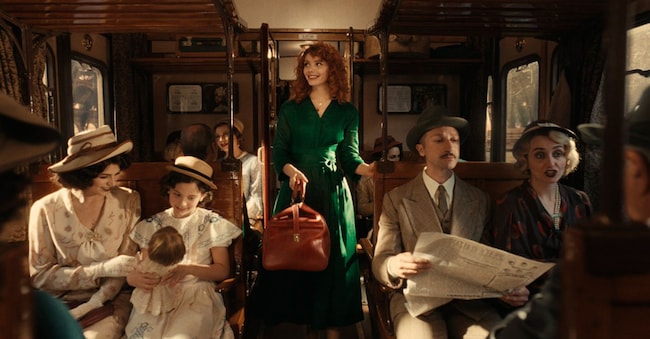
And it is precisely in the Sala Reale of that station – one of the historic halls preserved and restored by the Fondazione FS Italiane – that the new advert, produced by the Foundation itself in collaboration with the FS Group, opens. It is entitled “Travelling in Italia, travelling through time” and was presented at the 21st edition of the Rome Film Festival on 19 October. The film, created by VML Italy, produced by Buddy Film and directed by Volfango De Biasi, features a young passenger, played by Serena De Ferrari, walking through the carriages of a train, retracing various eras. Amidst carriages from bygone eras and historic trains, the narrative takes the viewer on a journey through the evolution of the railways and that of a country in constant transformation. Set to the tune of Lucio Dalla’s ‘Felicità’, the protagonist immerses herself in the dreams and aspirations of Italians, experiencing first-hand the changes of a people on a journey. A story that allows us to rediscover places such as the Sala Reale and the vintage trains preserved by the Foundation: over 400 historic rolling stock items, around 200 of which are still capable of travelling. A moving story broadcast in 60-, 30- and 15-second formats on major television channels, and in a 60-second version in cinemas and on social media.
Giuseppe Inchingolo, Deputy Director General for Corporate Affairs at the FS Group, stated during the presentation event at the Rome Film Festival that the railway world and cinema have always shared a special bond, as both recount journeys, movement and people’s stories, bearing witness to the transformations of society and the country. Furthermore, according to Inchingolo, the Rome Film Festival represents a valuable opportunity to renew this dialogue, portraying an Italia on the move, capable of preserving its roots whilst, at the same time, looking to the future with increasingly integrated and accessible transport. Through this project, he explained, the FS Group and the FS Italiane Foundation aim to celebrate a historical and cultural heritage that forms part of Italians’ collective memory, rediscovering the evolution of the train and its role in connecting regions, communities and generations through the language of cinema.
Welcoming the film festival’s audience on the red carpet is also the art installation ‘Pensiero Binario’, commissioned by the FS Group and created by designers Giulio Iacchetti and Luca Madonini. The work, created for Milan Design Week 2025 and previously exhibited at the Rimini Meeting, in Bari and in Cortina during the Winter Olympics, is dedicated to one of the cornerstones of the railway world and aims to elevate the railway track to a symbol of travel, connection and movement. The advert and the installation thus reaffirm the FS Group’s commitment to portraying, through art and culture, an Italia that does not forget its roots but looks towards an increasingly sustainable, integrated and accessible transport system.

