Separatist republic

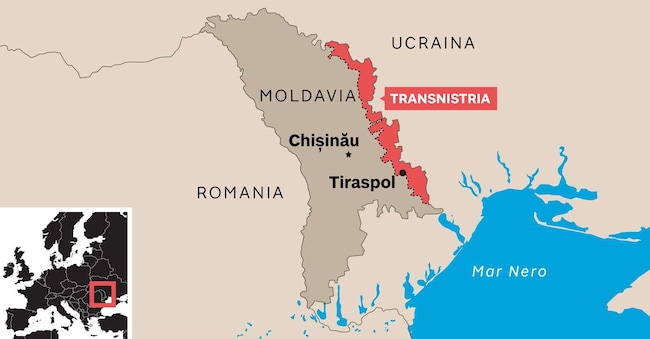
Transnistria, why the territory is in Russia's crosshairs

The international community does not recognise it and the de-facto government, which remains in a stalemate with Moldova, is supported economically, politically and militarily by Russia, which has around 1,500 soldiers in Transnistria
3' min read

3' min read

The appeal to Russia to 'implement measures to protect Transnistria under increasing pressure from Moldova' once again brings international attention to this pro-Russian separatist entity.

The separatist region of Transnistria - a narrow strip of land between the Dniester River and the Ukrainian border - broke away from Moldova in 1990.

Loading...

The international community does not recognise it and the de-facto government, which remains in a stalemate with Moldova, is supported economically, politically and militarily by Russia, which has around 1,500 soldiers in Transnistria.

The 2006 referendum

.

A referendum on independence in September 2006, not recognised by Moldova or the international community, saw the territory reaffirm its demand for independence and vote in favour of a union with Russia.

In the partitioning of the region after World War II, Moscow created the forerunner of Moldova, the Moldovan Soviet Socialist Republic, from two distinct elements: the predominantly Russian-speaking Dniester region, formerly an autonomous part of Ukraine, and the neighbouring region of Bessarabia, which had been part of Romania from 1918 to 1940.
But in the last days of the Soviet Union, alarm grew in the Dniester region over growing Moldavian nationalism and the possible reunification of Moldova with Romania.

The separation in 1990

.

A 1989 law making Moldavian an official language increased the tension and the region seceded in September 1990.

In 1991, paramilitary forces from the separate territory took control of the Moldovan public institutions in the area. Fighting intensified, culminating in a battle on the right bank of the Dniester in June 1992. Up to 700 people were killed in the conflict.

In July 1992, a ceasefire was signed and a demilitarised security zone was established. The agreement was implemented by Russian army troops already on the territory.

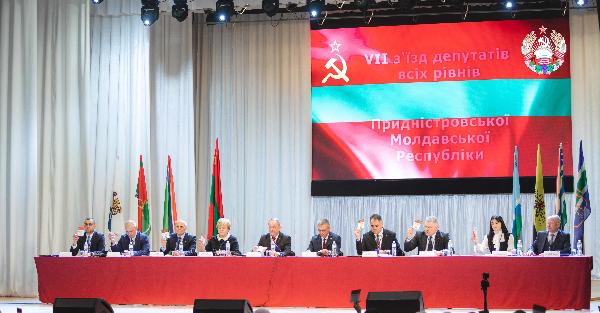
Il congresso della Transnistria a Tiraspol (Photo by STRINGER / AFP)

Money, Parliament and Anthem

Transnistria contains most of Moldova's industrial infrastructure, but its economic potential is limited by its international isolation.

It has its own currency, constitution, parliament, flag and anthem. One of the last bastions of Soviet-style rhetoric, the territory has nevertheless privatised some of its industrial enterprises.

Russia supports the region with financial assistance. It has a reputation for corruption, organised crime and smuggling, and has denied allegations of illegal arms sales and money laundering.

Soviet-era open-air museum

The self-proclaimed Republic of Transnistria is a true open-air museum of the Soviet era, with a Russian-speaking majority. Unlike Moldova, it has retained the Cyrillic alphabet. However, it is not recognised as a state by the international community, including Russia, which nevertheless considers it a bridgehead not far from the borders of the European Union. Strongly economically dependent on Moscow, which for instance provides it with free gas, it has an economy based on heavy industry and multiple trades, but the standard of living remains very low.

The Sheriff Group monopoly

.

The Sheriff group, founded in the early 1990s by two former Soviet police officers who were regularly accused of corruption, enjoys a near-monopoly economically and politically in this territory. It owns supermarkets, petrol stations and even a football team, FC Sheriff, which, to everyone's surprise, has made its debut in the Champions League in 2021-2022. But also the famous Kvint cognac distillery and a beluga sturgeon farm from which a fine caviar is produced.

L’ingresso della sede operativa delle truppe russe a Tiraspol (Photo by Sergei GAPON / AFP)

The Statue of Lenin

In 2015, the investigative media Rise Moldova claimed that one third of the territory's budget went into the coffers of this group. Despite its unbridled capitalism, symbols of the Soviet era dominate in Transnistria. A statue of Lenin stands in the centre of its main city, Tiraspol, and a bust of the father of the 1917 Bolshevik revolution stands guard in front of the town hall building that has retained its original name: the House of Soviets. The flag also still bears the most well-known communist symbols: the hammer and sickle and the red star.

Copyright reserved ©
Loading...

Brand connect

Loading...

Newsletter

Notizie e approfondimenti sugli avvenimenti politici, economici e finanziari.

Iscriviti