
Transport heading for a Black Friday: trains, planes and local services at risk
The national strike called by Usb, Sbg and Cub. Trade unions demand wage increases against inflation and reduction of working hours
by M.Mor.
3' min read
Key points
3' min read
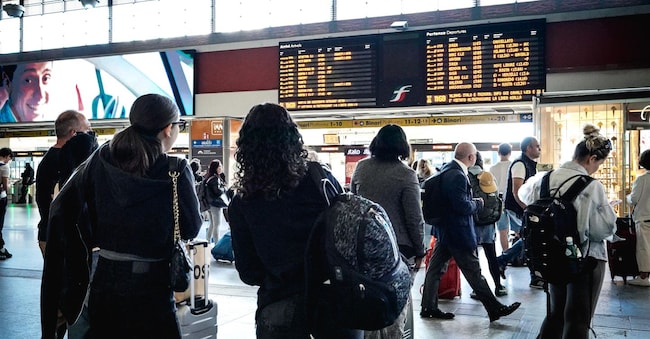
Friday 20 June will be a black day for Italian transport. Yet another black Friday. Several unions (including Usb, Sbg and Cub) have proclaimed a national strike that will involve the entire sector: from trains to planes, via local public transport, motorways and ports.
The inconvenience
.Underlying the mobilisation, the unions point to economic and contractual reasons: in particular, the adjustment of salaries to the high cost of living and the demand for a reduction in working hours. The train stop will begin at 9 p.m. on Thursday 19 June and will end at 9 p.m. the following day. Involved will be the staff of the Ferrovie dello Stato group, Italo and Trenord. Essential services will be guaranteed in the 6-9 a.m. and 6-9 p.m. time slots. The railway companies advise passengers to consult their websites for up-to-date information on guaranteed routes and cancellations. In the event of train cancellations, tickets will be refunded in full. Captrain Italia, active in rail freight transport, will also strike from 1pm to 9pm on Friday.
Disruptions also occur at airports, where the strike of ground staff (baggage handlers, shuttle bus drivers and ground handling staff) is scheduled for the whole day on Friday, from midnight to 23.59.
As far as local public transport is concerned, in Rome Atac and Cotral will guarantee service in the protected time slots: early in the morning and between 5 p.m. and 8 p.m. Atm, the company that manages public transport in Milan, explains that the service is not guaranteed from 8.45 a.m. to 3 p.m. and after 6 p.m., until the end of the service.
Finally, disruptions are also expected on motorways: staff will be on strike from 10pm on Thursday 19 June until 10pm on Friday 20 June.


