
Transport Authority: 'Ponte sullo Stretto, contain costs for users'
In a document, the Art led by Nicola Zaccheo makes a number of observations on the work's economic plan

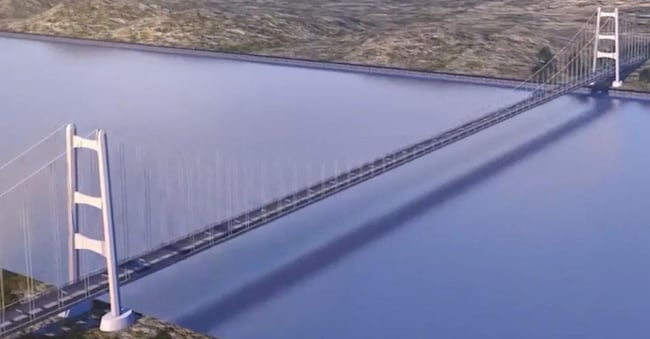
The economic-financial plan of the Ponte sullo Stretto can be considered "adequate in the current phase of setting up and launching the project", but it needs to be monitored over time on tariffs, cost containment and user protection. This was said by the Transport Regulatory Authority headed by Nicola Zaccheo in an opinion to the Ministry of Infrastructure, a 19-page dossier full of remarks and observations. The document (Opinion No. 39/2026) does not in fact reject the tariff plan for the work and comes after the Court of Auditors' rejection of the first Cipess resolution, which lacked, among other things, the opinion of Art. This is therefore one of the pieces needed to restart the process and build a new resolution that will pass the scrutiny of the accounting court. But to do so, Art prescribes a series of technical conditions and findings.
The Opinion
The authority immediately put a stake in the ground: the opinion only concerns the toll rates, not the opinion on the work as a whole. But the Ponte sullo Stretto, Art notes, is a work characterised by "absolute specificity", as well as by "uniqueness and technical, economic and financial complexity". Precisely for this reason, according to the Authority, it requires more stringent checks on the economic viability of the project and the distribution of risks. The guiding thread of the opinion is clear: to contain costs for users, to ensure that the risk really remains with the concessionaire, to avoid economic-financial imbalances and to encourage efficiency in management. These are, moreover, the principles that the Authority itself expressly recalls in the document when it speaks of "containing costs for users" and of "effective risk transfer". And so the road is marked out: the Plan will have to be accompanied by a structured and continuous monitoring system to verify its adequacy and overall sustainability over time. In particular, monitoring will have to make it possible to assess the economic-financial sustainability of the project as a whole, the proper allocation of risks among the parties involved, and the congruity of toll rates with respect to the costs actually incurred and the levels of service offered to users.
Tolls
One of the most sensitive chapters concerns tolls. The Plan estimates an average tariff per vehicle of EUR 27.43 when the work comes into operation, scheduled for 2034, which will gradually increase to EUR 48.71 in 2063, with an average annual increase of 2%. On this point, however, Art recalls the need for the tariff system to remain consistent with the principles of "tariff sustainability" and "user protection", as well as with a proper allocation of risks. They know this well on the Authority's side: the real issue remains who bears the economic risk of the work. And it is here that the opinion becomes sharper. According to Art, the tariff model proposed by Stretto di Messina does not include an explicit productivity recovery factor typical of regulated concessions. Operating costs are substantially updated on the basis of inflation, without an explicit productivity factor typical of regulated concessions. "The tariff system on which the Plan is based is not fully suitable for providing incentives to contain costs," the Authority observes. An element that in fact determines "a weakening of the incentive function proper to regulation" And therefore "it seems opportune that the efficiency objectives applicable to the operational phase envisaged in the perspective are defined in such a way transparent and verifiable, with the involvement of the Authority in due course, on the occasion of the review of the Plan prior to the entry into operation of the Work.
The remodelling
Even more sensitive is the passage on the remodulation of tolls. In fact, the agreement allows the concessionaire to modify rates by vehicle categories, time bands or periods in the event of deviations in traffic revenues, while keeping overall revenues unchanged. A provision that, according to Art, could lead to a "substantial sterilisation of traffic risk in the hands of the concessionaire", effectively mitigating the business risk. This is why the Authority requests that any changes in tariffs be submitted for its opinion in advance. The Authority points out that the final figures for the work are still uncertain, since "the concessionaire emphasises that the overall investment is to be understood in nominal terms, but does not quantify any impact of the price revision clauses, which, even on the basis of future figures, are not quantified.125rem;">based on future actual inflation rates, could in all likelihood entail significant adjustments to the Plan as set forth in the Agreement, without prejudice to the need to ensure the full transfer of the risks pertaining to the concessionaire, according to what is regulated by the risk matrix
Traffic Estimates and Complementary Works
Finally, there is the issue of complementary works. According to Art, the traffic estimates supporting the Plan presuppose the completion of Anas and Rfi works - from motorway connections to rail links - which in some cases still lack coverage or a definite timeframe. If those pieces were to slow down, the traffic demand and thus the economic balance of the Bridge could also change. It is not surprising that the Authority is therefore asking for better clarification of timetables, coverage and allocation of risk in the event of delays on the works functional to the link: "It is considered appropriate - Art specifies - that, with reference to the complementary investments relevant to the traffic estimates, the state of financing, the expected timetable and the subject responsible for the relative implementation should be punctually indicated. In addition, in the event of failure, delay or incompleteness realization of the commitments set forth in the Programme Agreement, it should be clarified on which party the relative risk falls


