Drt Radio 24

Transport: the new frontiers of multimodality for goods

Technology, intermodality, logistics and energy transition at the centre of the debate

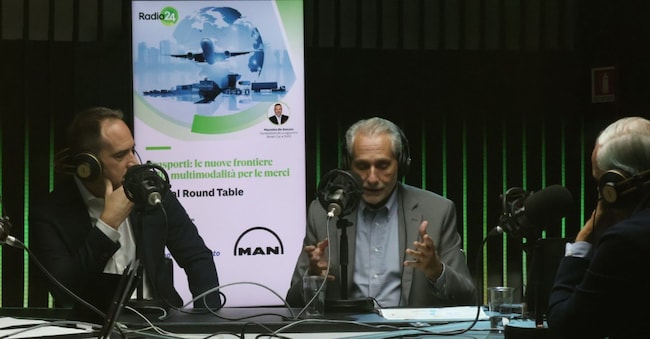
Da sinistra a destra: Alessandro Smania (MAN Truck&Bus Italia), Enrico Finocchi (Albo Autotrasportatori)

5' min read

Translated by AI
Versione italiana

5' min read

Translated by AI
Versione italiana

What is the future of intermodality and, more generally, of freight transport in Italy? This was the question at the centre of Radio 24's Digital Round Table, 'Transport: the new frontiers of multimodality for goods', which took place on 30 September in the Radio 24 studios, moderated by journalist Massimo De Donato, presenter of the programmes Container and Shift, also on Radio 24.

Present at the table were Enrico Finocchi, president of the Central Committee of the National Roll of Road Hauliers, Ennio Cascetta, president of the National Technological Transport Cluster and scientific coordinator of the MOST Observatory, and Alessandro Smania, marketing and communication director of MAN Truck & Bus Italia. In remote connection were Davide Bordoni, sole director of RAM - Logistica Infrastrutture e Trasporti, Sabrina De Filippis, managing director and general manager of FS Logistix, and Leopoldo Destro, delegate of the president of Confindustria for Transport, Logistics and the Tourism Industry.

Loading...

The round table described a sector on the move, in which technology, rules, infrastructure and innovation must travel together. Road, rail, digital and energy are the pillars on which to build the new Italian logistics, with intermodality as an objective and not a slogan. Different points of view, therefore, to attempt to outline the main scenarios of Italian freight transport in the light of the challenges posed by the ongoing technological revolution and the objectives for sustainability and decarbonisation of mobility in Europe.

Intermodality is at the heart of an efficient and sustainable supply chain, both environmentally and economically, but for its full realisation a number of conditions must be put in place: infrastructure development, integration between the different systems, digitisation. Until these conditions are fully realised, road transport remains the central mode.

In his speech, Professor Ennio Cascetta pointed out that the movement of goods by road is, in fact, in the midst of a growth phase.

Between 2019 and 2025, for example, road traffic increased by 5 per cent. 'Last year,' he recalled, 'we had the highest flow of freight vehicles in our history. This is also thanks to the growth of eCommerce. Mobility is growing and shows no signs of recession. And intermodality is one of the options, but only for long distances (from 250 kilometres upwards, according to the European Commission)'. This being the case, it is also necessary to continue to focus on road transport, which moves 80% of goods. In this perspective, one can understand the importance of road haulage companies for the national economic fabric.

A sector,' explained the president of the National Roll of Road Hauliers, Enrico Finocchi, 'made up of 100,000 companies, many of which are single-vehicle companies, which over the years are showing a clear trend towards aggregation. "The world of road haulage is flexible also thanks to the so-called padroncini, but at the same time there is a trend in the sector towards greater structuring. And this is also important with a view to intermodality. Road transport responds to the flexibility that the market demands,' he said, adding that 'there is a lot of movement in the sector and this makes control essential'.

The issue of control goes hand in hand with that of regularity; regularity is necessary for a reliable logistics system.

"Since 2021, we have been carrying out in-depth checks on companies, assessing various aspects ranging from financial suitability to good repute; from the adequacy of the fleet and drivers to the regularity of contributions or the correct insurance coverage of vehicles. Out of 37 thousand checks, 28 thousand led to suspension or cancellation. The aim is to have regular and reliable companies in order to improve the system'.

A reliable system is what the manufacturing world needs. This was emphasised by the delegate of Confindustria, Leopoldo Destro, pointing out the issue of ex-works, a method that demotes the costs and risks of transporting goods to the buyer. "In Italy, most companies sell goods and have them picked up by foreign companies sent by the buyer; in this way we give up the last link in our production chain. In Germany, on the other hand, the 'free at destination' system is used in 70 per cent of cases, so the transport phase is also handled by the supplier,' explained Destro, emphasising the need to establish a strong dialogue between the worlds of manufacturing and logistics.

Dialogue and integration, two other key words of the meeting.

The managing director and general manager of FS Logistix, Sabrina De Filippis, spoke about cooperation within the rail freight chain, which is more necessary than ever now in this complex phase due to the modernisation of the network. "Rail freight," she said, "is going through a difficult time due to disruptions and rescheduling that will continue until 2026-2027. We need a flexible approach, also from customers' side'. In the meantime, the group continues to invest in intermodal hubs in ports, interports and near railway hubs. "Investments that must also concern digitalisation and technology, as envisaged in FS's Industrial Plan," he emphasised.

In fact, technology is a key element to make the different transport modes communicate with each other. Davide Bordoni, sole director of RAM spa, recalling the 157 million euro MIT call for tenders for the digitalisation of logistics, also mentioned the National Digital Logistics Platform project, which is based on four cornerstones: interoperability, reuse, management autonomy and security. Port Community Systems, interoperable digital platforms for the management of logistics activities and maritime transport, are important in this context. "They have been implemented in 16 Italian ports," he said, emphasising that Italy is working well in this direction because "companies are eager to digitalise".

And still on the subject of innovation, Alessandro Smania of MAN Truck & Bus Italia, turned his attention to what is happening in the world of manufacturers, who are grappling with the decarbonisation objectives for road transport. In Italy, he emphasised, 'the dominant motorisation is currently diesel; as far as heavy-duty vehicles are concerned, in fact, the push towards electric vehicles is still limited also because there is a lack of recharging infrastructure'.

With regard to hydrogen, on the other hand, he mentioned that it is an interesting vector: 'it has greater autonomy and less weight than electric. So it is very useful in exceptional transport, for example. But the price is still out of reach'. Then there is the issue of green hydrogen production, which is still complex: 'so there are still a lot of elements to evaluate'.

Copyright reserved ©
Loading...

Brand connect

Loading...

Newsletter

Notizie e approfondimenti sugli avvenimenti politici, economici e finanziari.

Iscriviti