
Trapped in the time of escape
In *Ciechi al rosso*, Aliyeh Ataei, a writer of Afghan origin who migrated to Iran, explores the question of what constitutes a homeland and what a migrant’s identity is

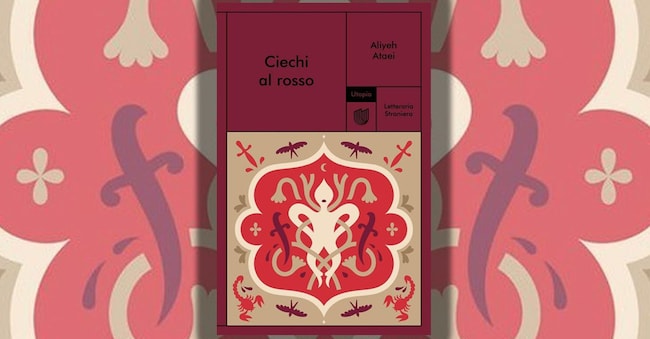
‘The rhythm of time is not the same for those who leave as for those who stay. For those who stay, time flows past them; for those who leave, they remain trapped within it.’ The story that Aliyeh Ataei tells in Ciechi al rosso is a story of ‘people with a bit here and a bit there’, who do not truly belong anywhere – the story of a lineage of suffering. It is the story of people like her, born in 1980 in Iran to Afghan parents, raised in southern Khorasan, on the border with the land of her ancestors, just like the protagonist of her long story, who came into the world shortly after the April Revolution and the subsequent Soviet invasion of Afghanistan, in which 70 members of her clan died. Those years brutally brought to an end that brief period in which some young men and women had tried to break free from tribal customs, to marry people of different lineage, ethnicity and culture, and to imagine a different society.
The protagonist and narrator lives on the other side of the blood-stained border of a country where violence has never ceased: the Taliban took over from the Soviets, who were in turn replaced by ISIS, and then by the Americans. A story that ends on the eve of the Taliban’s return, yet somehow encompasses it, recounting a continuum of suffering passed down from mother to daughter that seems to have no end.
‘To understand the state of a country, one must ask how its women are faring. Migrant women have not only had to leave their homeland: thousands of children who were never born have also been left behind there. In return, they have carried the chromosomes of pain within their bodies to give birth elsewhere to exhausted daughters, and to hand them over, from generation to generation, to men from other lands,’ writes Ataei, in a book in which the protagonist, who had a child by an Iranian man, alternates between feminist reflections and others that are decidedly less so; moments in which she considers herself a stranger to all places and declares she does not wish to return to Afghanistan, and others in which she wonders where the Afghan men are who ought to be saving her – and their – homeland. A woman who is a little bit on this side of the border and a little bit on the other, in this case too.
‘For migrants, the homeland is merely an empty shell: that is why they are constantly trying to create new meaning to fill it,’ she observes, before wondering how many homelands a person can have and what it really means to have one. ‘I didn’t know Kabul. I didn’t know Afghanistan and, worse still, I didn’t recognise myself in that place. The emptiness of my Afghan identity was a torment, as were those fictitious origins that were beyond my control and over which I had no say, to the point where I could not even feign the joy of someone returning to their homeland.”
A story of real, ideological and existential disorientation, told in stark and brutal language – much like the descriptions of the countless violent deaths of her family members and acquaintances. Deaths that were recounted to her and shown to her from the time she was a child, when the bodies were delivered to relatives who had been displaced across the border. A time when she spent her days competing with her cousin to see who could catch the most scorpions, and then watching them die from the heat and cannibalism, crammed into a jar left in the sun. ‘According to my father, my cousin’s skill stemmed from his warrior heritage, and for us children – who, from the moment we opened our eyes, were judged and judged others on the basis of our ethnicity – that was enough to spark fierce competition.’ Until the local scorpions – whose ‘hiding places we had learnt, whose venom’s effects we knew, and how to kill them’ (and which, incidentally, nearly killed her anyway) – were replaced by others, brought from afar. Even more dangerous insects, perhaps a metaphor for the evolution of a warlike, patriarchal and cruel society, as emerges from her descriptions, which, despite herself, open up to a world where violence has merely changed form, becoming part of the global history of the twentieth century.


